
Spain's Minimum Income: Who Qualifies and Why It's Contested
Debate over Spain's IMV highlights perceived inequities, bureaucratic hurdles, and political clashes regarding eligibility for the country's flagship social aid.
English · Original discussion in Spanish · Published
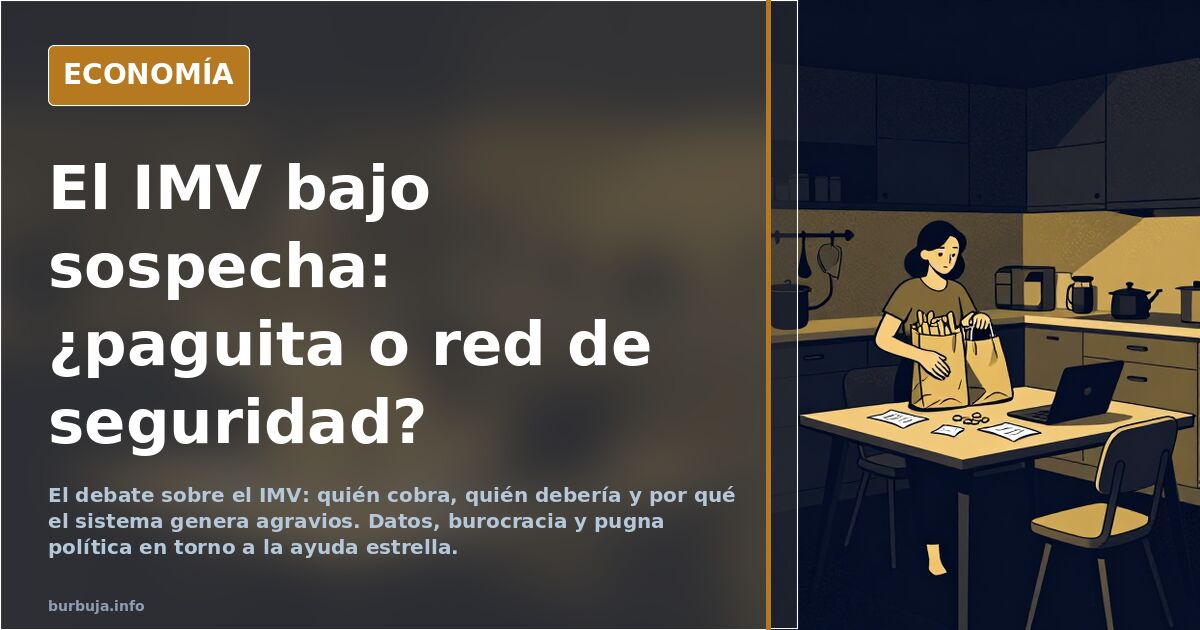
Spain's Minimum Income Under Scrutiny: Recipients and Criticism
The debate surrounding the Ingreso Mínimo Vital (IMV), or Minimum Vital Income, has resurfaced. Some argue that most recipients are migrants, while Social Security has announced measures to combat improper payments. Beyond mere political sparring, this discussion strikes at the core of the welfare state: is it social assistance or an incentive for inactivity? Available data suggests the current design creates comparative grievances between those who contribute through taxes and those receiving aid without prior contribution.
Who Actually Receives the IMV?
A prevailing view in public discourse is that the IMV disproportionately benefits the migrant population. Critics argue that lacking family networks in Spain, migrants are prioritized over Spaniards, who are presumed to have familial support. While this narrative is widespread, official breakdowns by nationality are not always clear in available materials, yet the perception persists. Conversely, others remind us that social assistance exists in any civilized nation; the issue lies not in its existence but in its management.
According to this viewpoint, the system penalizes self-employed individuals who pay contributions only to lose unemployment benefits later, while rewarding those who have never worked. Excessive bureaucracy, with endless forms, discourages legitimate applicants. The takeaway is that the IMV has become a Kafkaesque labyrinth where the most needy sometimes fail to qualify, while others receive payments without meeting requirements.
Political Clash: Vox and Threats of Cuts
Headlines suggesting "Vox will take away your IMV" reflect voter anxiety. However, reality is more nuanced. Critics of the far-right note that despite promises of strictness, significant cuts are rarely executed. Italy serves as a mirror example: Giorgia Meloni promised toughness on illegal immigration but took no action against employers offering precarious working conditions.
The discussion shifts to political hypocrisy. The right is accused of whitewashing economic policies that damaged the labor market by importing cheap labor, while asking Spaniards to tighten their belts. The conclusion drawn is that the problem isn't social assistance itself, but systemic inefficiency and a lack of will to distinguish between those truly in need and those abusing the system.
Opportunity Cost: Work or Collect Benefits?
A common argument is that the IMV disincentivizes job seeking. It is claimed that some prefer collecting benefits over accepting precarious jobs. This creates resentment among workers who contribute and see their efforts not translating into better public services. Comparisons with the United States are inevitable: there, it is said, working pays off because prosperity is possible; in Spain, the system pushes people toward the underground economy or dependency.
However, others clarify that the cost of living in the US is much higher, and health insurance can exceed €20,000 annually for a family. The conclusion is that not everything glitters, and the European model, despite its flaws, offers a safety net many Americans envy.
Bureaucracy and the Aid Maze
Processing the IMV and other aids is described as a Via Crucis. One case involves a self-employed person who, after 15 years of contributions, went to the mutual insurer to request cessation of activity benefits and faced 30 pages of requirements. The result: they gave up entirely. This experience reflects the frustration of many workers who, after years of paying in, find no reward when they need it most.
The paradox is that while improper payments are pursued, an administrative tangle remains that excludes legitimate applicants. The feeling is that the system is designed so few get paid and many give up. The lingering question is whether the IMV is real help or a bureaucratic mirage.
Future of the IMV: Reform or Dismantling?
Social Security's announcement to strengthen enforcement against improper payments has fueled the debate. Some see it as a step toward sustainability; others, as an excuse to cut rights. The discussion on whether the IMV should be tightened or expanded remains open. What seems clear is that the status quo satisfies no one: neither those who view it as a leaky bucket nor those who antiestéticar it becoming a political weapon.
Meanwhile, reality hits hard: some collect without needing it, and others need it without collecting. As currently structured, the system generates more questions than answers. In this limbo, politicians play on antiestéticar and necessity. Analysis stalls at a key point: there are no official data confirming if the IMV fulfills its function or has become just another chaotic scheme.
The debate surrounding the Ingreso Mínimo Vital (IMV), or Minimum Vital Income, has resurfaced. Some argue that most recipients are migrants, while Social Security has announced measures to combat improper payments. Beyond mere political sparring, this discussion strikes at the core of the welfare state: is it social assistance or an incentive for inactivity? Available data suggests the current design creates comparative grievances between those who contribute through taxes and those receiving aid without prior contribution.
Who Actually Receives the IMV?
A prevailing view in public discourse is that the IMV disproportionately benefits the migrant population. Critics argue that lacking family networks in Spain, migrants are prioritized over Spaniards, who are presumed to have familial support. While this narrative is widespread, official breakdowns by nationality are not always clear in available materials, yet the perception persists. Conversely, others remind us that social assistance exists in any civilized nation; the issue lies not in its existence but in its management.
According to this viewpoint, the system penalizes self-employed individuals who pay contributions only to lose unemployment benefits later, while rewarding those who have never worked. Excessive bureaucracy, with endless forms, discourages legitimate applicants. The takeaway is that the IMV has become a Kafkaesque labyrinth where the most needy sometimes fail to qualify, while others receive payments without meeting requirements.
Political Clash: Vox and Threats of Cuts
Headlines suggesting "Vox will take away your IMV" reflect voter anxiety. However, reality is more nuanced. Critics of the far-right note that despite promises of strictness, significant cuts are rarely executed. Italy serves as a mirror example: Giorgia Meloni promised toughness on illegal immigration but took no action against employers offering precarious working conditions.
The discussion shifts to political hypocrisy. The right is accused of whitewashing economic policies that damaged the labor market by importing cheap labor, while asking Spaniards to tighten their belts. The conclusion drawn is that the problem isn't social assistance itself, but systemic inefficiency and a lack of will to distinguish between those truly in need and those abusing the system.
Opportunity Cost: Work or Collect Benefits?
A common argument is that the IMV disincentivizes job seeking. It is claimed that some prefer collecting benefits over accepting precarious jobs. This creates resentment among workers who contribute and see their efforts not translating into better public services. Comparisons with the United States are inevitable: there, it is said, working pays off because prosperity is possible; in Spain, the system pushes people toward the underground economy or dependency.
However, others clarify that the cost of living in the US is much higher, and health insurance can exceed €20,000 annually for a family. The conclusion is that not everything glitters, and the European model, despite its flaws, offers a safety net many Americans envy.
Bureaucracy and the Aid Maze
Processing the IMV and other aids is described as a Via Crucis. One case involves a self-employed person who, after 15 years of contributions, went to the mutual insurer to request cessation of activity benefits and faced 30 pages of requirements. The result: they gave up entirely. This experience reflects the frustration of many workers who, after years of paying in, find no reward when they need it most.
The paradox is that while improper payments are pursued, an administrative tangle remains that excludes legitimate applicants. The feeling is that the system is designed so few get paid and many give up. The lingering question is whether the IMV is real help or a bureaucratic mirage.
Future of the IMV: Reform or Dismantling?
Social Security's announcement to strengthen enforcement against improper payments has fueled the debate. Some see it as a step toward sustainability; others, as an excuse to cut rights. The discussion on whether the IMV should be tightened or expanded remains open. What seems clear is that the status quo satisfies no one: neither those who view it as a leaky bucket nor those who antiestéticar it becoming a political weapon.
Meanwhile, reality hits hard: some collect without needing it, and others need it without collecting. As currently structured, the system generates more questions than answers. In this limbo, politicians play on antiestéticar and necessity. Analysis stalls at a key point: there are no official data confirming if the IMV fulfills its function or has become just another chaotic scheme.
Summary of a discussion on Burbuja.info - Foro de economía, actualidad y política., translated from Spanish and reviewed before publication. Read the full discussion (182 replies).
More summaries
-
Forum Cites Social Security Data: Girona Leads at 41.2%
Forum cites August 2026 Social Security data: Girona, 41.2%; Teruel, 40.4%; Basque Country, 28.8%.
-
Spain's IMV rises 6.9% to €1,462 monthly
The 6.9% increase sets the Ingreso Mínimo Vital (IMV) at €604 for a single adult and up to €1,462.62 for large single-parent families.
-
Spain's IMV recipient works only if she can bring her son
Karina, a single mother in Vigo receiving Spain's Minimum Vital Income (IMV), cleans houses conditionally and saves for her son's birthday, reigniting debate on welfare compatibility.
-
Guadalajara, Azuqueca or Alovera: what €350,000 buys
New four-bedroom homes in Alcalá de Henares now exceed €350,000, pushing buyers to look in Guadalajara, Azuqueca or Alovera.
-
Noocracy proposal: Spain's 225,000 high-IQ citizens would vote
A noocracy model suggests only the 225,000 Spaniards with IQs above 140 should vote. It features rotation and claims to prevent corruption.
-
Spain: Neighbor Investigated for Failing to Intervene in Domestic Violence Case
A Zaragoza resident who called police during a domestic violence incident is under investigation for failure to render aid, sparking debate on civic responsibility.