
Spain's midday bar crowds reveal pension and work gaps
Midday bar crowds in Spain highlight disparities between retirees, public sector workers, and self-employed individuals facing economic uncertainty.
English · Original discussion in Spanish · Published
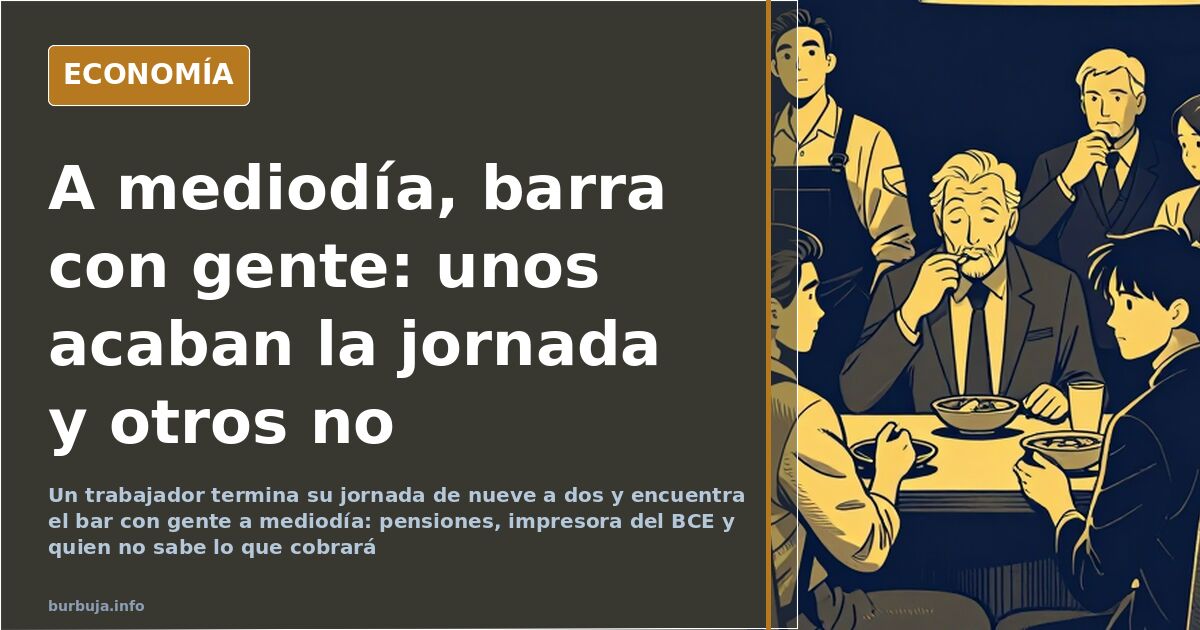
Midday coffee: crowded bars and finished shifts
Why are Spanish bars busy on weekday noons? Because some have already finished their nine-to-two shift, while others haven't started. Between these extremes sit those who pop in for a quick coffee. Retirees enjoy wine and tapas; one buys tobacco before returning to work; another stands at the counter with a cortado.
This scene isn't news but acts as a thermometer, raising an uncomfortable question: if part of the country has free time at noon, what pays for it? The circulating answer involves three letters and a printer.
Coffee break lengths: fifteen minutes, an hour, or none
Coffee habits reflect three regimes. Some rush out but linger to kill time until two. Others claim a full-hour breakfast with the newspaper. Some skip food entirely until lunch, relying on sweets. Three ways to be in the same bar at the same hour, with vastly different workloads.
What if the ECB stops printing money?
It is often argued, more through wit than statistics, that public spending, pensions, and even bar snacks depend on the European Central Bank (ECB) buying debt. The image is of a printer running at 200% capacity, paying for rations and wages. If switched off, critics say, austerity would hit instantly.
Opposing this view is the nuance that collapse warnings have repeated since 2009, 2010, and 2012 without immediate effect. "Either the party continues or we crash in a minute," summarizes another voice, referring to bank balances and how long administrations take to withdraw deposits. No one signs off on the end.
Shopping centers during work hours: observation vs interpretation
The bar scene joins another: shopping centers busy on weekday mornings. Families with young children, middle-aged couples, shoppers in cosmetics stores, carts in budget fashion sections. Some see this as proof people aren't where they should be. Others argue the scene proves nothing alone. Some note UK pubs are always full without questioning the model. The issue isn't the crowd, but who pays for the next round.
Self-employed face uncertain future income
Here, finances come into play. Pensions, including extra payments, arrive with known amounts, offering predictability. Public sector employees share this certainty. Private sector workers and the self-employed lack it, depending on contracts, clients, or campaigns.
A logical consequence emerges: predictable incomes lead to spending; unpredictable ones encourage saving. Thus, when austerity hits, it doesn't affect everyone equally. Some suggest less welfare state and more private savings.
Gerontocracy or generational prejudice?
The harshest debate assigns blame by age. It is claimed, based on memory rather than data, that the average voter is around 50, so older voters decide governance and budget protections. A sharper thesis suggests current retirees contributed less than they receive.
Context matters, as the exchange itself notes: many retirees worked hard in local factories, contributing what was expected. Blaming an entire group for budget imbalances is convenient but explanatory failure. Imbalance exists; sole culprit does not.
At two, the bar empties only to fill again. The coffee ended earlier. One person's shift also did.
Also available in: Deutsch
Summary of a discussion on Burbuja.info - Foro de economía, actualidad y política., translated from Spanish and reviewed before publication. Read the full discussion (122 replies).
More summaries
-
China's Hidden Crisis: 12-Hour Shifts, $1,200 Wages
Viral videos and expat testimonies reveal a China of grueling shifts, low pay, and youth unemployment. Is this reality or anti-China propaganda?
-
Son of PVTA. In the SECT RIDICULING PEOPLE.
Josep Borrell says immigrants are needed to care for the elderly in Spain, a key issue for the country's demographic future.
-
Why Do People Vote for the PSOE? Competing Theories Divide Experts
The debate surrounding the profile of the socialist voter centers on two theories: clientelism and resentment. What is true? An analysis of critical viewpoints.
-
128,000 pesetas in 1988: the salary that supported a family now barely covers one person
A salary of 128,000 pesetas in 1988 supported a family of four. Adjusted for today, that's €2,368, not enough to live alone in a big city.
-
Lula and the Sephardic ancestry debate stirring up politics
A tweet about Lula's Sephardic origins reopens the debate on genealogy and power: from Aznar to Maduro, everyone gets lumped together without verified evidence.
-
Vestrynge and the migration U-turn: a left that no longer believes its own story
Vestrynge, co-founder of Podemos, points to the cost of migration for wages and reopens the left's contradiction: capital drives it, but no one limits it