
Spain's mass amnesty: captive votes and downward pressure on wages
Spain's mass regularization of undocumented migrants is not solidarity but calculation: a captive electoral bloc on one side, and downward wage pressure in low-skilled sectors on the other.
English · Original discussion in Spanish · Published
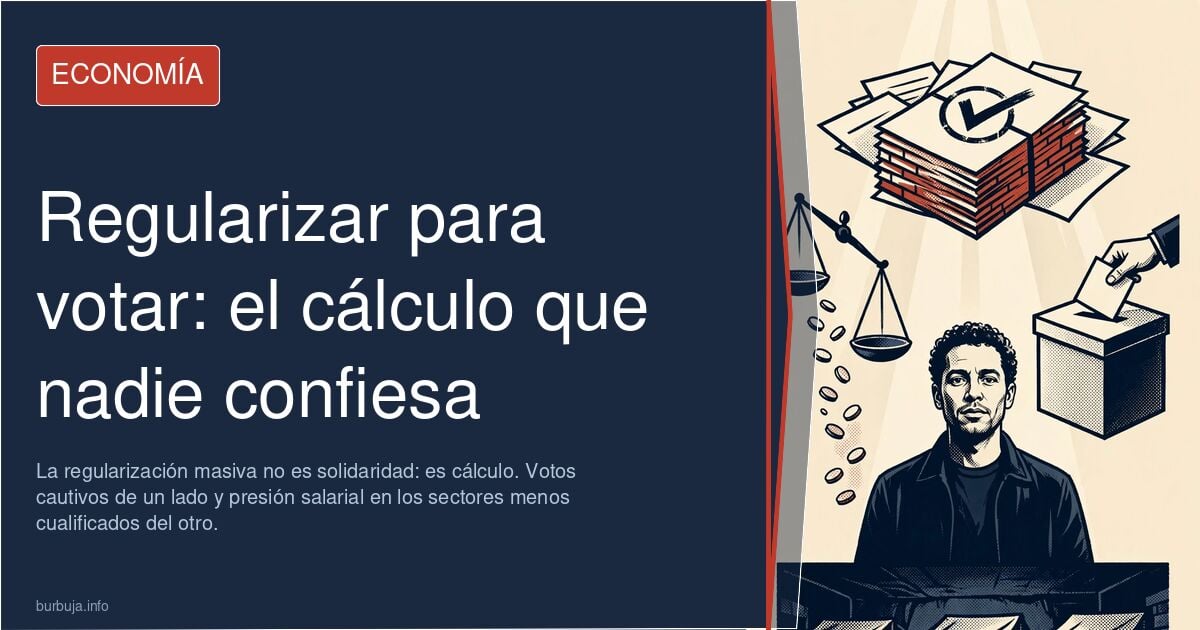
Regularization is not solidarity, it is a two-column ledger
Mass regularization does not respond to any internationalist epic. It responds to a calculation. And not a sarracena one: it is the sum of an electoral roll that grows overnight and a workforce that, moving from off-the-books to official, pushes down the least skilled wages. As of this discussion, with the issue back on the front pages, the official explanation was still generosity; the numbers, however, pointed elsewhere. Anyone who has set foot on a construction site, a greenhouse or a summer kitchen on the coast intuits the mechanism.
Captive votes: the engineering nobody signs off on
The first argument is mechanical. Regularizing hundreds of thousands of people amounts to building an electoral cushion overnight that will mostly depend on state transfers and will associate their legal status with whoever granted it. No conspiracy theories needed: just look at the electoral calendars. The operation would reach its optimum precisely when gratitude still weighs and real integration has not yet begun.
Against this plays a detail the narrative skips over. The link between papers and ballots is not automatic, and a newly regularized group can split its vote like any other. The hypothesis is plausible, not provable. But as a hypothesis it is enough to design a policy.
The silent gift to employers
The second argument is the one almost never said out loud. There is an army of irregular workers who have spent years accepting any conditions, any hours, any wage. Once legalized they start paying social contributions and consuming —on paper—, but the dominant effect in the least skilled sectors is another: they widen the labor supply and push wages down. The benefit does not go to the newly regularized worker, who remains at the bottom of the scale, but to the employer who no longer has to negotiate.
The awkward dilemma: off-the-books without rights or legal with a cost
There is a prior front rarely made explicit: which option is more profitable for the public purse? While working without papers they do not draw on healthcare or benefits, but neither do they contribute. When they enter the system they contribute —if the job is real and not a sham— and begin consuming services. Neither scenario is free, and the full arithmetic is settled nowhere.
When every region looks out for itself
On top of this economic base sits a social dynamic that dismantles the epic part of the narrative. Distant solidarity works as long as nothing concrete has to be shared; when jobs, housing or access to services collide, cohesion cracks and the conflict turns local. Recent cases on Spain's southern border made that plain. The supposed brotherhood of the dispossessed lasts exactly as long as the sharing does.
Given this logic, one can expect regularization to advance more out of electoral and wage interest than out of conviction. With one major caveat: the calculation assumes that those who receive papers will vote gratefully, and that assumption —like almost all assumptions made about people— can blow up on election day.
Summary of a discussion on Burbuja.info - Foro de economía, actualidad y política., translated from Spanish and reviewed before publication. Read the full discussion (35 replies).
More summaries
-
Construction union seeks legal status for 700,000 immigrants
Spain's construction sector demands regularization for 700,000 workers, sparking debate over low wages and high housing costs.
-
Migratory Regularization and the Electoral Census: The Debate Dividing Spain
Migratory regularization and the electoral census: figures, accusations of rigging, and the European precedent. An analysis of a debate redefining the map...
-
Electric Car Fire in Garage Forces Building Reinforcement
A rental electric vehicle caught fire in a garage, destroying an adjacent car. Residents stayed in shelters while the building required emergency structural reinforcement.
-
Vito Quiles confronts Zapatero's daughters over Venezuelan funds in Spain
Vito Quiles confronts the daughters of former Spanish PM Zapatero and asks them about Venezuelan money; the investigation remains without any public resolution.
-
Trump vowed to tame inflation, yet intervenes more than Biden
Trump promised to end inflation and foreign interventions: a year on, prices are rising and military operations are multiplying.
-
Threats against Ayuso in Madrid and TVE's alleged silence
Reports are spreading on social media alleging death threats against Madrid's regional president Isabel Díaz Ayuso, with claims that Spain's public broadcaster TVE failed to cover or condemn them.