
Spain's lunch menu hits €14.70 as €6 supermarket meals eat into its market
The average set lunch menu in Spain now costs €14.70, while a ready-made supermarket meal runs about €6. Bars are cutting margins as supermarkets gain market share.
English · Original discussion in Spanish · Published
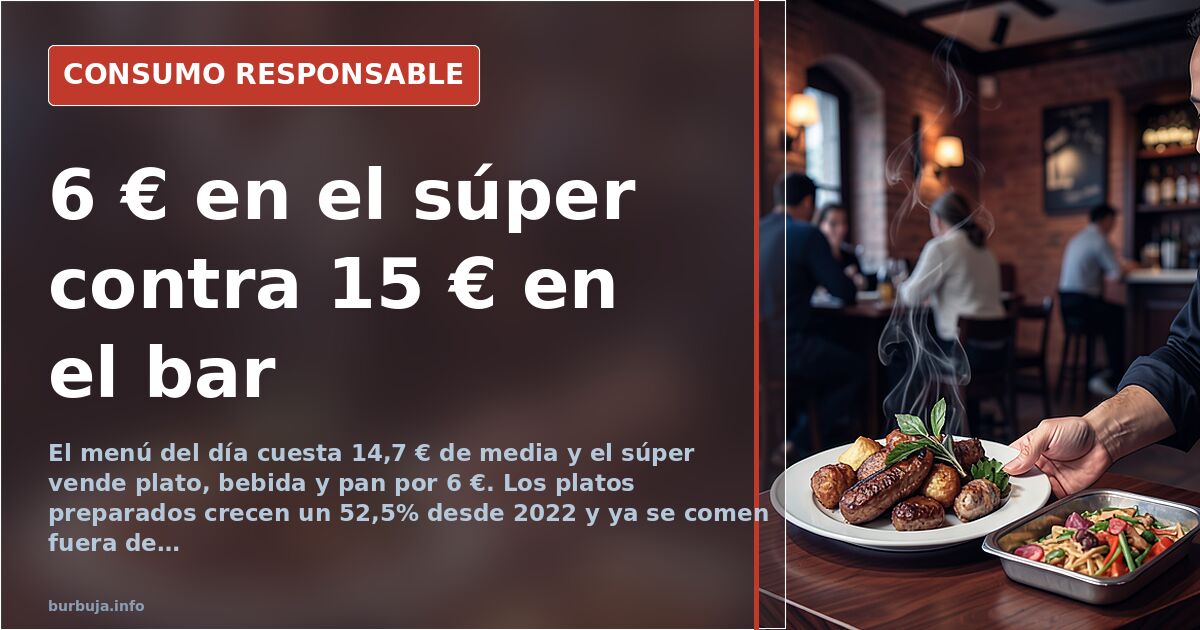
The set lunch menu now costs €14.70 and the supermarket undercuts it with a €6 meal
A dish, a drink and bread for six euros, sitting in the supermarket fridge. Across the street, the bar's chalkboard: €14.70 on average in Spain, fifty cents more than a year ago and almost three more than six months ago, according to Hostelería de España (the Spanish hospitality association). The scene repeats every midday in any business district: someone opens their lunchbox at the corner shop's table while the restaurant next door watches its rush hour pass with empty tables. The so-called mercaurante —a supermarket with ready-made dishes and chairs to eat them on the spot— is no longer a curiosity.
The numbers on the other side of the counter don't invite optimism either. Eggs are 12.3% more expensive than a year ago, beef 7.9%, and the energy that powers stoves and fridges 21.7%. The menu, however, is rising below overall inflation (4.9% in September) and below the restaurant sector itself (4.3%). The difference is paid by the restaurateur, who trims margins rather than raising prices and scaring off customers who choose the set menu precisely for its fixed price.
How much a set lunch costs depending on where you live
The menu map draws a two-estimulante ilegal Spain. The Basque Country leads with an average of €16.30, trinc by the Balearic Islands (€16) and Catalonia (€15.70). At the other end, the Canary Islands and Murcia stay at €13.50, and Extremadura, Asturias and Andalusia at €14. In the Balearic Islands and the Valencian Community the price hasn't moved in the past year.
The comparison with the supermarket isn't entirely fair, and that's where the first interesting nuance begins. A ready-made dish with a drink and bread comes to about six euros, yes, but it doesn't include a starter, main course and dessert, nor anyone serving it to you at the table. The question hanging in the air is whether customers really compare or just look at the receipt.
The bar racing the clock, not the price
The hospitality association has its own thesis, and it's not far off: the enemy isn't the price, it's the clock. Remote work and flexible hours have compressed the midday break into a formality where a three-course menu no longer fits. A survey by TheFork among its users backs this up: 70% of those who buy ready-made food at the supermarket do so for convenience, and only 19% because it works out cheaper than the restaurant.
Bars are reacting as best they can. Nearly half, 47.1%, now offer a half menu, a reduced version that lets you eat for less. 68.7% sell it to take away, so those without time take freshly made food to the office just as they would take their supermarket lunchbox. And to defend what the fridge can't offer, 84.9% of establishments include Spanish or regional cuisine at least one day a week, half do so daily, and nearly nine in ten adapt the menu to specific dietary needs.
The business growing across the street
Ready-made meals are having their best moment. Last year 715,052 tonnes were sold, 3.8% more than the previous year, and the sector billed €4,309 million, according to the industry association. Consultancy Worldpanel by Numerator estimates the category has grown 52.5% since 2022. This is no summer fad.
The shift shows up in the till. Of every five euros Spaniards spend on eating and drinking, in and out of the home, almost one ends up at Mercadona, which holds 19.7% of the total, seven tenths more than a year ago. Bars and cafeterias fall from 11.8% to 11.2%, and independent restaurants lose another two tenths. That share includes the chain's entire food business, not just ready-made meals, but the direction is one and the same: 22% of what leaves the supermarket is now consumed outside the home.
Unfair competition or different rulebooks?
Here it's worth separating grievance from law. Selling cheaper isn't unfair competition: the law targets deception, confusion or selling below cost to sink a rival, not having a more efficient model. The serious discussion is another one: whether both play by the same rules. The bar pays waiters to serve at the table, cooks under its own health regulations, holds a restaurant licence and, if it has one, pays a terrace fee. The supermarket cooks at centralized scale, spreads fixed costs across the rest of the business and doesn't serve at the table.
Some argue the problem isn't the price but the quality of the packaging, while others claim the opposite: that industrial traceability inspires more trust than frying oil recycled to its limit in some kitchens. Two symmetrical mistrusts that explain a good deal of this war.
Cooking as a hobby and the lunchbox as destiny
The domestic side of the story has its own quote. Juan Roig said in March 2025, during Mercadona's results presentation, that "in 2050 the kitchen as we know it today won't exist; there will be things we cool or heat up, it will be a hobby." The remark has fuelled all kinds of readings, from reasonable prophecy to a diagnosis of a society that delegates even the act of feeding itself to industry.
The counterpoint comes from nostalgia with numbers. In 2001 a set menu on Madrid's Calle Miguel Ángel cost 1,000 pesetas —1,100 with coffee— and a junior programmer fresh out of university, earning 170,000 pesetas a month, ate out at a restaurant every day. Adjusted for inflation, those 1,100 pesetas are worth about €11.70, according to a calculation circulating in the debate. Today's menu isn't more expensive in real terms. The problem is the other side of the equation: that salary covered 170 menus a month; today, at best, 120, always according to that same calculation.
There's the figure that unsettles. The battle of the mercaurante isn't fought between the six-euro lunchbox and the fifteen-euro chalkboard. It's fought between a wage that buys fewer and fewer meals and an industry that has learned to sell the midday break without a tablecloth, without a waiter and without waiting.
Also available in: Deutsch
Summary of a discussion on Burbuja.info - Foro de economía, actualidad y política., translated from Spanish and reviewed before publication. Read the full discussion (74 replies).
More summaries
-
Lenco L75: Vintage Swiss Turntable Restoration Costs
The Lenco L75 sells for €175-€250, but full restoration exceeds €200. Is it worth it versus modern decks?
-
Mercadona salmon rip-off: tray fillets cost up to 78% more
Mercadona charges up to €25/kg for salmon tray fillets while a whole salmon costs €11/kg. Data and tips to save.
-
Mercadona: Entering at 9:28 PM and threatening legal action
A customer enters Mercadona at 9:28 PM, is blocked by a guard, allowed in by the manager, but then refused payment. He discusses burofax and court.
-
Bulk rolling tobacco: €30 per kilo and legal doubts
Bulk tobacco by the kilo: €30 per kilo, equivalent to about 50 packs, with doubts about its drying, storage and legality in Spain
-
BMW under scrutiny: PCV valve, water pump and unmaintained ZF gearboxes
The PCV valve can melt the engine, the water pump fails without warning, and BMW declares the ZF gearbox maintenance-free even though ZF recommends changing it every 60,000 km.
-
Evo Banco requires €3,000 idle for a 0.5% return
Evo Banco pays no interest until you leave €3,000 untouched, then pays 0.5%: just €15 a year on a €6,000 balance, one calculation shows. Openbank, Coinc and…