
Spain's low-cost boarding ritual: Standing for nothing
In Spain, priority boarding often leads to pointless queues. Passengers stand for hours waiting for overhead bin space.
English · Original discussion in Spanish · Published
Spain's low-cost boarding ritual: Standing for nothing
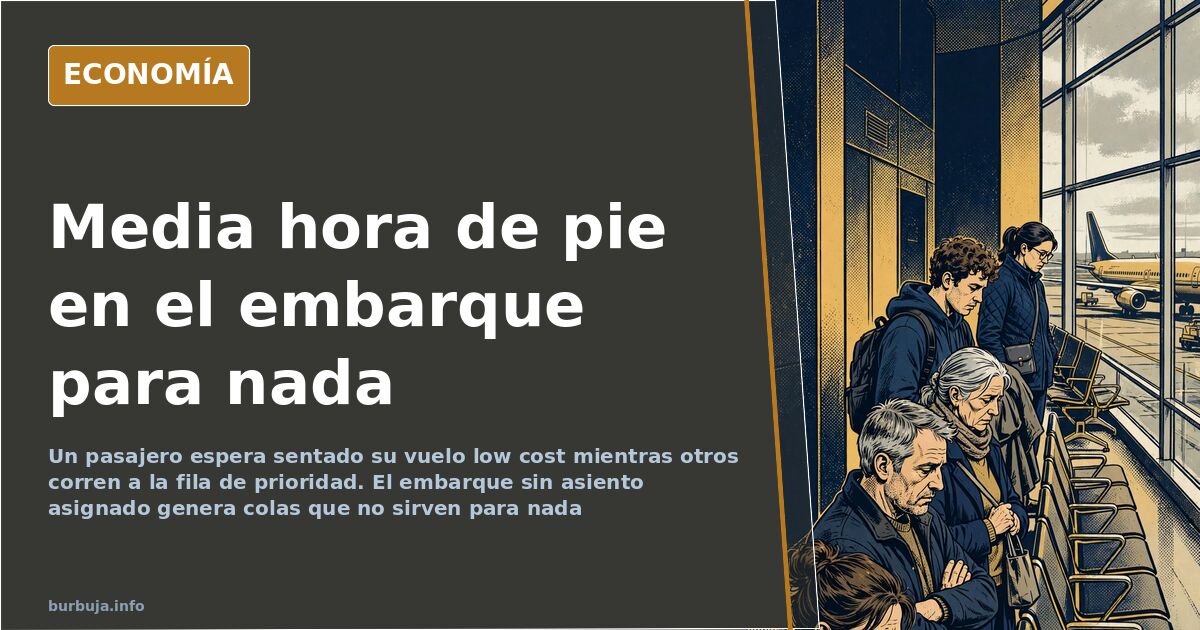
A passenger waits seated for their budget flight while watching dozens of people rush to the priority line as soon as crew arrives. Without assigned seats or jet bridges, boarding involves walking to the plane. He, with a seat number and backpack, stays put. This scene repeats at European gates, sparking a two-year debate on what priority truly means.
What is priority boarding and why do lines form?
Budget airlines sell priority boarding as early access. In practice, frequent flyers agree it serves one purpose: securing overhead bin space before it fills up. Those without cabin luggage or with small bags fitting under seats gain nothing by boarding first.
Most passengers don't realize this. When airline staff appear, they rush to the line. Some compare it to Pavlov’s bell: stimulus triggers automatic response. Lines form before boarding opens, sometimes thirty minutes early, leaving passengers standing in rooms lacking sufficient seating.
Overbooking doesn't happen at the gate
Many believe queuing prevents being bumped due to overbooking. Experienced travelers debunk this simply: once you reach the gate, you've checked in and have an assigned seat. Overbooking occurs earlier, at check-in or via booking systems, not at the gate.
Some note overbooking can vary, occasionally leading to reaccommodation. However, consensus holds that gate queuing offers no protection. What helps is checking bags or carrying only a backpack that fits under the seat.
Ticket checks in line: Another pointless ritual
Checking tickets while people stand confuses many. If scanners verify documents later, why check beforehand? The stated reason is separating priority from non-priority passengers to avoid useless queues. Critics argue the real effect trains passengers to perform meaningless actions.
After landing: The other side of anxiety
The phenomenon continues after arrival. Passengers rise and grab belongings even from row 42, before the jet bridge connects. This indicates inexperience; veterans know doors open only after parking, and rising early just means standing in aisles.
Veterans wait until their row advances, then stand, collect bags, and exit in turn, while those who stood fifteen minutes watch them wait.
Delays, crowded airports, and the cattle theory
Delays worsen scenes. People check reverse flights online seeing hours of delay yet still queue hoping for on-time departure. Delays are announced incrementally: thirty minutes, an hour, nearly two. Total: almost three hours standing.
At airports like Bilbao, half-hour delays collapse terminals. Lack of seating is a common complaint. The underlying conclusion is that air travel has become cattle transport, with cramped passengers, snatched bags, and conflicts over bin space.
Why do people keep queuing? Habit and antiestéticar of losing spots are common explanations. The uncomfortable truth is nobody ever explained it serves no purpose.
A passenger waits seated for their budget flight while watching dozens of people rush to the priority line as soon as crew arrives. Without assigned seats or jet bridges, boarding involves walking to the plane. He, with a seat number and backpack, stays put. This scene repeats at European gates, sparking a two-year debate on what priority truly means.
What is priority boarding and why do lines form?
Budget airlines sell priority boarding as early access. In practice, frequent flyers agree it serves one purpose: securing overhead bin space before it fills up. Those without cabin luggage or with small bags fitting under seats gain nothing by boarding first.
Most passengers don't realize this. When airline staff appear, they rush to the line. Some compare it to Pavlov’s bell: stimulus triggers automatic response. Lines form before boarding opens, sometimes thirty minutes early, leaving passengers standing in rooms lacking sufficient seating.
Overbooking doesn't happen at the gate
Many believe queuing prevents being bumped due to overbooking. Experienced travelers debunk this simply: once you reach the gate, you've checked in and have an assigned seat. Overbooking occurs earlier, at check-in or via booking systems, not at the gate.
Some note overbooking can vary, occasionally leading to reaccommodation. However, consensus holds that gate queuing offers no protection. What helps is checking bags or carrying only a backpack that fits under the seat.
Ticket checks in line: Another pointless ritual
Checking tickets while people stand confuses many. If scanners verify documents later, why check beforehand? The stated reason is separating priority from non-priority passengers to avoid useless queues. Critics argue the real effect trains passengers to perform meaningless actions.
After landing: The other side of anxiety
The phenomenon continues after arrival. Passengers rise and grab belongings even from row 42, before the jet bridge connects. This indicates inexperience; veterans know doors open only after parking, and rising early just means standing in aisles.
Veterans wait until their row advances, then stand, collect bags, and exit in turn, while those who stood fifteen minutes watch them wait.
Delays, crowded airports, and the cattle theory
Delays worsen scenes. People check reverse flights online seeing hours of delay yet still queue hoping for on-time departure. Delays are announced incrementally: thirty minutes, an hour, nearly two. Total: almost three hours standing.
At airports like Bilbao, half-hour delays collapse terminals. Lack of seating is a common complaint. The underlying conclusion is that air travel has become cattle transport, with cramped passengers, snatched bags, and conflicts over bin space.
Why do people keep queuing? Habit and antiestéticar of losing spots are common explanations. The uncomfortable truth is nobody ever explained it serves no purpose.
Summary of a discussion on Burbuja.info - Foro de economía, actualidad y política., translated from Spanish and reviewed before publication. Read the full discussion (194 replies).
More summaries
-
Tokyo Haneda Collision: 379 Evacuated, 5 Dead in Coast Guard Plane
A Japan Airlines A350 collided with a Japanese Coast Guard DHC-8 at Haneda Airport. 379 passengers evacuated safely; 5 crew members died in the military aircraft.
-
Ignacio Lázaro: 'Maricarmen paid €154 rent while we paid €750'
Ignacio Lázaro, grandson of the original owner, reveals the other side of the Maricarmen case: 'We subsidized her for years and now, with our taxes.'
-
Colombia: 80% of children grow up without a father
In Colombia, an estimated 80% of children are raised solely by their mothers. Spain records 50.2% births to unmarried mothers.
-
Germany Announces Painful Social Spending Cuts
Germany announces painful social spending cuts as its industry fades after losing cheap Russian gas and assuming rearmament costs.
-
Saudi Umbrella Tweet Sparks First World Debate
A viral tweet about giant umbrellas in Saudi Arabia ignites a debate on GDP per capita, European technology, and the definition of the First World.
-
Women's football struggles: Real Madrid-Barça draws 208,000 viewers
A Copa de la Reina semi-final between Real Madrid and Barcelona on Teledeporte attracted 208,000 viewers and a 2.2% share.