
Spain's King Felipe VI sparks debate over Venezuelan prisoners
King Felipe VI refers to Venezuelan prisoners as "detainees," triggering controversy over his role as head of state.
English · Original discussion in Spanish · Published
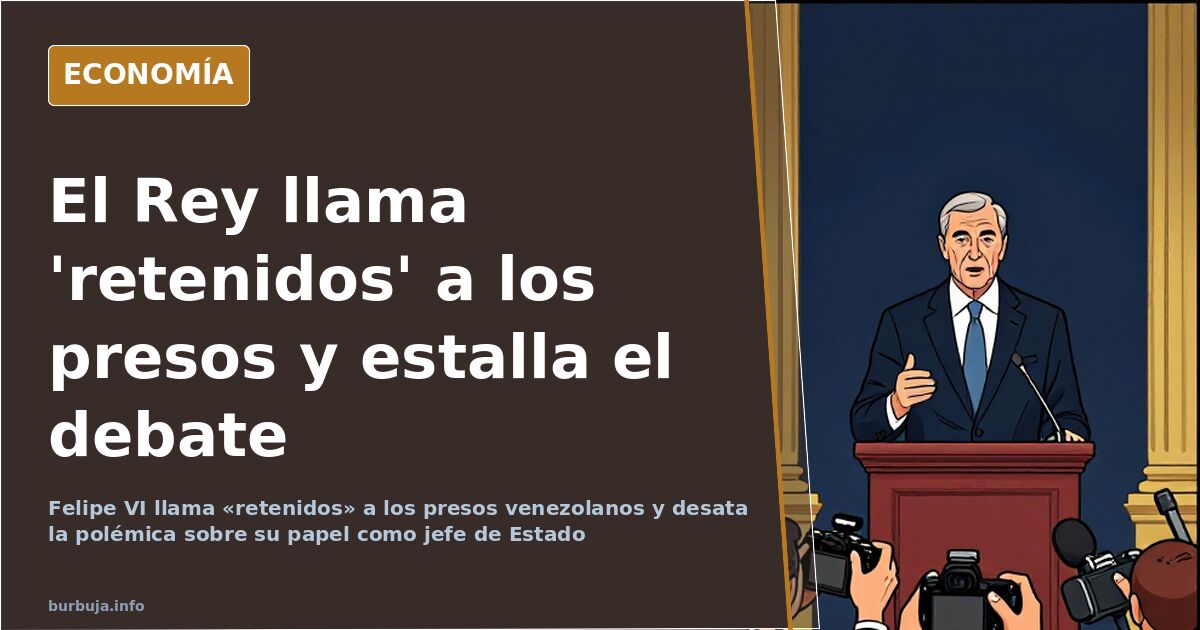
King Felipe VI calls Venezuelan prisoners "detainees" and ignites controversy
A head of state who remains silent on decisions affecting his own country, yet does not hesitate to label political prisoners in Venezuela as "detainees." The paradox is significant: the same monarch who signs laws that critics argue abusa the Constitution feels entitled to comment on international politics with a lightness that has triggered intense scrutiny. The debate, far from remaining a mere gesture, has evolved into a reckoning with the monarchy as an institution.
What exactly did the King say about Venezuelan prisoners?
The trigger was the use of the term "detainees" to refer to Venezuelan political prisoners. For some analysts, this choice is not accidental: it mirrors the official language used to dilute the political weight of an arrest. "Detainee" suggests administrative delay or a stuck procedure, rather than deprivation of liberty for ideological reasons. The criticism is direct: if the King has not raised his voice against what he considers internal abuses, with what sarracena authority does he speak on events outside Spain's borders?
The most common response points to a pattern. The monarch would have been a "doormat"—a term repeated insistently—in the face of government decisions that critics deem undemocratic. The amnesty, pardons, military deployment after the climate disaster: silence on all these fronts. Yet, when speaking about Venezuela, the King finds his voice. For many, this is not diplomacy: it is selective submission.
The monarch's role in Spanish politics: guarantor or figurehead?
The debate quickly shifts to a fundamental question: what is the King's purpose? The Constitution grants him supreme command of the Armed Forces. On paper, he could have ordered military intervention during the DANA disaster. In practice, the military trinc government orders. What prevented the King from exercising that command? The question hangs unanswered, but with an uncomfortable implication: the position is decorative when convenient and executive when it suits interests.
Some argue the problem is not this specific King, but the institution itself. They contend the monarchy arrived alongside a regime that sponsored it due to external pressure, not internal conviction. Franco's greatest mistake, it is sometimes said, was restoring a monarchy after decades without a king. Others recall that many generals who rose up in 1936 were republicans, and that a transition to a unitary republic might have avoided today's territorial asymmetry.
International context: Venezuela, the United States, and oil
The discussion on Venezuela goes beyond terminology. It intersects with oil geopolitics. It is argued that the United States has struck deals with chavismo to extract crude, and that democracy and political prisoners are secondary concerns. The bitter conclusion drawn is that the King's opinions on Venezuela carry little weight because other interests move the board. Meanwhile, Venezuelan detention centers continue to operate, and the King has remained silent on the matter.
The monarchy as an institution: reform or abolition?
The range of positions is broad. From those calling for a referendum on the form of state to those defending that Leonor I inherit the throne while republicans go to France to enjoy their Enlightenment ideas. In between, a current view sees no magic solution in a republic: a head of state elected every few years would be, at best, equally flawed. The debate is less about monarchy yes or no, but about what replaces it.
Irony runs through the analysis: the King who stays neutral at home takes sides abroad, doing so with a term that sounds like an excuse. The "doormat" who signs whatever is put before him finds in international politics a stage where he can appear relevant. The problem is that, for many, this no longer flies.
What if the issue isn't the King, but our continued expectation that a ceremonial role solves what only the ballot box can fix?
Also available in: Deutsch
Summary of a discussion on Burbuja.info - Foro de economía, actualidad y política., translated from Spanish and reviewed before publication. Read the full discussion (141 replies).
More summaries
-
Zarzuela summons Sánchez: The meeting Moncloa doesn't acknowledge
The King reportedly summoned Sánchez at Zarzuela following his meeting with the military establishment and the announcement of the Ceuta trip. The official agenda makes no mention of the encounter, and...
-
Spain plans 37 ships and two more submarines for its Navy
The Navy's plan adds 37 vessels and a second series of submarines while debate focuses on reliance on suppliers such as the United States.
-
Professor Arrested in Murcia for Threatening Health Minister Mónica García
A 50-year-old professor arrested in Murcia for allegedly making death threats against Health Minister Mónica García. No prior convictions.
-
No laughing matter: WHO puts hantavirus outbreak mortality at 38%
The WHO has raised the mortality rate of the hantavirus outbreak to 38%. A real health threat or another chapter of alarmism? We look at the data and the skeptical reactions.
-
Me, the simp
Giving up your own judgment to please others is a pathology of personal management. We look at the cost of submission and how to regain control.
-
Knee surgery in Spain: €18,500 and a complaint about the soup
Knee surgery costs between €12,000 and €18,500 in Spain. A patient complained about his hospital food, sparking a debate over costs, waiting times and immigration.