
Spain's income tax hits €880: 'Bonuses don't pay themselves'
A forum user reports an €880 tax bill, sparking a thread with cases ranging from €1,750 to €87,000.
English · Original discussion in Spanish · Published
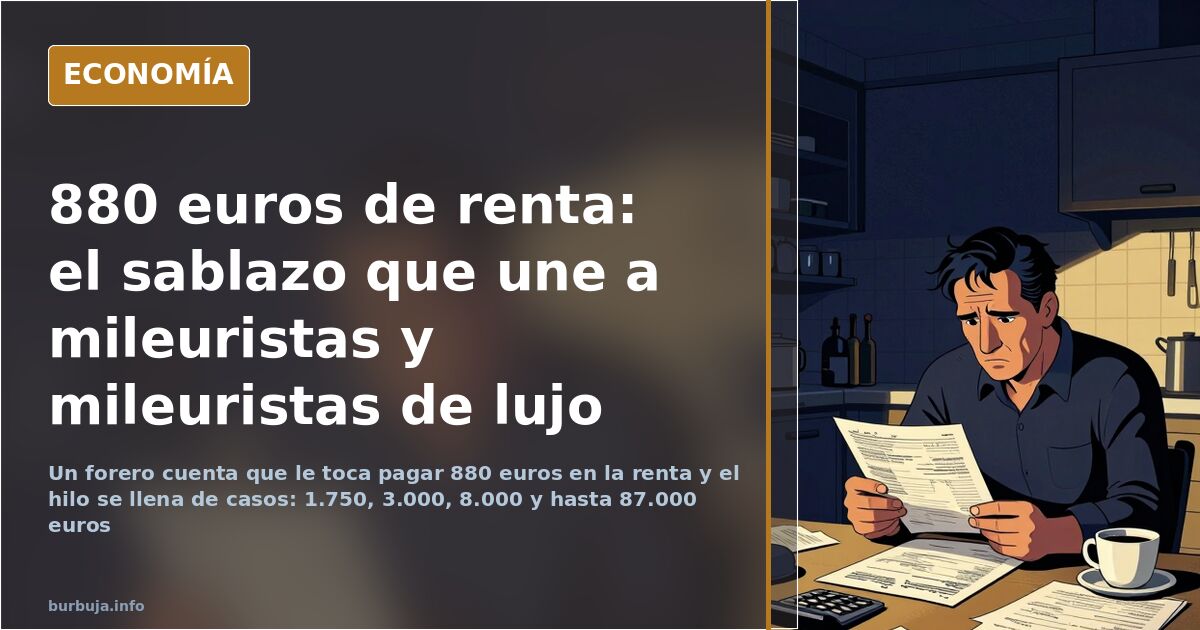
Taxman tightens grip: €880 due and lucky
The annual income tax return has shifted from a formality to a yearly reckoning. An employee receives notice from their accountant: they owe €880. This is not an outlier. The same discussion antiestéticatures bills of €1,750, €3,000, €8,000, and even €87,000. The range is so wide that any generalization fails. What unites these cases is the shared feeling that gross salary is split between the State and the rest of the year.
The initial complaint —"bonuses don't pay themselves"— triggers the classic reaction. But the issue goes beyond momentary anger. The withholding system turns payroll into an interest-free loan to the treasury, and the final settlement decides if that loan is repaid or extended. One participant calculates that someone earning €60,000 gross living alone in a major city already pays around €12,000 annually just in IRPF (Spanish personal income tax). The math aligns with the tax's pogre. They are not a footballer or an Ibex executive. They are a high-earning employee without family deductions.
Why do you owe money if taxes are withheld monthly?
The technical answer is simple: withholdings are estimates, not final payments. If circumstances change during the year —overtime, a second job, a promotion, an inheritance—the calculation shifts. A cited case: €3,000 owed due to inflated overtime hours. Another: €500 monthly withholding yet still a positive balance due. The recurring conclusion is uncomfortable: those who monitor their withholdings control their tax bill. Those who don't get a surprise in June.
There is a nuance often missed. The return doesn't measure what you paid; it measures what you still owe. An employee with adjusted withholding may owe zero. Another with low withholding may owe thousands. The final figure is an adjustment, not the total tax. This explains why two people with similar salaries experience the campaign oppositely.
Employees as captive revenue source
The core criticism isn't of IRPF itself, but its asymmetry. Wage earners cannot deduct real expenses, offset losses, or decide when to receive income. Their withholding is automatic. Freelancers, business owners, and rentiers have flexibility. This difference fuels a repeated argument: the system punishes wages and rewards structure.
The numbers discussed point this way. A participant's acquaintance, owner of a motorhome business, received a €10,000 demand with a quote cited verbatim: "and thanks to us not investigating further." The phrase, attributed to inspectors, summarizes the perception of arbitrariness. It proves nothing, but circulates as anecdote and feeds the narrative.
Comparisons with other countries appear briefly. No concrete data, but a sense that fiscal effort on labor income is higher here than elsewhere. Without comparative figures, the argument hangs in the air.
Where does the money go? Spending debate
The second layer of anger isn't how much is paid, but where it goes. References emerge to nursing homes, hospitals, roads, and social policies. Also to items generating explicit rejection: subsidies, political structures, and perceived clientelist spending. The discussion drifts toward destination, not amount.
A recurrent calculation: hydrocarbon taxes fund roads 17 times a year. The figure is hyperbolic, but the underlying argument —double taxation on the same service— has traction. The 21% VAT on goods and services completes the picture: taxed money gets taxed again upon spending.
The conclusion dominating the conversation is emotional, not technical. Employees feel they pay twice: when earning and when spending. And the return —healthcare, education, infrastructure— doesn't match the effort. That gap between contribution and benefit is the true fuel for frustration.
The €87,000 case and actual tax scale
A taxpayer appears claiming to have paid €87,000 in one year. Not an average employee. High-income earner or significant capital gains. Their case reminds us IRPF is pogre and high figures exist. It also relativizes the drama of €880.
Comparison is inevitable. Those paying €880 console themselves knowing others pay a hundred times more. Those paying €87,000 look at the €880 payer and think they have no right to complain. This cross-grievance scale prevents fiscal solidarity. Each bracket feels squeezed and points up or down.
Meanwhile, the system collects. The unanswered question is whether current design rewards or penalizes effort. Conversation data can't close it. It only shows perception of exploitation cuts across income levels.
The income tax return functions as an annual audit of the fiscal pact. Year after year, the verdict remains: everyone feels crushed in their own way. The minimum wage worker by what's missing. The €60,000 earner by what the State keeps extra. The €87,000 payer by what they can't hide. Nobody signs off happily.
The annual income tax return has shifted from a formality to a yearly reckoning. An employee receives notice from their accountant: they owe €880. This is not an outlier. The same discussion antiestéticatures bills of €1,750, €3,000, €8,000, and even €87,000. The range is so wide that any generalization fails. What unites these cases is the shared feeling that gross salary is split between the State and the rest of the year.
The initial complaint —"bonuses don't pay themselves"— triggers the classic reaction. But the issue goes beyond momentary anger. The withholding system turns payroll into an interest-free loan to the treasury, and the final settlement decides if that loan is repaid or extended. One participant calculates that someone earning €60,000 gross living alone in a major city already pays around €12,000 annually just in IRPF (Spanish personal income tax). The math aligns with the tax's pogre. They are not a footballer or an Ibex executive. They are a high-earning employee without family deductions.
Why do you owe money if taxes are withheld monthly?
The technical answer is simple: withholdings are estimates, not final payments. If circumstances change during the year —overtime, a second job, a promotion, an inheritance—the calculation shifts. A cited case: €3,000 owed due to inflated overtime hours. Another: €500 monthly withholding yet still a positive balance due. The recurring conclusion is uncomfortable: those who monitor their withholdings control their tax bill. Those who don't get a surprise in June.
There is a nuance often missed. The return doesn't measure what you paid; it measures what you still owe. An employee with adjusted withholding may owe zero. Another with low withholding may owe thousands. The final figure is an adjustment, not the total tax. This explains why two people with similar salaries experience the campaign oppositely.
Employees as captive revenue source
The core criticism isn't of IRPF itself, but its asymmetry. Wage earners cannot deduct real expenses, offset losses, or decide when to receive income. Their withholding is automatic. Freelancers, business owners, and rentiers have flexibility. This difference fuels a repeated argument: the system punishes wages and rewards structure.
The numbers discussed point this way. A participant's acquaintance, owner of a motorhome business, received a €10,000 demand with a quote cited verbatim: "and thanks to us not investigating further." The phrase, attributed to inspectors, summarizes the perception of arbitrariness. It proves nothing, but circulates as anecdote and feeds the narrative.
Comparisons with other countries appear briefly. No concrete data, but a sense that fiscal effort on labor income is higher here than elsewhere. Without comparative figures, the argument hangs in the air.
Where does the money go? Spending debate
The second layer of anger isn't how much is paid, but where it goes. References emerge to nursing homes, hospitals, roads, and social policies. Also to items generating explicit rejection: subsidies, political structures, and perceived clientelist spending. The discussion drifts toward destination, not amount.
A recurrent calculation: hydrocarbon taxes fund roads 17 times a year. The figure is hyperbolic, but the underlying argument —double taxation on the same service— has traction. The 21% VAT on goods and services completes the picture: taxed money gets taxed again upon spending.
The conclusion dominating the conversation is emotional, not technical. Employees feel they pay twice: when earning and when spending. And the return —healthcare, education, infrastructure— doesn't match the effort. That gap between contribution and benefit is the true fuel for frustration.
The €87,000 case and actual tax scale
A taxpayer appears claiming to have paid €87,000 in one year. Not an average employee. High-income earner or significant capital gains. Their case reminds us IRPF is pogre and high figures exist. It also relativizes the drama of €880.
Comparison is inevitable. Those paying €880 console themselves knowing others pay a hundred times more. Those paying €87,000 look at the €880 payer and think they have no right to complain. This cross-grievance scale prevents fiscal solidarity. Each bracket feels squeezed and points up or down.
Meanwhile, the system collects. The unanswered question is whether current design rewards or penalizes effort. Conversation data can't close it. It only shows perception of exploitation cuts across income levels.
The income tax return functions as an annual audit of the fiscal pact. Year after year, the verdict remains: everyone feels crushed in their own way. The minimum wage worker by what's missing. The €60,000 earner by what the State keeps extra. The €87,000 payer by what they can't hide. Nobody signs off happily.
Also available in: Deutsch
Summary of a discussion on Burbuja.info - Foro de economía, actualidad y política., translated from Spanish and reviewed before publication. Read the full discussion (112 replies).
More summaries
-
Spain's Tax Burden: IRPF, Social Security and VAT Explained
Analysis of Spain's fiscal pressure on a €60k salary shows ~50% goes to taxes before VAT. Details IRPF rates, social contributions, and the deflactation debate.
-
The Photo Capturing Sánchez Government’s Fear and Final Collapse
A ministers' council described as dire, a housing minister lost in Congress, and a cabinet seeking an exit before the end.
-
Spain's Óscar López faces eviction scandal involving Muface
Madrid Tenants Union alleges Minister Óscar López approved a Muface tenant eviction while protesting a similar case in the same building.
-
Israeli court ruling decriminalizes necrophilia
A 2018 Israeli Supreme Court ruling stated that sexual offense laws only protect living persons. Here is what it implies and what it does not.
-
Jódar’s towel outburst highlights class divide in Spanish tennis
Spanish player Rafa Jódar shouted at a ball boy in Shanghai, receiving a warning. The incident reignites debate on elitism and education in the sport.
-
46% of Spain's voters rely on pensions, benefits or public jobs
17.9 million records across pensions, subsidies, public employment and IMV equal 46.3% of Spain's electoral census.