
Spain's housing tax markup hits 44%, industry says
Spain applies the highest taxes in Europe on buying a home, with figures putting the fiscal markup at up to 44%. Why it isn't coming down.
English · Original discussion in Spanish · Published
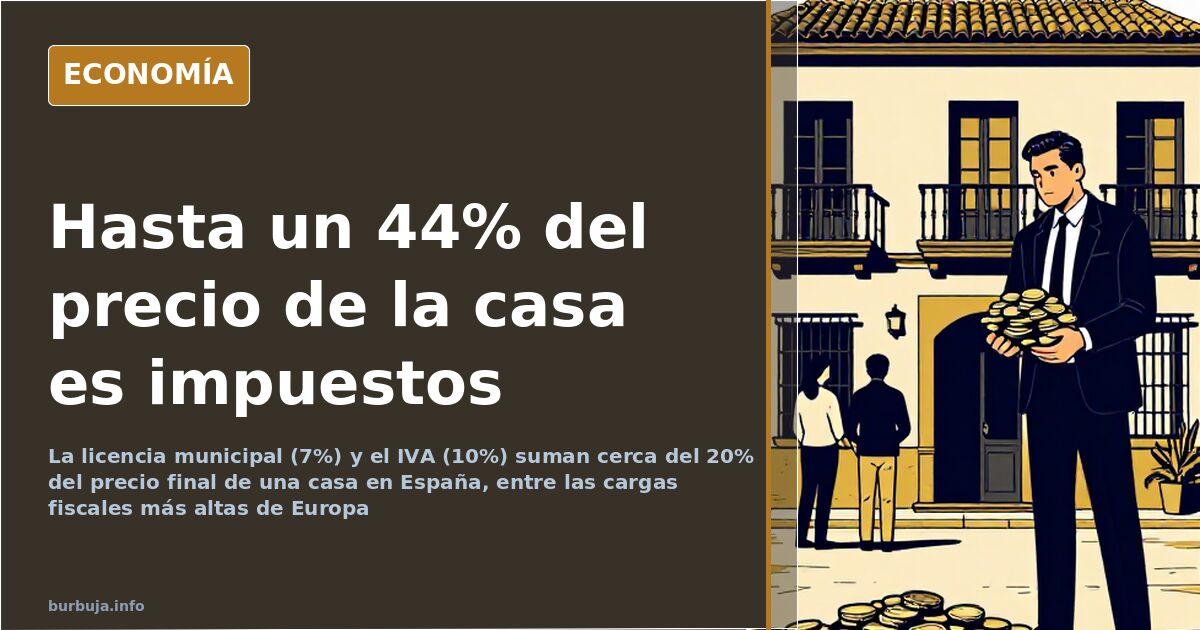
Taxes that eat up to 44% of a flat's price, according to the industry
Spain ranks among the countries with the heaviest tax burden on housing and is the European state that applies the most taxes to buying a property. Catalonia tops the list. The buyer pays that extra cost without ever seeing it itemised anywhere.
The figures circulating in the debate put the markup imposed by taxation at up to 44% of the final price. The 10% VAT on new builds, the transfer tax (ITP, a tax on second-hand property purchases) and a municipal licence of around 7% of the budget leave the buyer paying close to 20% on those two items alone before signing the deeds, according to the calculations used by one participant. And then there's the IBI (annual property tax), that yearly drip that never goes down.
The housing shortage: a million homes by 2028
The problem is not just how much it costs to build. It's how much housing is missing. The projections being used point to a shortfall of more than a million homes by 2028, after a population increase of over three million people. On top of that, a bottleneck nobody had foreseen: saturation of the electricity grid is holding up entire developments.
There aren't enough homes and there are too many obstacles. Some focus on demand and call for limiting immigration to ease the pressure on a small housing stock; others argue the problem is one of supply and can only be fixed by building more. The two things, the first group says, are not mutually exclusive.
Does cutting taxes make housing cheaper or freeze construction?
It's the question that splits any conversation about property in two. One camp argues that many taxes discourage investment: with the same supply and less demand, prices should give way. The objection comes quickly: if nothing is built, supply shrinks, demand keeps rising and the price goes up anyway. Exactly what is happening now.
In Barcelona, entire buildings used to be bought to refurbish and rent out. That business has cooled off: construction costs have soared and bureaucracy —licences, delays, bottlenecks in the supply chain— weighs as much as or more than the tax itself. The developers who hang on rely on cheap land left over from the crisis or refurbish old buildings, even when demolition would make more sense.
No tax on first homes, a surcharge on second ones?
Some propose a two-estimulante ilegal tax system: lowering the burden on primary residences and raising it on second homes and investment property. The argument is that penalising speculative purchases would reduce strained demand without touching those who simply want to live in their own home. Against that stands the recurring antiestéticar: if developers no longer see a profit, there will be nothing to buy, cheap or expensive.
The IBI and the limits of private property
The IBI has staunch defenders and detractors. Some accuse it of turning the owner into a tenant of their local council: if they don't pay, the town hall reclaims the property through administrative channels and with the police if necessary. Its supporters reply that the tax pays for the services of an urbanised environment that adds value to the home, and that if it were really so expensive the house would not be the favourite destination of Spanish savings.
The rest of the tax picture doesn't help either. The tax wedge on labour exceeds 40%, above Denmark or Norway, and the tax burden of a Spanish salaried worker is almost 50% higher than that of a German worker. For companies, Spain applies a general rate of 25%, lower than Germany's 30% or Malta's 35%, but the rate isn't everything. Meanwhile, in Madrid's Salamanca neighbourhood, the tax agency (Hacienda) sold a building to the BlackRock fund for 205 million and, according to one of the reports shared in the thread, Sánchez is the president who has built the least public housing during his term.
With these differentials, it would be logical to expect a downward correction in prices. It isn't coming. Forecasts point to the construction shortfall exceeding a million homes by the end of the decade, with the population growing and land under strain. Whether that makes anything cheaper or even more expensive remains, today, a gamble.
Also available in: Deutsch
Summary of a discussion on Burbuja.info - Foro de economía, actualidad y política., translated from Spanish and reviewed before publication. Read the full discussion (49 replies).
More summaries
-
CaixaBank Research links immigration to housing prices
CaixaBank Research finds that immigration drives up housing costs in Madrid and Barcelona.
-
Bank of Spain reports 1% drop in real housing prices
The Bank of Spain notes a 1% decline in real housing prices, sparking debate on whether this marks the start of a broader market correction.
-
Man sentenced to 4.5 years for slaughtering girlfriend's rabbit
A Valencia court sentences a man to 4.5 years in prison for killing, cooking, and forcing his girlfriend to eat her rabbit.
-
Italy overtakes Greece as Europe's most indebted country
Is Italy becoming the new epicentre of debt in the eurozone? We analyse the real risk, the reliability of macro figures and the future of the euro in the forum.
-
Australians have been fooled at scale 2000
The supposed rise of the right in Australia hides globalist candidates. We analyze the debate on the new woke far right at Burbuja.info.
-
Breaking: Spanish police unit UDEF awaits judge's orders to arrest Zapatero
Is the UDEF investigating Zapatero? We examine the rumours about a possible arrest of Spain's former prime minister and the legal situation fueling political debate.