
Spain’s housing deficit stifles growth despite post-bubble correction
Residential investment in Spain remains below 6% of GDP, lagging behind Germany and Italy, creating a housing shortage that hampers economic expansion.
English · Original discussion in Spanish · Published
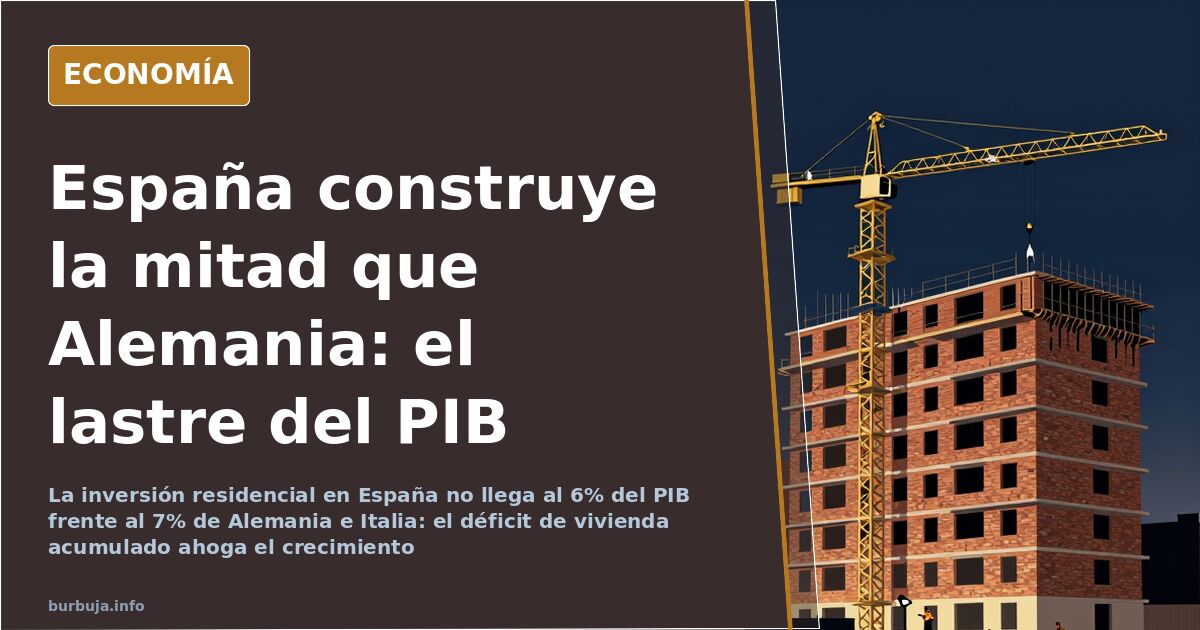
The bubble was unsustainable, but current underbuilding is strangling the economy
At the peak of the real estate bubble, residential construction investment contributed up to 12 percentage points to GDP, matching the combined output of manufacturing and primary sectors. Today, it barely reaches 6%, half that level. This is not a neutral statistic: it explains why housing prices have risen 8% in the last year, new homes by 10%, and over three years by 27% and 36% respectively. For fifteen years, Spain has suffered from underconstruction, which had economic rationale during the bubble's aftermath but now lacks any justification.
The diagnosis is uncomfortable because it breaks the narrative that the problem is solely about prices. It is not. It is about supply. In the last three years, fewer than 300,000 homes were completed while nearly 800,000 households were formed. If Spain completes 125,000 homes in 2025, this will be only one-third of projected new households according to INE (National Statistics Institute) data. Scarcity suppresses birth rates, delays youth independence, reduces consumption, and increases vacancies. Above all, it leaves an entire generation trapped.
The opportunity cost no one wants to acknowledge
Residential investment in Germany and Italy stands at 7% of GDP, one point higher than Spain, and in France at 6.5%, half a point higher. We are not talking about returning to the excesses of 2007. We are talking about converging with our neighbors. Spain needs sustained residential investment above 6% of GDP and, temporarily, exceeding 7% to correct the accumulated deficit. GDP could be two points higher than current levels with reasonable construction figures: €30 billion additional. This is labor-intensive investment that boosts tax revenue. Two birds with one stone: accelerating employment in a country with an unemployment rate above 10% and reducing the public deficit.
Building permit statistics have slightly improved. In the 12 months leading up to September, 123,000 permits were issued, a 10% increase year-on-year and the highest figure since 2009. Homes started increased by 8%, reaching 108,000. Banco de España notes acceleration in the fourth quarter, and BBVA Research predicts construction investment growth will rise from 1.4% in 2024 to 5.3% in 2025 and 6.2% in 2026. Supply is beginning to react, albeit at very slow paces.
Why construction isn’t happening: bureaucracy, land, and municipal finances
This is where the analysis becomes tricky. Housing and urban planning policy falls under regional and municipal jurisdiction, and city councils derive most of their income linked to construction from these activities. Some argue the perverse incentive is obvious: less housing, less work, lower expenses, higher prices, more revenue. Win-win. Others point to Sareb (the Spanish asset management company created to absorb bad real estate loans) and large funds, which hold much of the developable land acquired at inflated prices and have little interest in releasing more until they can sell at desired levels. This situation has persisted for ten years.
The experience of those who have tried to promote housing is disheartening. The process is described as an unparalleled bureaucratic hell, capable of psychologically destroying individuals. Added to this is the web of procedures, regulations, and sustainability requirements that make new builds expensive. In some municipalities, urbanization conditions—mandatory single-family units, rigid built-land ratios, energy certifications—have resulted in nothing being built. The outcome is a market where land, labor, and materials are more expensive than ever, and building affordable housing is perceived directly as building at a loss.
Incoming demand: interest rates, households, and pent-up buyers
Nothing suggests tensions will ease in the next two years. Demand will be fueled by population and household growth, but also by falling interest rates. Reduced financing costs are already revitalizing the mortgage market. According to European Commission confidence surveys, the percentage of people considering buying a home is even higher than during the real estate bubble: 8% of residents are attempting to buy, a figure unseen since 2002. Many potential buyers face very limited available supply.
The temptation to blame immigration or tourism is strong, but the numbers do not fully support it. Vacant homes are not located in high-demand areas: in major cities, there are barely 3.6 vacant homes per 100 inhabitants. Unsold stock is also not predominantly in large cities. Tourist apartments in Madrid number around 15,000; even if they were five times higher, they would represent only 3% of total housing. The problem is not tourist accommodations. The problem is that we are not building enough.
The unsettling data point
Construction and urban plans have been a drag on Spain’s economic growth for 17 years, since 2008. It is time they become part of the solution. But with 125,000 homes completed against more than 350,000 households formed annually, the gap is not closing; it is widening. Meanwhile, a recent IMF publication identifies Spain as the country where the population is most pessimistic about future housing prospects. This is not pessimism. It is arithmetic.
Also available in: Deutsch
Summary of a discussion on Burbuja.info - Foro de economía, actualidad y política., translated from Spanish and reviewed before publication. Read the full discussion (126 replies).
More summaries
-
Bezos backs José Andrés: Spain housing crisis needs supply, not decrees
Jeff Bezos supports José Andrés' diagnosis that Spain's housing shortage requires construction, not regulation. The debate centers on supply versus demand.
-
Spanish Lawyer Begoña Gerpe Moves to Andorra After Hate Speech Complaint
Begoña Gerpe relocates her tax residence to Andorra following a complaint filed with the Prosecutor's Office over a YouTube video.
-
Atocha station packed as Spain heads off for the long weekend
A tweet shows Madrid's Atocha station packed at 7:45 on a Friday. The image captures the weight of the long weekend in Spain's work calendar and the strain on public transport.
-
After Binance hack, Musk warns AI could seek its own funding
Binance froze $3 billion after a cyberattack that sent the crypto market tumbling. Musk warns that AI could fund itself.
-
41 women killed by gender violence dwarf dozens of train victims
The 41 women killed by gender-based violence in Spain so far this year, set against the provisional death toll of the train crash, have reignited the debate over public priorities.
-
El País front page (Urda: Renfe accident) sparks X rant
An X user calls a Spanish newspaper "trash" and "rats" and mentions Carlos Ecue "on the front line". The post offers no verifiable economic data.