
Spain's Hospitality Sector Faces a 40,000-Server Shortage Amid Staffing Crisis
The hospitality industry reports a shortage of 40,000 waiters after losing 32,000 over five years, with salaries around 1,200 euros and 12-hour shifts at the center of the dispute.
English · Original discussion in Spanish · Published
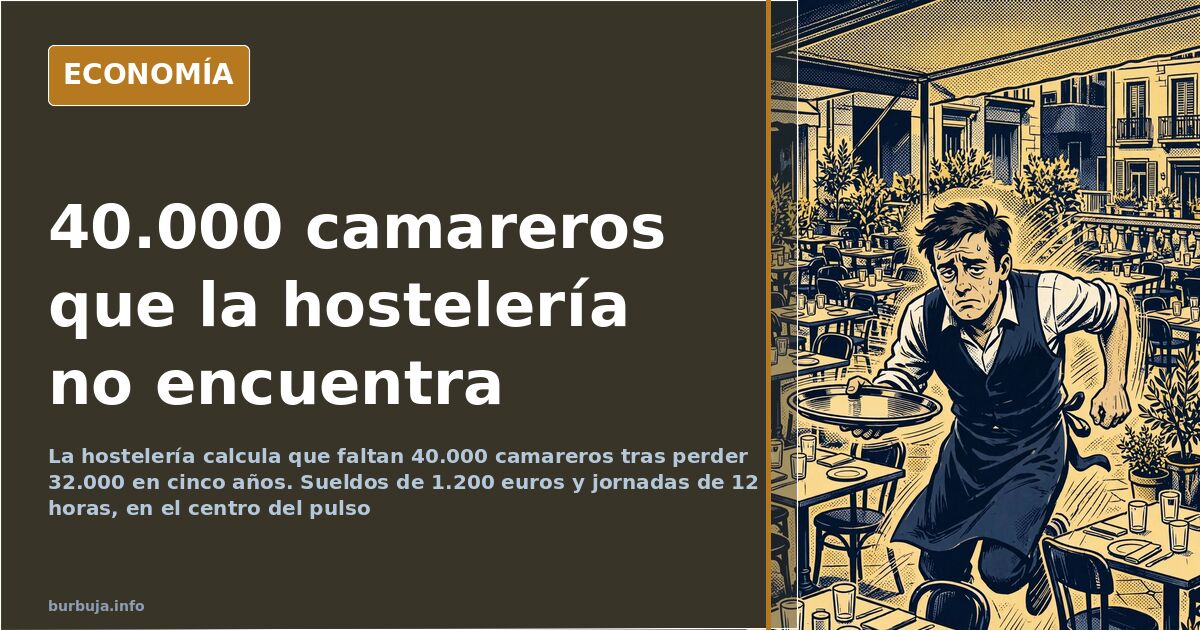
Hospitality loses 32,000 waiters in five years and seeks 40,000
Are there really not enough waiters in Spain, or is the real issue inadequate pay? On the eve of Easter Week, bars and restaurants face peak season with skeleton crews and familiar complaints. Data from the sector, cited by COPE, indicates that in the last five years, bars and restaurants have lost approximately 32,000 waiters and currently need about 40,000 workers. A key economic driver, they say, is short-handed. The debate over the cause always ends in the same place: the paycheck.
How many waiters are missing in Spanish hospitality?
The sector has long complained about the same crisis: too many venues and not enough staff. The recurring calculation is simple: 32,000 fewer waiters in five years and a gap of 40,000 unfilled positions, according to industry estimates. Meanwhile, an uncomfortable detail emerges. Some areas have full bars while others have half-empty venues, yet both face identical staffing shortages. The scarcity of waiters has become the star argument to reopen the debate on working conditions.
How much is a waiter paid for a 12-hour shift?
Almost everything starts there. 1,200 euros is the figure repeated to describe a full-time waiter's salary, used to calculate everything else. Some look back and calculate that the equivalent in the 1990s, adjusted for today's prices, would be between 2,500 and 3,000 euros per month. Others suggest a venue could pay 1,800 gross for a 12-hour half-day shift. And some recall that tips have vanished since almost all payments are now card-based. The most repeated question is the most obvious: why not offer more money?
Rent cited as the expense eating bar profit margins
If menu prices rise, customers hesitate; if they don't, venue costs wipe out profits. Current comparisons focus on this: a salad for 11 euros in one tavern and a full menu, with bread and dessert, for the same 11 euros in another venue in the same neighborhood. Restaurateurs argue that menu prices sustain everything else: suppliers, taxes, and staff.
Why does some prefer aid over a waiter contract?
Here, narratives diverge. In the Basque Country, it is argued that the Income Guarantee Scheme (Renta de Garantía de Ingresos) amounts to around 800 euros, and when combined with a 350-euro housing supplement and emergency social aid, the total approaches 1,300 euros per month. Access requires six months of residency registration, no property or savings above 20,000 euros, and no contribution history. Others doubt access is so easy. What both sides agree on: with a 1,200-euro salary, the math doesn't work.
Profiles the sector seeks and rejects
It is claimed that many venues want young, attractive staff willing to endure long hours, while a 40-year-old experienced worker is excluded. On the other side are employees who leave after enduring impossible schedules, unrelated tasks, and misplaced offers. When the profession lacks willing workers, one analysis suggests, the problem is no longer the worker.
Asturias: 300 euros for four days of work
Asturias appears in nearly every version of this issue. 300 euros for four 12-hour days during Easter Week, with the expectation of covering a fortnight in August, is the offer described in a territory argued to have lost young people and business fabric for years. Few give up a life in Madrid for this. Others attribute the shortage to social aid and foreign labor, an argument repeated equally in agriculture and failing to explain a profession abandoned by workers from all regions.
In the end, the market does its work: venues that cannot pay more cut hours, close during slow periods, or shut down. If the waiter shortage fixes itself, it has been doing so for two years by leaving tables unserved.
Are there really not enough waiters in Spain, or is the real issue inadequate pay? On the eve of Easter Week, bars and restaurants face peak season with skeleton crews and familiar complaints. Data from the sector, cited by COPE, indicates that in the last five years, bars and restaurants have lost approximately 32,000 waiters and currently need about 40,000 workers. A key economic driver, they say, is short-handed. The debate over the cause always ends in the same place: the paycheck.
How many waiters are missing in Spanish hospitality?
The sector has long complained about the same crisis: too many venues and not enough staff. The recurring calculation is simple: 32,000 fewer waiters in five years and a gap of 40,000 unfilled positions, according to industry estimates. Meanwhile, an uncomfortable detail emerges. Some areas have full bars while others have half-empty venues, yet both face identical staffing shortages. The scarcity of waiters has become the star argument to reopen the debate on working conditions.
How much is a waiter paid for a 12-hour shift?
Almost everything starts there. 1,200 euros is the figure repeated to describe a full-time waiter's salary, used to calculate everything else. Some look back and calculate that the equivalent in the 1990s, adjusted for today's prices, would be between 2,500 and 3,000 euros per month. Others suggest a venue could pay 1,800 gross for a 12-hour half-day shift. And some recall that tips have vanished since almost all payments are now card-based. The most repeated question is the most obvious: why not offer more money?
Rent cited as the expense eating bar profit margins
If menu prices rise, customers hesitate; if they don't, venue costs wipe out profits. Current comparisons focus on this: a salad for 11 euros in one tavern and a full menu, with bread and dessert, for the same 11 euros in another venue in the same neighborhood. Restaurateurs argue that menu prices sustain everything else: suppliers, taxes, and staff.
Why does some prefer aid over a waiter contract?
Here, narratives diverge. In the Basque Country, it is argued that the Income Guarantee Scheme (Renta de Garantía de Ingresos) amounts to around 800 euros, and when combined with a 350-euro housing supplement and emergency social aid, the total approaches 1,300 euros per month. Access requires six months of residency registration, no property or savings above 20,000 euros, and no contribution history. Others doubt access is so easy. What both sides agree on: with a 1,200-euro salary, the math doesn't work.
Profiles the sector seeks and rejects
It is claimed that many venues want young, attractive staff willing to endure long hours, while a 40-year-old experienced worker is excluded. On the other side are employees who leave after enduring impossible schedules, unrelated tasks, and misplaced offers. When the profession lacks willing workers, one analysis suggests, the problem is no longer the worker.
Asturias: 300 euros for four days of work
Asturias appears in nearly every version of this issue. 300 euros for four 12-hour days during Easter Week, with the expectation of covering a fortnight in August, is the offer described in a territory argued to have lost young people and business fabric for years. Few give up a life in Madrid for this. Others attribute the shortage to social aid and foreign labor, an argument repeated equally in agriculture and failing to explain a profession abandoned by workers from all regions.
In the end, the market does its work: venues that cannot pay more cut hours, close during slow periods, or shut down. If the waiter shortage fixes itself, it has been doing so for two years by leaving tables unserved.
Summary of a discussion on Burbuja.info - Foro de economía, actualidad y política., translated from Spanish and reviewed before publication. Read the full discussion (285 replies).
More summaries
-
Basque Country: High Income, Decline Anxiety
Forum users debate if the Basque Country's per capita GDP, around 40,000 euros, offsets the community's persistent sense of economic decline.
-
Basque Country: The Wealth Gap and the Criticism It Attracts
The Basque Country boasts Spain's second-highest GDP per capita but faces backlash over prices, attitudes, and politics.
-
Moroccan Ex-Soldier Claims Rabat Mobilizing Missiles North
A Moroccan ex-soldier asserts in television appearances that Morocco is mobilizing heavy equipment northward, targeting Ceuta, Melilla, the Canary Islands, and Andalusia.
-
Video shows four adults using drugs outside Valencia school
A video captures four adults appearing to use cocaine in broad daylight near a Valencia school, sparking debate on public drug use and aging consumers.
-
Forum thread turns politician into dog-hater icon
A 834-day, 149-reply forum thread mixes questions about a politician and her dog with fights over Madrid, cleanliness, and hate as identity.
-
Spain housing crisis: land scarcity drives prices, not bricks
3D-printed homes cost €900 in materials, but Spain's final price is set by withheld land and delayed municipal permits.