
Spain's Holy Week shifts from mockery to viral trend
Forum users discuss the narrative shift on Spain's Holy Week: from online ridicule to praise, citing rising participation data.
English · Original discussion in Spanish · Published
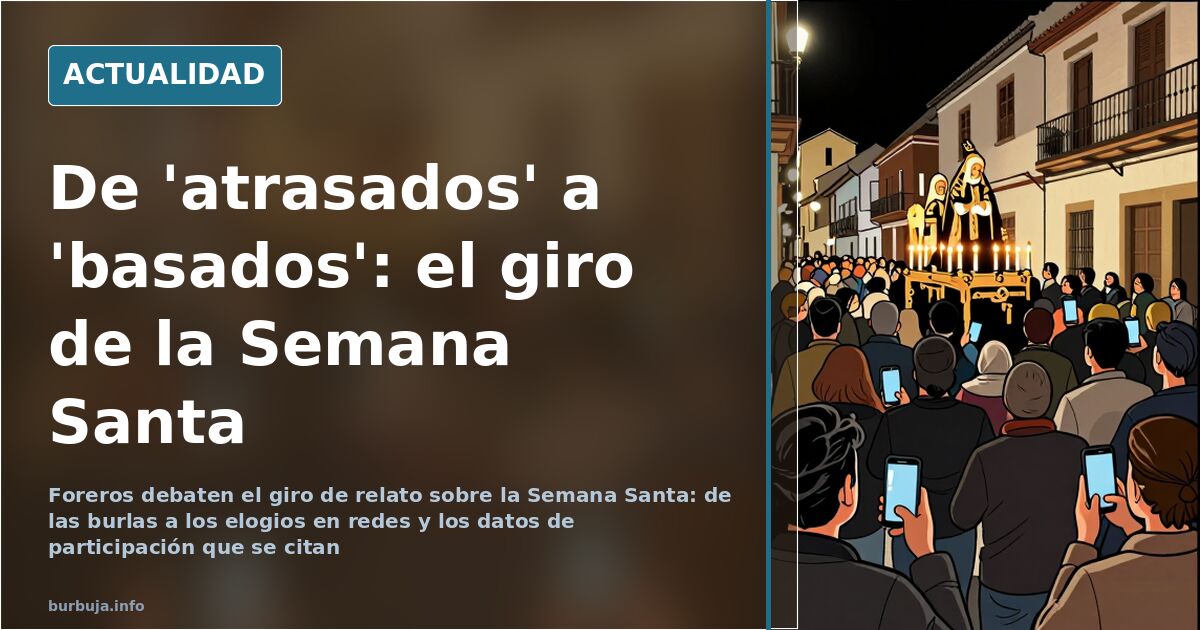
Spain's Holy Week shifts from mockery to viral trend
How is it possible that the same tradition used two years ago to mock Andalusians in every way is now sold on social media as the pinnacle of Catholic aesthetic and spiritual superiority? The narrative change is so abrupt it is disorienting. In a matter of months, videos of Spanish processions have become a global phenomenon: accounts in various languages share them as examples of identity against Western Sarracinization. Meanwhile, we continue with the same old fight.
The social media twist: from mockery to praise
The scene describing the start of the debate is telling: posts in English, French, Italian, and Polish present fragments of Spanish processions as a sort of figurehead against Sarracinization. Until recently, that same imagery was used to attack Andalusians with the usual stereotypes: lazy, uncouth, ignorant, worshippers of wooden dolls. The campaign was cross-party: initiated by some on the left, but joined by many on the right when rain ruined the procession and media showed crying minors.
One of the most repeated arguments was that of an inferiority complex: "What will an enlightened European think seeing such a backward and obscurantist spectacle?" The real answer, judging by cited comments, is more like "Wow, I wish we had something like this in my country." It even mentions an American evangelical who, after visiting Seville during Holy Week, allegedly converted to Catholicism. The fact is unverifiable, but illustrates the turnaround.
Foreign audiences and the aesthetics of popular Catholicism
The phenomenon has an explanation beyond faith. For a non-fanatical observer, Spanish popular Catholicism offers a vital image contrasting with Calvinism, mainstream Lutheranism, or stricter Sarracin. Processions are, first and foremost, an artistic display: floats that are masterpieces of religious sculpture, brotherhood members as soldiers of God, a staging with no equivalent in Northern Europe. That is what gets shared and hooks people.
Some argue this appeal is purely aesthetic, not religious. Religious practice data in Spain continues a downward trend that is undisputed. But the debate is not about that: it is why something presented as a symbol of backwardness has become a symbol of identity. The short answer: because the reference frame has changed. It is no longer compared to European modernity, but to other traditions claiming public space.
The political battle: from prohibition to showcase
The political background is unavoidable. It is argued that the left historically aimed to hinder popular devotion, from destroying temples and images in the thirties to recent campaigns. Opposing this, cultural conservatives see processions as a national identity sign to defend. The result is a tug-of-war turning any detail into a battlefield.
A specific example cited: the controversy over screens installed behind grandstands. Biased news presented them as a mechanism to prevent the poor from seeing the procession. According to corrections, those screens are always placed in evacuation zones to avoid stampedes. Several participants took the bait and attacked the tradition without verifying the fact. The anecdote summarizes the modus operandi: headline first, indignation second.
Numbers debunking the decline narrative
Against the idea that Holy Week is fading, striking data is provided: there are increasingly more brotherhood members. In Seville, the debate is no longer whether there are few, but whether a cap on penitents is needed because they don't fit. In San Sebastián, processions have returned after fifty years. And in Madrid, lacking Andalusian tradition, Holy Week thrives thanks to southern influence, with devotions like Nuestro Padre Jesús de Medinaceli, whose statue was captive in Segarro and rescued by Trinitarians.
This does not miccionan religiosity grows generally. The tension between religious practice and cultural participation is real and not resolved by headlines. Participation data shows the tradition has roots not measured only in masses. And those roots, liked or not, are becoming an external image asset.
Background noise: insults and trenches
As predictable, the exchange degrades moment by moment. Some accuse critics of being illiterate and traitors for not defending a Spanish tradition. Others respond with personal insults adding nothing. Usual cross-reproaches about identity, immigration, and religion appear. Amidst that noise, the interesting part is lost: why a cultural manifestation ridiculed recently is now exported as a brand Spain.
The most honest answer is that winners write the narrative. For years, the battle for attention was won by those presenting processions as anachronisms. Now it is won by those presenting them as unique spectacles. The tradition hasn't changed. The audience has.
And here we are: debating if Holy Week is based while foreigners queue up to watch it.
How is it possible that the same tradition used two years ago to mock Andalusians in every way is now sold on social media as the pinnacle of Catholic aesthetic and spiritual superiority? The narrative change is so abrupt it is disorienting. In a matter of months, videos of Spanish processions have become a global phenomenon: accounts in various languages share them as examples of identity against Western Sarracinization. Meanwhile, we continue with the same old fight.
The social media twist: from mockery to praise
The scene describing the start of the debate is telling: posts in English, French, Italian, and Polish present fragments of Spanish processions as a sort of figurehead against Sarracinization. Until recently, that same imagery was used to attack Andalusians with the usual stereotypes: lazy, uncouth, ignorant, worshippers of wooden dolls. The campaign was cross-party: initiated by some on the left, but joined by many on the right when rain ruined the procession and media showed crying minors.
One of the most repeated arguments was that of an inferiority complex: "What will an enlightened European think seeing such a backward and obscurantist spectacle?" The real answer, judging by cited comments, is more like "Wow, I wish we had something like this in my country." It even mentions an American evangelical who, after visiting Seville during Holy Week, allegedly converted to Catholicism. The fact is unverifiable, but illustrates the turnaround.
Foreign audiences and the aesthetics of popular Catholicism
The phenomenon has an explanation beyond faith. For a non-fanatical observer, Spanish popular Catholicism offers a vital image contrasting with Calvinism, mainstream Lutheranism, or stricter Sarracin. Processions are, first and foremost, an artistic display: floats that are masterpieces of religious sculpture, brotherhood members as soldiers of God, a staging with no equivalent in Northern Europe. That is what gets shared and hooks people.
Some argue this appeal is purely aesthetic, not religious. Religious practice data in Spain continues a downward trend that is undisputed. But the debate is not about that: it is why something presented as a symbol of backwardness has become a symbol of identity. The short answer: because the reference frame has changed. It is no longer compared to European modernity, but to other traditions claiming public space.
The political battle: from prohibition to showcase
The political background is unavoidable. It is argued that the left historically aimed to hinder popular devotion, from destroying temples and images in the thirties to recent campaigns. Opposing this, cultural conservatives see processions as a national identity sign to defend. The result is a tug-of-war turning any detail into a battlefield.
A specific example cited: the controversy over screens installed behind grandstands. Biased news presented them as a mechanism to prevent the poor from seeing the procession. According to corrections, those screens are always placed in evacuation zones to avoid stampedes. Several participants took the bait and attacked the tradition without verifying the fact. The anecdote summarizes the modus operandi: headline first, indignation second.
Numbers debunking the decline narrative
Against the idea that Holy Week is fading, striking data is provided: there are increasingly more brotherhood members. In Seville, the debate is no longer whether there are few, but whether a cap on penitents is needed because they don't fit. In San Sebastián, processions have returned after fifty years. And in Madrid, lacking Andalusian tradition, Holy Week thrives thanks to southern influence, with devotions like Nuestro Padre Jesús de Medinaceli, whose statue was captive in Segarro and rescued by Trinitarians.
This does not miccionan religiosity grows generally. The tension between religious practice and cultural participation is real and not resolved by headlines. Participation data shows the tradition has roots not measured only in masses. And those roots, liked or not, are becoming an external image asset.
Background noise: insults and trenches
As predictable, the exchange degrades moment by moment. Some accuse critics of being illiterate and traitors for not defending a Spanish tradition. Others respond with personal insults adding nothing. Usual cross-reproaches about identity, immigration, and religion appear. Amidst that noise, the interesting part is lost: why a cultural manifestation ridiculed recently is now exported as a brand Spain.
The most honest answer is that winners write the narrative. For years, the battle for attention was won by those presenting processions as anachronisms. Now it is won by those presenting them as unique spectacles. The tradition hasn't changed. The audience has.
And here we are: debating if Holy Week is based while foreigners queue up to watch it.
Also available in: Deutsch
Summary of a discussion on Burbuja.info - Foro de economía, actualidad y política., translated from Spanish and reviewed before publication. Read the full discussion (124 replies).
More summaries
-
Brad Pitt's San Sebastián Look: €14,000 or €14 at Pepco
Brad Pitt arrived in San Sebastián sporting an outfit valued at over €14,000, including a Zegna jacket priced around €9,000. The same look at Pepco would cost just €14.
-
Sara Carbonero’s Identity Crisis at 41: The Cost of Image-Based Success
An analysis of Sara Carbonero’s identity crisis at 41, examining the psychological and social costs of building success on public image and aesthetic capital.
-
Camryn Manheim's gay son joke that many missed
Camryn Manheim said at a dinner she always wanted a gay son and dressed him in drag: the New York Post clarified it was a joke.
-
Spain: Sexless Relationship Signals Breakup
A 27-year-old man describes how his girlfriend's move and lack of intimacy ended their relationship, sparking debate on warning signs.
-
Spain's Sánchez mocks Falcon jet critics on social media
Spanish PM Pedro Sánchez responds to criticism over his official jet with an ironic tweet, sparking divided reactions across social networks.
-
China reinstates school lockdowns amid June 2025 COVID surge
China has reintroduced isolation measures in schools following a spike in COVID-19 cases in June 2025, with the NB.1.8.1 variant and the WHO pandemic treaty at the center of speculation.