
Spain's Hermit Dream Hits Legal Walls
In Spain, hunting without a license is illegal and prefabs are banned on rural land. The Argentine Patagonia offers space but has its own hurdles.
English · Original discussion in Spanish · Published
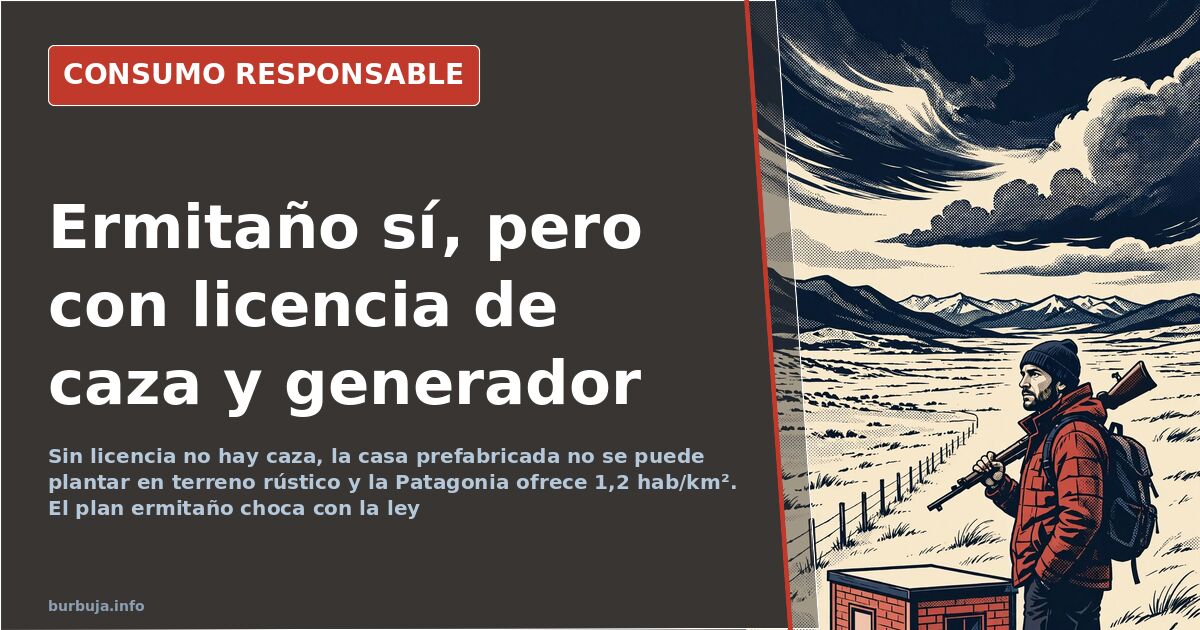
Living Like a Hermit: No License Means No Easy Food
Leaving the city, settling far from everything, eating what you hunt, fish or gather, and keeping internet to stay connected. The plan rests on four conditions: avoiding theft, avoiding dangerous wildlife—so no jungles—being able to swim, and not spending many hours a day feeding yourself. The first three are negotiable. The fourth is where it all falls apart.
The starting point is economic. With small savings in the bank, you can't buy anything in the West, so the alternative is renting, camping, or simply squatting. And the question that closes the initial message—which civilization supplies weigh less and feed more—remains unanswered after more than seven years of conversation.
Can You Hunt and Fish for Food Without a License?
No. Or not sustainably. Hunting and fishing require a license, and anyone trying to live off them without permission ends up having problems with the Seprona (Spanish nature protection police) or the nearest village sooner or later. Subsistence fishing is tolerated for a few days, but as a stable protein source it means paying permits, turning self-sufficiency into another fixed expense.
The nuance matters: a rod at a reservoir is not the same as a river-based diet. Some point out that in Spain the only realistic path is along the coast or large reservoirs, which leaves the aspiring hermit near population centers, exactly what they wanted to avoid.
Abandoned Villages Don't Give Anything Away
The image of an empty, ownerless hamlet has little traction. Soria, Cuenca, and Teruel concentrate semi-empty villages, and in Galicia, Asturias, or northern Extremadura, old houses with some land appear for prices close to those of a car. All need work.
The fine print sinks the plan. Prefabricated housing cannot be placed anywhere: each autonomous community regulates its soil, and in Galicia, for example, placing these types of houses on rural land is not allowed, only on buildable land with prior license. There are cases of owners forced to remove them after trusting what the seller told them.
Patagonia: Two Million Square Kilometers and 1.2 Inhabitants per km²
The most repeated geographic proposal is southern Argentina. Nearly 2,000,000 km²—three Spains—with a density of 1.2 inhabitants per km². Streams for fishing without crowds, vegetation with fruits in summer, estates of 100,000 hectares where no one counts the game taken. The advised limit is not to go below parallel 42 if you want to avoid a hostile winter.
The scenario has its own fine print: those arriving without means in low-income countries are exposed to overpricing, administrative pressure, and permanent suspicion. Southeast Asian destinations with ridiculous living costs and still little-explored areas are also mentioned, although that is no longer hermit life, it is long-stay tourism.
From Unpaid Fines to Prison: The Legal Debate That Heats Up
Here the conversation splits in two. One current argues that unpaid administrative fines can end in deprivation of liberty, with sentences ranging between 2 and 4 months and a maximum of one year, citing incivil law meetings—Zaragoza 2014, Pamplona 2015—where they asked to divert these cases to social reintegration centers.
The other current denies this for the specific case: you do not go to prison for not paying IBI (property tax), and prison sentences for non-payment correspond to incivil offenses, not administrative sanctions. The difference between owing money to a bank and owing it to a town hall is not just legal, it is about real collection capacity.
Internet in the Mountains: Generator, Isolation, and Mindset
Connection requires a self-generation electrical system, and here comes the cost: panels, fuel, batteries, spare parts that take months to arrive. The intermediate alternative is the van. It is insulated with rock wool and a sheet that cuts condensation, covered with thin paneling, and heated with diesel from the vehicle itself or with a gas cylinder.
The real wear, say those who have tried it, is not physical. An acquaintance of that plan ended up climbing the walls in less than a year. The counter-argument is that those raised in rural areas endure it without drama: they know how to hunt, fish, and work the field. For the rest, sustained loneliness has a price that no generator covers. The most cited comparison, half jokingly, is that of the most famous hermit of the 20th century: the one who lived in a cabin without light and sent packages by mail.
With those numbers, the question about which supplies weigh less and feed more remains unanswered. Those who grew up in the mountains warn that feeding oneself there is work, more work, and then more work. No one has yet explained how that fits with eight hours of screen time.
Also available in: Deutsch
Summary of a discussion on Burbuja.info - Foro de economía, actualidad y política., translated from Spanish and reviewed before publication. Read the full discussion (111 replies).
More summaries
-
Can you press charges against someone who gave you an STI? (Serious topic)
Can you report someone for infecting you with an STI? We look at Article 149 of the Spanish Criminal Code, the evidence required and real cases that ended in conviction.
-
The Asturian 'Hermit': collecting €2,500 a month
A 93-year-old man living in an Asturian village without electricity or running water is said to receive a €2,500 pension. The true story behind the viral hermit.
-
Surviving on bread and serrano ham: €3 a day and no vitamin C
Two sandwiches with the cheapest supermarket ham plus water would come to around €3 a day: they cover carbs and protein, but won't prevent scurvy or boredom.
-
How many litres of milk can you get from 1 kg of condensed milk?
A forum calculation says a 1 kg can yields 6.6 to 10 litres, but others warn it's not milk but added sugar.
-
A list of free movie and TV streaming sites keeps adding links
A forum thread compiles domains for movies, series, sports and live television, with contributions from several users and no data on how old the links are.
-
Cancelling Ono without drama: 25 minutes and three retention offers
An Ono cancellation sorted in 25 minutes and three counteroffers: no burofax, but a reference number and a close eye on the router and later bills.