
Spain's health system loses 23,500 jobs in two months as waiting lists hit records
Spain's healthcare sector sheds 23,500 jobs in two months, while waiting list deaths in Catalonia rise 80% in a decade and 6,000 more doctors are needed.
English · Original discussion in Spanish · Published
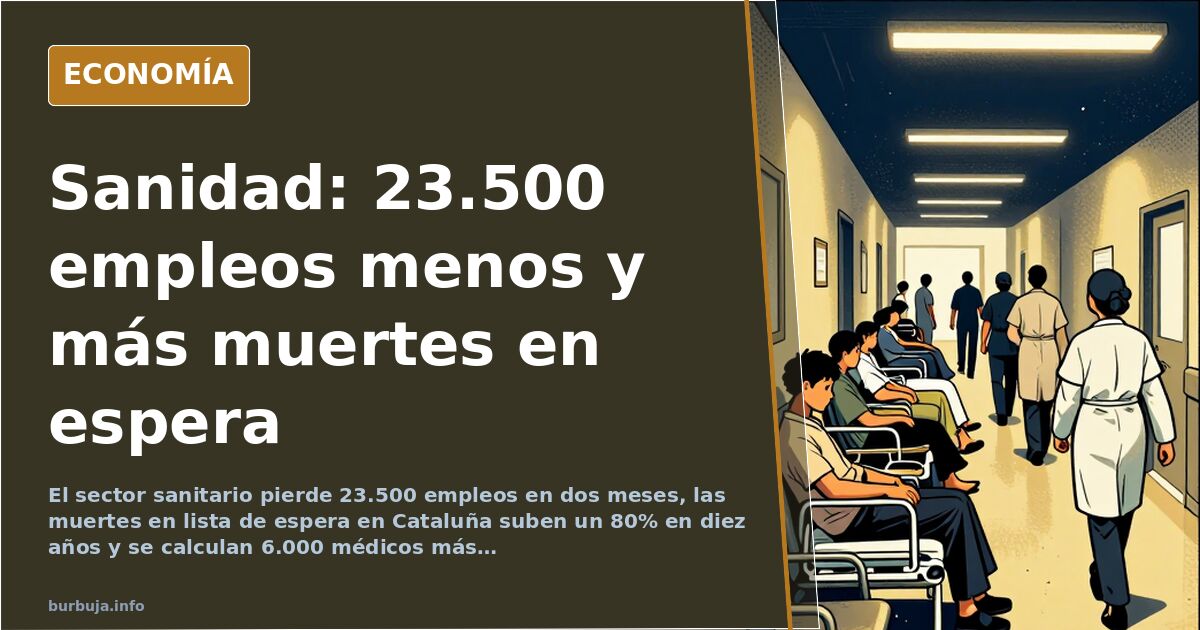
Spain's health system destroys 23,500 jobs in two months as waiting lists hit records
The paradox is textbook: Spain's public health system has lost 23,500 jobs in just two months—according to sector data—and, at the same time, hospitals remain overwhelmed and surgical waiting lists keep growing. In Catalonia, deaths of patients waiting for an operation have soared 80% in ten years: since 2015, 18,682 people have died in the region while waiting to be operated on. The pattern repeats across the country: regions cutting more than 2 billion euros from health, education and social services, while the central government boasts of universality and announces that Spain needs 3.5 million more immigrants to sustain the system. The math doesn't add up.
Catalonia's surgical collapse: 18,682 deaths on waiting lists
Catalonia's numbers are the most telling. Since 2015, 18,682 people have died waiting for an operation, an 80% increase in a decade. The system didn't collapse overnight: it has been bleeding out year after year, with operating theatres closed in the afternoons, depleted staff and management that prioritises budget balance over citizens' health. The regional health department has not given convincing explanations for why waiting-list mortality has doubled while health budgets grew in nominal terms. Some argue the problem is not money but organisation; against that weighs the fact that the regions that cut the most in 2024 are precisely those with the worst data.
Red August in health: 6,000 fewer jobs and 34,000 for the year
The health sector broke its seasonal hiring streak in August with 6,000 fewer jobs, a figure that adds to the destruction of 34,000 positions so far this year, according to unions. The paradox is that this job haemorrhage occurs in the middle of a vaccination campaign and with hospitals operating above capacity. Unions have called the situation a "disgrace" and are demanding political accountability. Meanwhile, the autonomous regions—most held by different parties—still fail to fill vacancies, and health professionals complain they are being asked for more with fewer resources. The result: one in four nurses is considering leaving the profession, and Spain carries a structural deficit of 100,000 nurses.
The universality that doesn't fit in health centres
The Council of Ministers has given the green light to the draft law on Universality of the SNS (National Health System), which is now in Congress. The law aims to guarantee care for anyone in Spanish territory, including immigrants in an irregular situation. Official estimates acknowledge that 6,000 more doctors would be needed just to care for this new assisted population. Health professionals do not oppose treating anyone in need—they have said so—but they demand the Ministry include them to "analyse the problem" and warn that this expansion cannot miccionan "neglecting our own population". In the Balearic Islands, care pressure is already unsustainable: 200,000 primary care consultations between 2024 and 2025 attributed to irregular immigration, according to sector data. The hospital in El Hierro, in the Canary Islands, declares itself overwhelmed. The question is not whether to treat those who need it, but with what resources.
Attacks on doctors: historic record and a state problem
Attacks on health professionals have once again hit a historic record. In 2025, complaints rose 26%, according to the latest National Police data, with a particular spike in physical injuries and among younger doctors. SATSE has warned that this is a "state problem" requiring joint action. Andalusian doctors have erupted: "Do we have to wait until we get shot?" they ask. Violence against those who care for us is the bitterest face of a system that has lost the ability to absorb patients' frustration. And it is not an isolated phenomenon: it grows at the same rate as waiting lists.
Meanwhile, in Moncloa: 7 more health staff than under Rajoy
The Sánchez government has multiplied by ten its spending on health staff for La Moncloa and now has 7 more personnel than under Rajoy. The irony is inevitable: while the public system bleeds out, the presidential palace reinforces its medical service. This is not a minor detail. It reflects priorities. And it explains why a growing part of the population—including those who voted for PSOE—is beginning to look suspiciously at the official discourse. Some argue that public healthcare is becoming a sort of low-quality charity, with endless waiting lists, while those who can afford it switch to private care. The collapse of the public system is already creating waits in the private sector too, as insurers themselves acknowledge.
The Swiss mirror: compulsory insurance and expulsion if you don't pay
In Switzerland, any foreigner must take out private health insurance costing between 300 and 500 euros a month. If you don't have it, you are expelled from the country. The comparison with Spain—where healthcare is universal and free for all residents, including irregular immigrants—is inevitable. Swiss work colleagues comment jokingly: "We're not rich like you Spaniards, who can pay for free healthcare for everyone." The joke stings. Because the Spanish model, once a source of pride for decades, has become a system that serves more people with fewer resources, while professionals emigrate or burn out. The question no one answers is how long this equation can hold before the building collapses entirely.
Is a health system sustainable that loses 23,500 jobs in two months, that accumulates 18,682 deaths on waiting lists in a single region and that, at the same time, prepares to serve more population without having hired the 6,000 doctors needed? The answer is not in speeches, but in the figures. And the figures, today, do not invite optimism.
The paradox is textbook: Spain's public health system has lost 23,500 jobs in just two months—according to sector data—and, at the same time, hospitals remain overwhelmed and surgical waiting lists keep growing. In Catalonia, deaths of patients waiting for an operation have soared 80% in ten years: since 2015, 18,682 people have died in the region while waiting to be operated on. The pattern repeats across the country: regions cutting more than 2 billion euros from health, education and social services, while the central government boasts of universality and announces that Spain needs 3.5 million more immigrants to sustain the system. The math doesn't add up.
Catalonia's surgical collapse: 18,682 deaths on waiting lists
Catalonia's numbers are the most telling. Since 2015, 18,682 people have died waiting for an operation, an 80% increase in a decade. The system didn't collapse overnight: it has been bleeding out year after year, with operating theatres closed in the afternoons, depleted staff and management that prioritises budget balance over citizens' health. The regional health department has not given convincing explanations for why waiting-list mortality has doubled while health budgets grew in nominal terms. Some argue the problem is not money but organisation; against that weighs the fact that the regions that cut the most in 2024 are precisely those with the worst data.
Red August in health: 6,000 fewer jobs and 34,000 for the year
The health sector broke its seasonal hiring streak in August with 6,000 fewer jobs, a figure that adds to the destruction of 34,000 positions so far this year, according to unions. The paradox is that this job haemorrhage occurs in the middle of a vaccination campaign and with hospitals operating above capacity. Unions have called the situation a "disgrace" and are demanding political accountability. Meanwhile, the autonomous regions—most held by different parties—still fail to fill vacancies, and health professionals complain they are being asked for more with fewer resources. The result: one in four nurses is considering leaving the profession, and Spain carries a structural deficit of 100,000 nurses.
The universality that doesn't fit in health centres
The Council of Ministers has given the green light to the draft law on Universality of the SNS (National Health System), which is now in Congress. The law aims to guarantee care for anyone in Spanish territory, including immigrants in an irregular situation. Official estimates acknowledge that 6,000 more doctors would be needed just to care for this new assisted population. Health professionals do not oppose treating anyone in need—they have said so—but they demand the Ministry include them to "analyse the problem" and warn that this expansion cannot miccionan "neglecting our own population". In the Balearic Islands, care pressure is already unsustainable: 200,000 primary care consultations between 2024 and 2025 attributed to irregular immigration, according to sector data. The hospital in El Hierro, in the Canary Islands, declares itself overwhelmed. The question is not whether to treat those who need it, but with what resources.
Attacks on doctors: historic record and a state problem
Attacks on health professionals have once again hit a historic record. In 2025, complaints rose 26%, according to the latest National Police data, with a particular spike in physical injuries and among younger doctors. SATSE has warned that this is a "state problem" requiring joint action. Andalusian doctors have erupted: "Do we have to wait until we get shot?" they ask. Violence against those who care for us is the bitterest face of a system that has lost the ability to absorb patients' frustration. And it is not an isolated phenomenon: it grows at the same rate as waiting lists.
Meanwhile, in Moncloa: 7 more health staff than under Rajoy
The Sánchez government has multiplied by ten its spending on health staff for La Moncloa and now has 7 more personnel than under Rajoy. The irony is inevitable: while the public system bleeds out, the presidential palace reinforces its medical service. This is not a minor detail. It reflects priorities. And it explains why a growing part of the population—including those who voted for PSOE—is beginning to look suspiciously at the official discourse. Some argue that public healthcare is becoming a sort of low-quality charity, with endless waiting lists, while those who can afford it switch to private care. The collapse of the public system is already creating waits in the private sector too, as insurers themselves acknowledge.
The Swiss mirror: compulsory insurance and expulsion if you don't pay
In Switzerland, any foreigner must take out private health insurance costing between 300 and 500 euros a month. If you don't have it, you are expelled from the country. The comparison with Spain—where healthcare is universal and free for all residents, including irregular immigrants—is inevitable. Swiss work colleagues comment jokingly: "We're not rich like you Spaniards, who can pay for free healthcare for everyone." The joke stings. Because the Spanish model, once a source of pride for decades, has become a system that serves more people with fewer resources, while professionals emigrate or burn out. The question no one answers is how long this equation can hold before the building collapses entirely.
Is a health system sustainable that loses 23,500 jobs in two months, that accumulates 18,682 deaths on waiting lists in a single region and that, at the same time, prepares to serve more population without having hired the 6,000 doctors needed? The answer is not in speeches, but in the figures. And the figures, today, do not invite optimism.
Also available in: Deutsch
Summary of a discussion on Burbuja.info - Foro de economía, actualidad y política., translated from Spanish and reviewed before publication. Read the full discussion (165 replies).
More summaries
-
Catalonia launches first public clinic for anal sex-related conditions
Germans Trias Hospital in Badalona opens Spain's first public clinic for anal pathologies, sparking debate on healthcare spending.
-
Spain’s hospital diet: no salt, saccharin flan
A patient in Spain received a soft diet menu featuring vegetable cream, unsalted meat, and saccharin flan, sparking debate on public healthcare food standards.
-
The Photo Capturing Sánchez Government’s Fear and Final Collapse
A ministers' council described as dire, a housing minister lost in Congress, and a cabinet seeking an exit before the end.
-
Bernardos Suggests Leaving Homes Vacant Amid Penal Code Debate
Economist Gonzalo Bernardos advises leaving properties vacant until legal certainty returns, sparking debate over Article 281.1 of the Spanish Penal Code.
-
Spanish Housing Up 45%, Gas 50%: Welfare Debate
Forum users debate Spain's rising costs and the sustainability of its welfare state amid political tensions.
-
Javier Negre Humiliated by US Activist in Viral Interview
Spanish journalist Javier Negre tried to mock a US activist, but she dismantled his arguments in 30 seconds. The video he posted went viral.