
Spain's general election: turnout and postal voting debated in online forum
Forum users speculate that turnout could be 50% in person plus 30% by post or CERA, and jokingly forecast a 105% turnout.
English · Original discussion in Spanish · Published
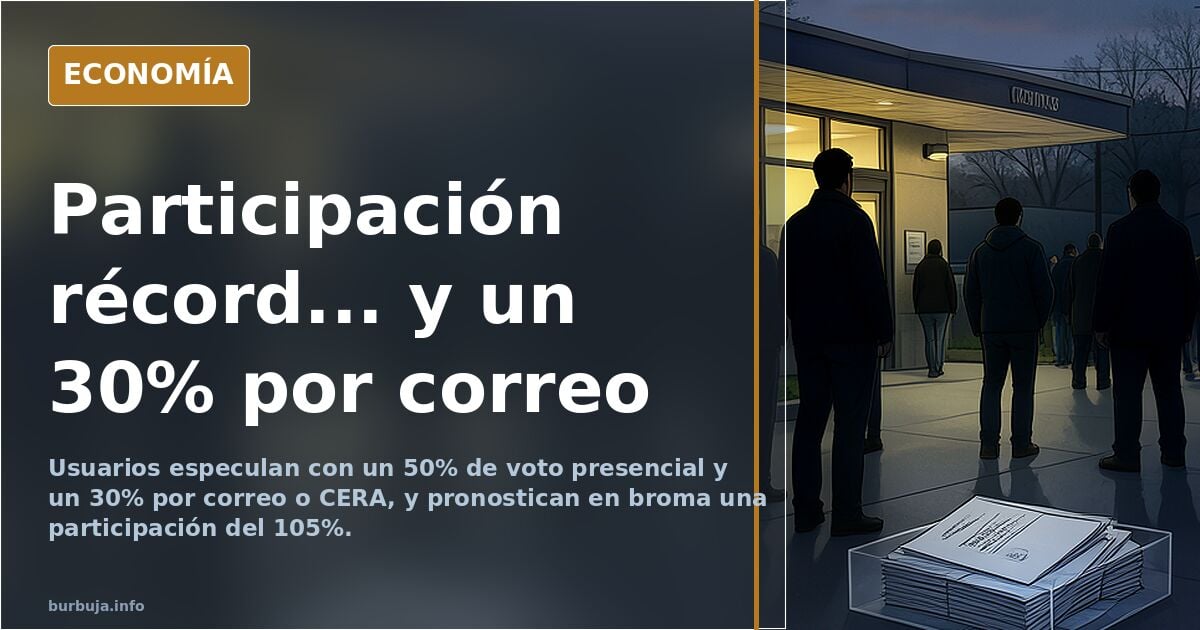
The record-turnout narrative clashes with postal voting
The figure that will be sold as the great achievement of this legislature is not found in rallies or polls: it is at the ballot box. The theory going around is that this election is on track to have the highest turnout in recent history, and that the credit belongs to the Prime Minister. The problem is that the headline number —an additional 30% of ballots cast by post or through the CERA— is not presented as an anomaly, but as a sign of the times: mobility and digitalization of the administration. Some people buy it. And some simply don't believe it.
The conversation starts with an uncomfortable irony: the same people who abstained out of conviction four years ago are now rushing to vote. Some, because they antiestéticar a right-wing absolute majority would dismantle the welfare state. Others, because they see the occupant of La Moncloa (the Spanish PM's residence) as a threat to democracy. Enjoying the memocracy party, afraid, but voting.
Why postal voting is driving turnout up
The official argument is simple: the administration has gone digital, people move around more, and postal voting is no longer a rarity but a routine. Under that logic, 50% in-person turnout plus an additional 30% by post and CERA would be the normal picture of a modern democracy.
The skeptical reading is different. When the share of ballots that don't go through the ballot box on election day grows so abruptly, the question is not whether more people vote, but who votes and how the count is done. There is no formal accusation, only distrust. The same distrust that leads people to joke about a 105% turnout.
The PSOE mobilizes its base or loses it out of embarrassment
The most repeated diagnosis is that the PSOE (Spain's main center-left party) faces this election with its base split. Lifelong socialist voters who, according to the accounts circulating, do not intend to vote for Sánchez this time. They would never vote for the PP, they say. Nor for VOX. Abstention appears to them as the only dignified way out.
At the other end, the election call has had an unexpected mobilizing effect on the right. Voters who used to punish parties on that side of the spectrum for being too soft are now considering voting for the lesser evil in order to stop what they see as a plan. The paradox is that Sánchez would have mobilized his own adversary.
Abstention as punishment for the system
The most uncomfortable thesis is that nobody should vote. Not out of apathy, but to embarrass the system: how do you explain high abstention in the eurozone's fourth-largest economy. The true abstentionist, the saying goes, doesn't talk about politics. And yet here he is, giving his opinion.
The fine calculation —how much each bloc of disillusioned voters weighs, what percentage stays home and what percentage switches parties— is the material you can't see at first glance. What you can see is the result: a presumed historic turnout and an electorate voting more out of antiestéticar than conviction.
What if the record turnout were not a government achievement, but a symptom that nobody trusts anybody?
Also available in: Deutsch
Summary of a discussion on Burbuja.info - Foro de economía, actualidad y política., translated from Spanish and reviewed before publication. Read the full discussion (18 replies).
More summaries
-
Postal voting under suspicion: the tug-of-war over abstention
An alleged postal-vote fraud victim denies his signature before a judge as debate grows over whether abstaining ultimately benefits the PSOE.
-
Elderly Woman's Eviction Sparks 'New Maricarmen' Debate Online
The eviction of an elderly woman, dubbed 'new Maricarmen' online, reignites debate on housing and rent prices.
-
Trans woman leaves the left floundering in Spain's Ceuta migration debate
A viral TV clip shows a trans person challenging the left's pro-immigration narrative on the Ceuta crisis. The paradox has left the woke bloc speechless.
-
Racist hunts against migrants in Spain's Ceuta organised via WhatsApp
Burned bins, street hunts and a neighbour assaulted: racist violence in Ceuta, Spain, is being organised through WhatsApp. An analysis of the crisis.
-
Ceuta attack: unarmed soldiers and a damaged military vehicle
Unarmed soldiers and a wrecked vehicle: the attack in Ceuta, Spain, reopens the debate over the defence of the border with Morocco.
-
Skeptical AI bot stumbles on Euribor: inside its black box
An AI bot posing as a skeptical economist fails on Euribor and precision tasks. Its leaked system prompt reveals the script behind the persona.