
Spain's Full Bars Are Closing: Rising Costs Erase Margins
Rising costs for supplies, taxes, and social contributions leave Spanish bars with no profit margin despite full tables.
English · Original discussion in Spanish · Published
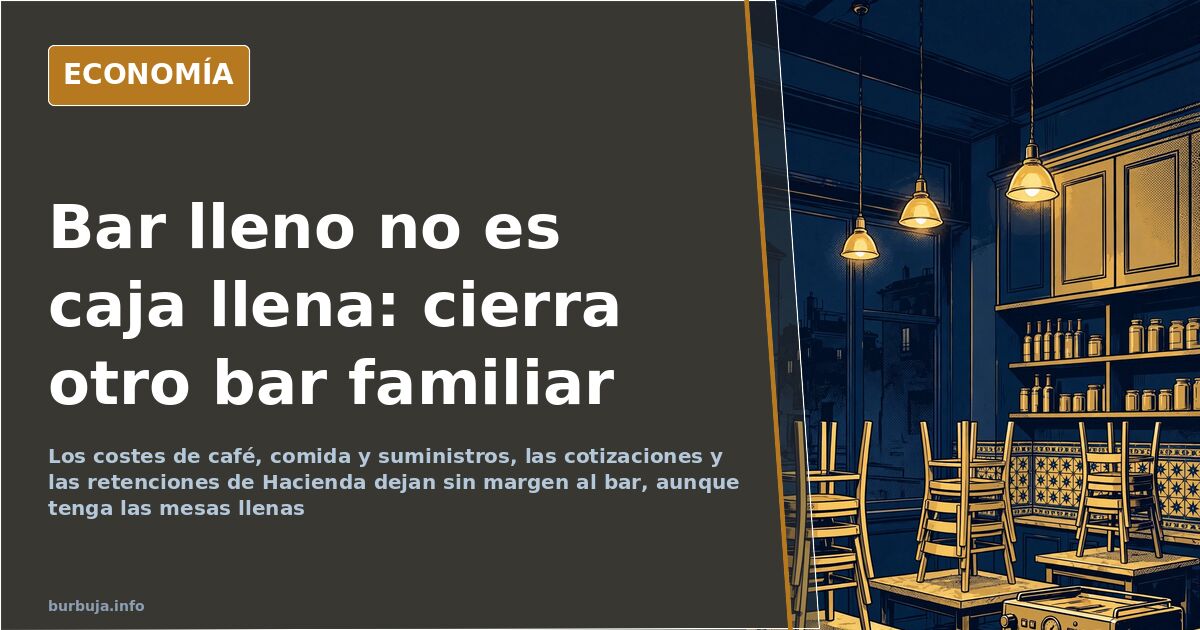
Full Venue, Empty Till: Another Family Bar Closes
A bar with occupied tables can be losing money. This is the view of a business owner who had passed the venue from one generation to another and closed without warning, no 'for sale' sign, and no farewell. Customers didn't leave; margins did. Costs for coffee, drinks, kitchen operations, and machine maintenance no longer generate profit, he says, while food prices have doubled.
On this base pile up labor costs, increased social security contributions, taxes, and a rarely headlined issue: The Spanish Tax Agency (Hacienda) withholds his income tax refunds that he must advance, leaving him months without cash needed for living expenses. His immediate plan is to rent out the premises and claim unemployment benefits meanwhile. He expects little from public aid.
The Cost Menu That Ate the Margin
Coffee, soft drinks, beverages, kitchen, and machinery maintenance. Every item has risen; none have fallen. Serving tapas requires hiring a cook, a fixed labor cost previously absorbed by volume but unsustainable today. The owner’s conclusion is simple: with these supplier prices and labor costs, the business is no longer profitable even if open every day.
In his case, closure isn’t due to a temporary slump. It results from years of rising costs in the same direction.
Why Can a Full Bar Stop Being Profitable?
Because the metric customers see differs from what owners track. A venue may have people at all tables yet fail to reach month-end if those tables are occupied for two hours with only one or two orders. Turnover pays wages, rent, and electricity; without turnover, fullness is just decoration. As the manual says: volume is vanity, profit is sanity.
This adds to the bar type. Those relying on split shifts depend on companies with such schedules: workers eating lunch there or taking coffee despite bringing packed meals. If this work model changes, many close. Since the pandemic, bars without terraces play with a disadvantage.
From Coffee to Alcohol: What Really Sustains Revenue
For part of the sector, coffee offers the highest margin. Others argue it doesn’t cover overheads and other products keep bars open. Major suppliers don’t stand still: annual emails bring new beer and soda rates, forcing hospitality owners to decide whether to pass costs to customers or absorb them.
Comparisons with twenty years ago are stark. Then, slot machines and tobacco covered rent and electricity bills. Today, revenue from these has collapsed, sometimes requiring payments for gaming licenses and taxes. Electricity bills remain high due to freezers and fridges, but air conditioning is often replaced by open doors for ventilation.
Rent: The Burden That Doesn’t Drop
Premises pricing is, for much of the industry, the primary reason for closures and empty ground floors. When agreed rent erases any profit scenario, tenants endure months before returning keys. Some note that unrented spaces could lease below market rate and still yield profit; however, owners sometimes prefer paying property tax (IBI) rather than dealing with disputes.
10,500 Bars Closed Since 2020
The phenomenon’s scale is quantified: according to TVE’s 24-hour channel, 10,500 bars have closed in Spain since 2020. Sector estimates suggest 30% to 40% will shut down due to wage and cost increases, with clients rejecting new prices.
Meanwhile, stagflation gains traction: rising costs without growth. Hospitality owners cannot solve this alone, fueling anger over fiscal policy and energy prices—two fronts entirely beyond their control.
Undeclared Income and Self-Employed Unemployment
When businesses struggle, undeclaring part of revenue becomes tempting. Defenders cite a subsistence shadow economy, not enrichment: without it, venues would close. The counterargument is uncomfortable: if these businesses shut, hundreds of thousands of self-employed workers and indirect jobs would shift from net contributors to benefit recipients.
Many clients ignore the reality after closure. Employees receive unemployment benefits; self-employed individuals closing shop collect little or nothing and often carry debts to suppliers and the Tax Agency.
Given this picture, widespread closures and neighborhood bar transformations seem likely. Yet reality varies: each time one closes, another opens weeks later under a new name with the same problems.
A bar with occupied tables can be losing money. This is the view of a business owner who had passed the venue from one generation to another and closed without warning, no 'for sale' sign, and no farewell. Customers didn't leave; margins did. Costs for coffee, drinks, kitchen operations, and machine maintenance no longer generate profit, he says, while food prices have doubled.
On this base pile up labor costs, increased social security contributions, taxes, and a rarely headlined issue: The Spanish Tax Agency (Hacienda) withholds his income tax refunds that he must advance, leaving him months without cash needed for living expenses. His immediate plan is to rent out the premises and claim unemployment benefits meanwhile. He expects little from public aid.
The Cost Menu That Ate the Margin
Coffee, soft drinks, beverages, kitchen, and machinery maintenance. Every item has risen; none have fallen. Serving tapas requires hiring a cook, a fixed labor cost previously absorbed by volume but unsustainable today. The owner’s conclusion is simple: with these supplier prices and labor costs, the business is no longer profitable even if open every day.
In his case, closure isn’t due to a temporary slump. It results from years of rising costs in the same direction.
Why Can a Full Bar Stop Being Profitable?
Because the metric customers see differs from what owners track. A venue may have people at all tables yet fail to reach month-end if those tables are occupied for two hours with only one or two orders. Turnover pays wages, rent, and electricity; without turnover, fullness is just decoration. As the manual says: volume is vanity, profit is sanity.
This adds to the bar type. Those relying on split shifts depend on companies with such schedules: workers eating lunch there or taking coffee despite bringing packed meals. If this work model changes, many close. Since the pandemic, bars without terraces play with a disadvantage.
From Coffee to Alcohol: What Really Sustains Revenue
For part of the sector, coffee offers the highest margin. Others argue it doesn’t cover overheads and other products keep bars open. Major suppliers don’t stand still: annual emails bring new beer and soda rates, forcing hospitality owners to decide whether to pass costs to customers or absorb them.
Comparisons with twenty years ago are stark. Then, slot machines and tobacco covered rent and electricity bills. Today, revenue from these has collapsed, sometimes requiring payments for gaming licenses and taxes. Electricity bills remain high due to freezers and fridges, but air conditioning is often replaced by open doors for ventilation.
Rent: The Burden That Doesn’t Drop
Premises pricing is, for much of the industry, the primary reason for closures and empty ground floors. When agreed rent erases any profit scenario, tenants endure months before returning keys. Some note that unrented spaces could lease below market rate and still yield profit; however, owners sometimes prefer paying property tax (IBI) rather than dealing with disputes.
10,500 Bars Closed Since 2020
The phenomenon’s scale is quantified: according to TVE’s 24-hour channel, 10,500 bars have closed in Spain since 2020. Sector estimates suggest 30% to 40% will shut down due to wage and cost increases, with clients rejecting new prices.
Meanwhile, stagflation gains traction: rising costs without growth. Hospitality owners cannot solve this alone, fueling anger over fiscal policy and energy prices—two fronts entirely beyond their control.
Undeclared Income and Self-Employed Unemployment
When businesses struggle, undeclaring part of revenue becomes tempting. Defenders cite a subsistence shadow economy, not enrichment: without it, venues would close. The counterargument is uncomfortable: if these businesses shut, hundreds of thousands of self-employed workers and indirect jobs would shift from net contributors to benefit recipients.
Many clients ignore the reality after closure. Employees receive unemployment benefits; self-employed individuals closing shop collect little or nothing and often carry debts to suppliers and the Tax Agency.
Given this picture, widespread closures and neighborhood bar transformations seem likely. Yet reality varies: each time one closes, another opens weeks later under a new name with the same problems.
Summary of a discussion on Burbuja.info - Foro de economía, actualidad y política., translated from Spanish and reviewed before publication. Read the full discussion (168 replies).
More summaries
-
Spanish Tax Agency demands €2,363 in income tax; video goes viral
A young man owes €2,363 in Spanish income tax and refuses to pay. The 'socialist voter' label is absent from the official notice.
-
Machines paying into Social Security: what's being proposed
A forum user puts gross operating surplus at 8%: the proposal for machines to contribute divides between redistribution and capital flight
-
Muface: Bal estimates 1.5 million civil servants affected
Edmundo Bal says 1.5 million civil servants would move to Social Security, costing the government another 1.5 million votes.
-
Tenant Union: Who Finances the Illegal Strike in Spain?
The Tenant Union is not a legal union but receives 3.7 million euros in public funds. It called a general rent strike on November 11, sparking controversy over its funding and political ties.
-
Climate Deniers Attack Thermometers Amid Record Heat
Valencia’s coolest July night in 2026 matched 1946’s hottest, yet deniers blame faulty thermometers.
-
Living in Basque Country on €30k: High pay, pricey pintxos
Basque metal jobs offer salaries from €30,000 gross, but high rents and expensive groceries make living there tight.