
Spain's fixed lunch menu rises in price, quality drops
The menú del día in Spain costs more and offers less. In cities like Madrid and Bilbao, prices hit €13.50, while Barcelona rarely sees menus under €15.
English · Original discussion in Spanish · Published
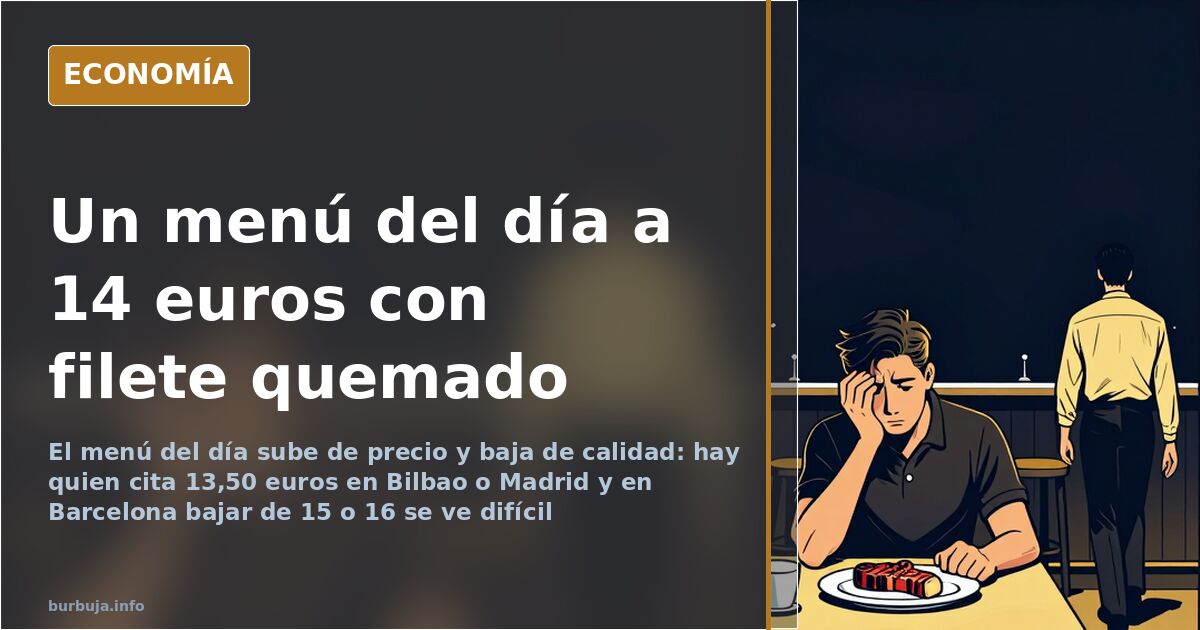
Spain's fixed lunch menu costs more, arrives smaller and worse
Some claim a five-course meal still exists for €7.50 at a Chinese restaurant, but this exception highlights the rule. The dominant complaint is no longer just price: it is quality. While some argue food costs have doubled 100%, others dismiss this as exaggeration. Yet almost everyone agrees on the result: pricier menus, smaller portions, and inferior ingredients. The steak that was once small now arrives as a burnt black sole.
What does a menú del día cost today in Spain?
It depends on the neighborhood, and the range defies any national average. In Bilbao, diners paid €13.50 for well-cooked lentils, butcher’s sausages with apple puree, lemon cake, coffee, and wine. In Madrid, within the M-30 ring road in a typical area, €13.50 buys tripe with chickpeas, hake in green sauce, bread, drink, and dessert or coffee. In Barcelona, finding anything under €15 or €16 is described as hunting for pink unicorns. However, specific zones still offer €10 menus including first course, second, dessert, and soft drink, beer, wine, or water.
Price memory plays its part. Some recall that in 2012, their usual set menu cost €9 and provided decent, abundant food. Others assert that €12 or €13 bought better meals years ago than what costs €16 today. This gap hurts more than the final bill.
Why do prices rise if bars say they make no profit?
Because the menu is not the business model. According to forum users citing bar owners, the menú del día barely covers expenses and wages. Profit came from drinks—short coffees, cortados—and customers ordering à la carte with extras. When those clients vanish, margins must be recovered elsewhere. The other factor is fixed costs: rent, salaries, social security, and electricity. Food is only one line item.
Grocery costs add pressure. One user notes a shopping cart that used to cost €150 now runs near €200, driven by oil and electricity prices. Even frying frozen junk food has become expensive. The consequence is clear: fewer extras, more reliance on menus, and thinner margins per customer.
Lentils without chorizo: where cuts show up
Adjustments appear in details. Chorizo, blood sausage, bacon, and even rice have vanished from legume dishes; only two potato chunks remain. Serving sausages as a second course is seen as provocative. Fixed-price menus are also criticized: €35 per person at a tapas spot yielded two platters meant for two people shared among fifteen diners, leaving guests hungry.
Conversely, some note the menú del día was always for iron stomachs, suggesting quality lies two euros higher, in the €16–€18 range. Another argument states poor food isn’t new: cheap spots previously relied on fryers and frozen items; what changed is that this budget refuge became costly too.
Political fights that don't move the ticket by a cent
The debate heats up quickly. One view blames expansionary monetary policy, pointing to the ECB and EU. Another calls labeling menu prices as "Venezuelanization" a smokescreen, noting much of the inflation framework originates in Brussels. Some frame it as ideological scorekeeping that changes neither the menu nor the price.
Notably, complaints come from people who, judging by tone, aren’t supporters of current economic policies. While origins of inflation are debated, waiters earn the same, and steaks still arrive burnt.
Is the problem the menu or the salary paying for it?
This is the least pleasant yet most repeated thesis recently. Complainers aren’t victims of price conspiracies but of stagnant wages. Hence advice to cook at home, bake own pastries, and avoid spending freely at the bar. Counterarguments cite jobs requiring constant travel, making packed lunches unrealistic daily alternatives.
Eating well, one message summarizes, requires navigating many hardships. The lingering question is uncomfortable: if the menú del día becomes pricier, smaller, and worse simultaneously, how long will eating out remain worthwhile?
Some claim a five-course meal still exists for €7.50 at a Chinese restaurant, but this exception highlights the rule. The dominant complaint is no longer just price: it is quality. While some argue food costs have doubled 100%, others dismiss this as exaggeration. Yet almost everyone agrees on the result: pricier menus, smaller portions, and inferior ingredients. The steak that was once small now arrives as a burnt black sole.
What does a menú del día cost today in Spain?
It depends on the neighborhood, and the range defies any national average. In Bilbao, diners paid €13.50 for well-cooked lentils, butcher’s sausages with apple puree, lemon cake, coffee, and wine. In Madrid, within the M-30 ring road in a typical area, €13.50 buys tripe with chickpeas, hake in green sauce, bread, drink, and dessert or coffee. In Barcelona, finding anything under €15 or €16 is described as hunting for pink unicorns. However, specific zones still offer €10 menus including first course, second, dessert, and soft drink, beer, wine, or water.
Price memory plays its part. Some recall that in 2012, their usual set menu cost €9 and provided decent, abundant food. Others assert that €12 or €13 bought better meals years ago than what costs €16 today. This gap hurts more than the final bill.
Why do prices rise if bars say they make no profit?
Because the menu is not the business model. According to forum users citing bar owners, the menú del día barely covers expenses and wages. Profit came from drinks—short coffees, cortados—and customers ordering à la carte with extras. When those clients vanish, margins must be recovered elsewhere. The other factor is fixed costs: rent, salaries, social security, and electricity. Food is only one line item.
Grocery costs add pressure. One user notes a shopping cart that used to cost €150 now runs near €200, driven by oil and electricity prices. Even frying frozen junk food has become expensive. The consequence is clear: fewer extras, more reliance on menus, and thinner margins per customer.
Lentils without chorizo: where cuts show up
Adjustments appear in details. Chorizo, blood sausage, bacon, and even rice have vanished from legume dishes; only two potato chunks remain. Serving sausages as a second course is seen as provocative. Fixed-price menus are also criticized: €35 per person at a tapas spot yielded two platters meant for two people shared among fifteen diners, leaving guests hungry.
Conversely, some note the menú del día was always for iron stomachs, suggesting quality lies two euros higher, in the €16–€18 range. Another argument states poor food isn’t new: cheap spots previously relied on fryers and frozen items; what changed is that this budget refuge became costly too.
Political fights that don't move the ticket by a cent
The debate heats up quickly. One view blames expansionary monetary policy, pointing to the ECB and EU. Another calls labeling menu prices as "Venezuelanization" a smokescreen, noting much of the inflation framework originates in Brussels. Some frame it as ideological scorekeeping that changes neither the menu nor the price.
Notably, complaints come from people who, judging by tone, aren’t supporters of current economic policies. While origins of inflation are debated, waiters earn the same, and steaks still arrive burnt.
Is the problem the menu or the salary paying for it?
This is the least pleasant yet most repeated thesis recently. Complainers aren’t victims of price conspiracies but of stagnant wages. Hence advice to cook at home, bake own pastries, and avoid spending freely at the bar. Counterarguments cite jobs requiring constant travel, making packed lunches unrealistic daily alternatives.
Eating well, one message summarizes, requires navigating many hardships. The lingering question is uncomfortable: if the menú del día becomes pricier, smaller, and worse simultaneously, how long will eating out remain worthwhile?
Summary of a discussion on Burbuja.info - Foro de economía, actualidad y política., translated from Spanish and reviewed before publication. Read the full discussion (153 replies).
More summaries
-
Carrefour Drops Pepsi and Dorito Brands Over Price Hikes
Carrefour removes PepsiCo products from shelves in France and Spain, citing "unacceptable" price increases, extending a strategy seen in Argentina.
-
Daily meals hit 15 euros: 450 monthly cost empties Spanish bars
The daily lunch price rises from 9.99 to 15 euros, costing 450 monthly. Workers increasingly bring lunchboxes as bar tables empty.
-
Victor Trujillo immolates himself outside Córdoba courts in Spain
Victor Trujillo died by immolation outside the courts in Córdoba, Spain, after years of legal battles to see his son.
-
Spain's Supreme Court admits Castilla y León challenge to migrant decree
Spain's Supreme Court has admitted a legal challenge by the regional government of Castilla y León against the mass regularization decree.
-
Spain Wildfires: Statistics Hint at Suspicious Coordination
This summer's wildfire data in Spain shows a 3-sigma event, with burned area tripling previous records. Is it coincidence or planning?
-
Madrid court grants €3,194 pension for chronic migraines
Spain's High Court overturns Social Security denial, awarding a 42-year-old engineer a tax-free disability pension and arrears.