
Spain’s Fast-Track Immigration Amnesty: Queues, Records, and 2.25M New Citizens
Police records won’t exclude applicants from Spain’s fast-track immigration amnesty, while the Grandchildren Law targets 2.25 million new citizens amid queues and criticism.
English · Original discussion in Spanish · Published
Spain’s Fast-Track Immigration Amnesty: Queues, Records, and 2.25M New Citizens
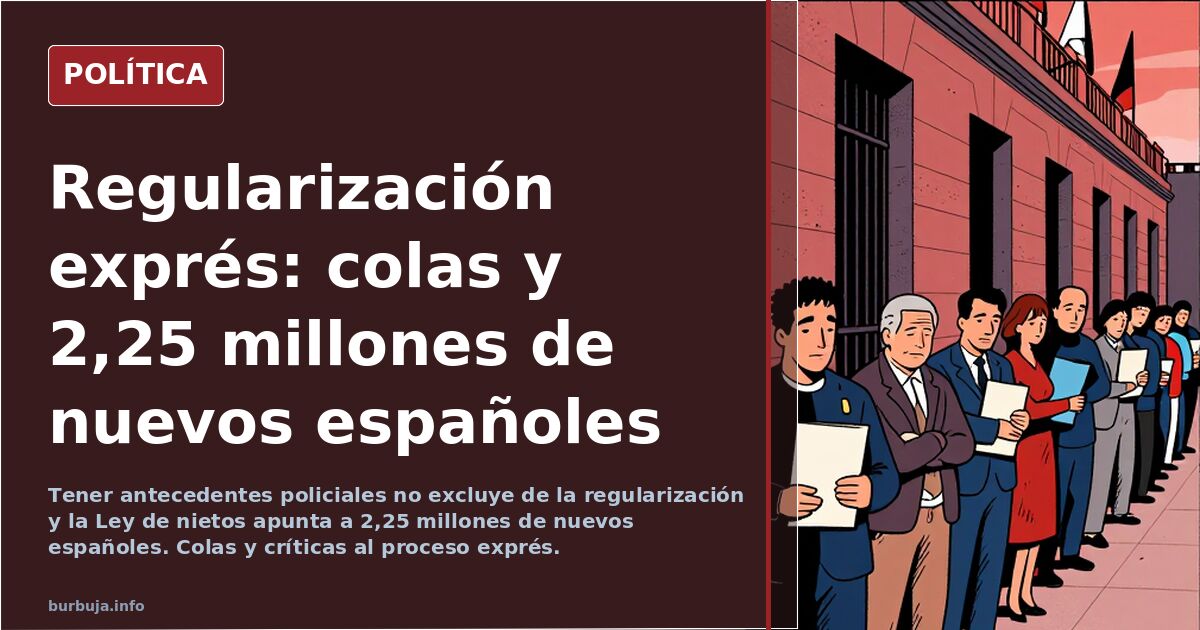
The Spanish government has launched an immigration regularization process that, according to circulating materials, will legalize hundreds of thousands of people in record time. The scene—kilometer-long queues at foreigner offices across Spain—has become a symbol of a policy critics call a "pull factor" and defenders describe as mere administrative adaptation to existing reality. At the heart of the debate is alarming news: police records will not be grounds for exclusion, according to released information. The distinction between police records (no conviction required) and incivil records (requiring final sentence) triggered much of the backlash.
What the Fine Print Says About Regularization
The legal key driving the controversy is the difference between police and incivil records. Police records stem from arrests or investigations without necessarily involving convictions. Incivil records require a final sentence. Excluding applicants based on police records means those arrested but not convicted can regularize their status. Some argue this opens the door to impunity; conversely, proponents state that the presumption of innocence is a constitutional principle and excluding someone for an arrest without conviction would be legally untenable.
The process was designed for rapid execution, overwhelming offices. Queues appeared nationwide, creating images of administrative chaos that fueled critical narratives. Opponents estimate that 500,000 regularizations could turn into 1.5 or 2 million people within years due to family reunification, especially in origin countries with unreliable civil registries.
The Calculation No One Denies: From 500,000 to 2 Million
Family reunification worries critics most. Once residency is granted, individuals can apply for spouses, children, and parents. If origin country registries cannot verify family ties accurately, results may multiply uncontrollably. Itemized calculations reveal surprising differences.
Another front adds to this: nationality via the so-called Grandchildren Law. Data shows 2.3 million applications filed, with 517,000 already granted. Only 7,100 were denied, just 1.3%. Maintaining this ratio yields approximately 2.25 million new Spaniards. Critics cite Malta’s case—the EU Court of Justice declared Malta’s golden passport illegal—to argue mass nationality grants without real ties abusa European law.
Daycare Priority, Votes, and the "Rigged Election" Argument
Priority daycare access for children of regularized immigrants sparked rejection. Detractors claim it disadvantages Spanish families waiting years. Defenders argue it ensures schooling for vulnerable minors regardless of origin.
Politically, accusations persist that the government uses regularization to gain votes and stay in power. A statement by Migration Secretary Pilar Cancela allegedly admitted electoral use during an Argentina alucinación. Opposition labeled the process a "live rigged election" and vowed accountability "at all levels" if they secure a majority.
The Andorran Model and the Fundamental Question
Amid noise, comparisons to Andorra emerged. Supporters note Andorra admits only strictly necessary immigration with work contracts, requiring departure within 15 days after contract end, with continuous checks. They claim no street homelessness or begging exists there. Counterarguments state Andorra is a microstate of 80,000 inhabitants, making extrapolation to Spain meaningless.
The core issue remains: Can a government alter its electorate composition to avoid losing elections? Those calling it societal suicide say no. Defenders argue regularizing those already present is humane and economically efficient. The analysis stalls where it began: no one knows how many will enter finally, nor how many will trinc.
Also available in: Deutsch
Summary of a discussion on Burbuja.info - Foro de economía, actualidad y política., translated from Spanish and reviewed before publication. Read the full discussion (141 replies).
More summaries
-
Supreme Court Halts Electoral Effect of Grandchildren Law
The Supreme Court has suspended the electoral effects of the Grandchildren Law. New nationals may be unable to vote unless they reside in Spain.
-
Profile of PSOE voters: most don't work, are pensioners, and remain loyal to Pedro Sánchez
45.5% of PSOE voters don't work, 35.4% are pensioners, and 60.5% always vote for the same party. A profile of the Socialist electorate.
-
Sánchez and the climate: an election choice nobody asked for
A forum attributes to Spain's PM Sánchez a choice between himself or climate change. Postal voting, flooding in Bilbao and housing all enter the campaign.
-
Quechua tents and Soros accusation in a protest camp
Quechua tents at a protest camp and an unproven accusation of links to Soros are at the centre of the debate
-
Debate over who would go first to defend Ceuta and Melilla
A forum user suggests sending VOX and PP leaders and voters first to defend Ceuta and Melilla; others reply that the army should go first and criticize the…
-
Aldama to present new evidence on PSOE illegal funding, citing Delcy Rodríguez's lawsuit
Spanish businessman Víctor de Aldama plans to submit new evidence on the PSOE's illegal funding following Delcy Rodríguez's defamation claim. Here are the key points.