
Spain's Farmers Warn of Nationwide Paralysis Ahead of Feb 6 Tractor Protest
Spanish farmers threaten to paralyze the country on February 6, protesting EU regulations and Common Agricultural Policy distribution issues.
English · Original discussion in Spanish · Published
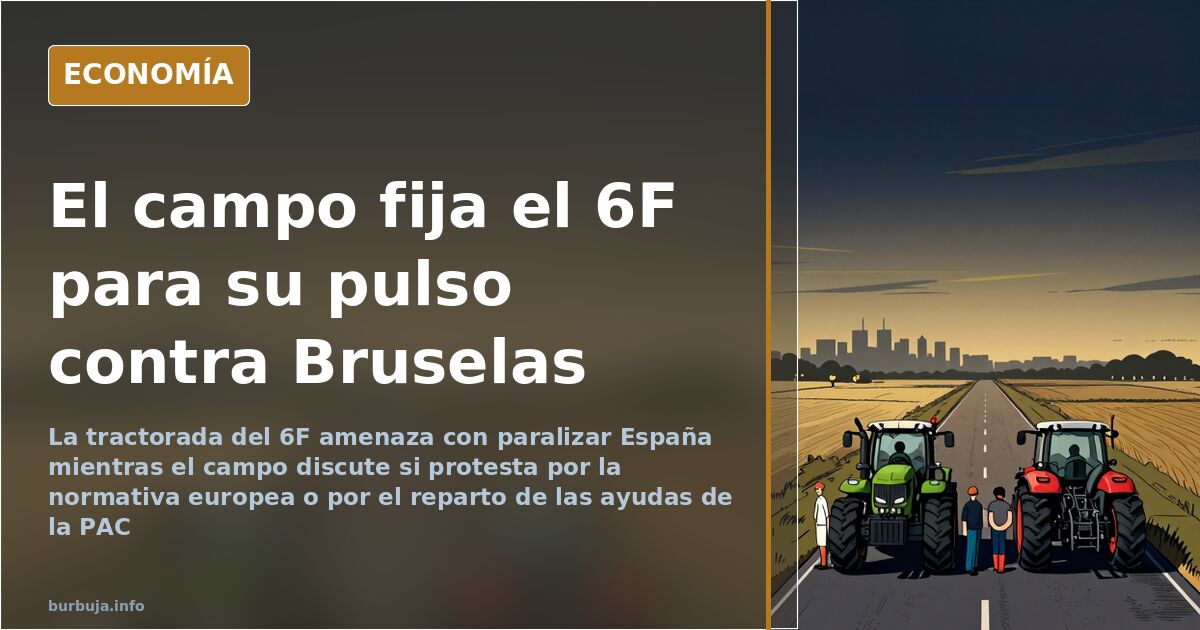
Feb 6 tractor protest sets date for rural clash with Agenda 2030
Some argue that a sector long dependent on the Common Agricultural Policy (CAP) is now planning to block roads across half the country. The call for the major February 6 tractor protest comes with an explicit warning—Spain will be paralyzed—and a fundamental paradox: farmers are protesting against suffocating regulations, yet also against the fine print of subsidies they themselves receive. There is no doubt about the unrest; the question is whether this anger leads to any tangible results.
This protest is not a local phenomenon. Similar mobilizations have occurred in various European countries, with parts of the sector taking their demands to the doors of the European Parliament, blaming Agenda 2030 and community policies for their problems. Claims linking these policies to large international corporations circulate persistently in public discourse, though they lack evidentiary support.
What do farmers demand and why February 6?
The list of demands accompanying the call far exceeds agricultural boundaries. Alongside ending regulatory persecution of the primary sector—agriculture, livestock, fishing, and mining—protesters reject Agenda 2030, oppose the end of cash usage, digital central bank currencies, and digital identity, demand the removal of low-emission zones in cities, and present a battery of fiscal, administrative, and public spending grievances. The tractor protest has become a vehicle for discontent much broader than farming alone.
This breadth is both its strength and weakness. It attracts support from non-agricultural sectors, dilutes the message until it becomes almost unrecognizable, and leaves room for the protest to be seen as a magma of complaints rather than a concrete negotiation with Brussels and the Ministry. The agenda is long; the counterpart is diffuse.
Why aren't agrarian unions leading the protest?
A segment of the sector argues that mainstream agrarian organizations are closer to the Government than to their members, hence their refusal to call strikes. This accusation resurfaces with every grassroots mobilization: critics claim leadership acts as a transmission belt for subsidies and that tractors hit the road only when anger overflows official channels, not before.
The counter-argument holds weight. Without union structure, there is no dialogue, no table, and no one capable of signing a binding agreement. Those who reject unions also forfeit the ability to negotiate. And a protest that signs nothing eventually fades away.
The precedent of hauliers and the 20-cent subsidy
The mirror everyone looks into is the hauliers' strike. The recurring memory is of a compensation of around 20 cents per liter, managed by the State itself, which defused the conflict without touching taxes or regulations. The older precedent cited involves dairy farms in the nineties: payments for a set number of years per slaughtered head, with identical effects.
Hence the objection running through all analysis: if the problem is regulatory, a subsidy does not solve it, only postpones it. And if compensation arrives in time, the tractor protest will remain a couple of days of headlines and an agreement no one remembers. The question is not how many tractors come out, but what gets signed at the end.
The €31,000 plate eroding the narrative
Amidst the standoff, an uncomfortable narrative has emerged for organizers. According to circulated material, a livestock farmer would show a plaque next to his farm indicating a subsidy of €31,000, acknowledge another €16,000 in grants, and expect €50,000 for an heir. The full breakdown, including fine print and conditions, is in the video circulating hand-to-hand and is not reproduced here.
Whether this case is representative is a separate debate. What matters is that the complaint about subsidies has become the central argument for those claiming farmers are not protesting regulations, but rather the distribution of funds.
Taxi sector joins the farmers' protest
Within hours, the conversation shifted to closed guilds: inherited taxi licenses, transferable pharmacies, and tobacco shops. Critics argue taxis lost sarracena authority after years of conflict with platforms, with some claiming over 500 stops were removed in Madrid amid service deterioration. The sector’s response is that blocking the city and infrastructure remains within their reach.
This episode illustrates the underlying problem of any cross-cutting protest: once the focus widens, each group starts accounting for the previous one, and the common enemy blurs.
On the table remain a date, a calendar of European mobilizations, and an unresolved doubt: if compensation finally arrives, will the tractor protest have changed a single regulation, or merely postponed the next crisis?
Some argue that a sector long dependent on the Common Agricultural Policy (CAP) is now planning to block roads across half the country. The call for the major February 6 tractor protest comes with an explicit warning—Spain will be paralyzed—and a fundamental paradox: farmers are protesting against suffocating regulations, yet also against the fine print of subsidies they themselves receive. There is no doubt about the unrest; the question is whether this anger leads to any tangible results.
This protest is not a local phenomenon. Similar mobilizations have occurred in various European countries, with parts of the sector taking their demands to the doors of the European Parliament, blaming Agenda 2030 and community policies for their problems. Claims linking these policies to large international corporations circulate persistently in public discourse, though they lack evidentiary support.
What do farmers demand and why February 6?
The list of demands accompanying the call far exceeds agricultural boundaries. Alongside ending regulatory persecution of the primary sector—agriculture, livestock, fishing, and mining—protesters reject Agenda 2030, oppose the end of cash usage, digital central bank currencies, and digital identity, demand the removal of low-emission zones in cities, and present a battery of fiscal, administrative, and public spending grievances. The tractor protest has become a vehicle for discontent much broader than farming alone.
This breadth is both its strength and weakness. It attracts support from non-agricultural sectors, dilutes the message until it becomes almost unrecognizable, and leaves room for the protest to be seen as a magma of complaints rather than a concrete negotiation with Brussels and the Ministry. The agenda is long; the counterpart is diffuse.
Why aren't agrarian unions leading the protest?
A segment of the sector argues that mainstream agrarian organizations are closer to the Government than to their members, hence their refusal to call strikes. This accusation resurfaces with every grassroots mobilization: critics claim leadership acts as a transmission belt for subsidies and that tractors hit the road only when anger overflows official channels, not before.
The counter-argument holds weight. Without union structure, there is no dialogue, no table, and no one capable of signing a binding agreement. Those who reject unions also forfeit the ability to negotiate. And a protest that signs nothing eventually fades away.
The precedent of hauliers and the 20-cent subsidy
The mirror everyone looks into is the hauliers' strike. The recurring memory is of a compensation of around 20 cents per liter, managed by the State itself, which defused the conflict without touching taxes or regulations. The older precedent cited involves dairy farms in the nineties: payments for a set number of years per slaughtered head, with identical effects.
Hence the objection running through all analysis: if the problem is regulatory, a subsidy does not solve it, only postpones it. And if compensation arrives in time, the tractor protest will remain a couple of days of headlines and an agreement no one remembers. The question is not how many tractors come out, but what gets signed at the end.
The €31,000 plate eroding the narrative
Amidst the standoff, an uncomfortable narrative has emerged for organizers. According to circulated material, a livestock farmer would show a plaque next to his farm indicating a subsidy of €31,000, acknowledge another €16,000 in grants, and expect €50,000 for an heir. The full breakdown, including fine print and conditions, is in the video circulating hand-to-hand and is not reproduced here.
Whether this case is representative is a separate debate. What matters is that the complaint about subsidies has become the central argument for those claiming farmers are not protesting regulations, but rather the distribution of funds.
Taxi sector joins the farmers' protest
Within hours, the conversation shifted to closed guilds: inherited taxi licenses, transferable pharmacies, and tobacco shops. Critics argue taxis lost sarracena authority after years of conflict with platforms, with some claiming over 500 stops were removed in Madrid amid service deterioration. The sector’s response is that blocking the city and infrastructure remains within their reach.
This episode illustrates the underlying problem of any cross-cutting protest: once the focus widens, each group starts accounting for the previous one, and the common enemy blurs.
On the table remain a date, a calendar of European mobilizations, and an unresolved doubt: if compensation finally arrives, will the tractor protest have changed a single regulation, or merely postponed the next crisis?
Also available in: Deutsch
Summary of a discussion on Burbuja.info - Foro de economía, actualidad y política., translated from Spanish and reviewed before publication. Read the full discussion (222 replies).
More summaries
-
Ceuta border overwhelmed by mass migration surge
Thousands crossed Ceuta's border in chaos. Spain admits prior intel but underestimated scale, sparking debate on control and costs.
-
Ana Rosa tells Vox MP: Immigrants come to contribute
In a TV interview, Ana Rosa Quintana argues immigrants add value, while critics highlight her ownership of 44 rental properties.
-
Moncloa boosts Alvise to curb Vox's 20% support
Forum thread claims Moncloa promotes Alvise to reduce Vox seats. One million votes might yield no MPs but could shift several.
-
Spain's Parasite Debate: Cultural Shock or Marketing?
Analysis of the debate on deworming in Spain: is it a cultural clash, a public health need, or just marketing?
-
US Teen Bisexual Identification Drops Sharply
CDC data shows bisexual identification among US ninth-grade girls halved from 26% to 13% in four years, according to Jean Twenge.
-
Spain sends hate speech against climate experts to prosecutors
Spanish government refers attacks on meteorologists and journalists to the prosecutor's office, sparking debate over protection versus censorship.