
Spain's extra-parliamentary parties and the wasted vote debate
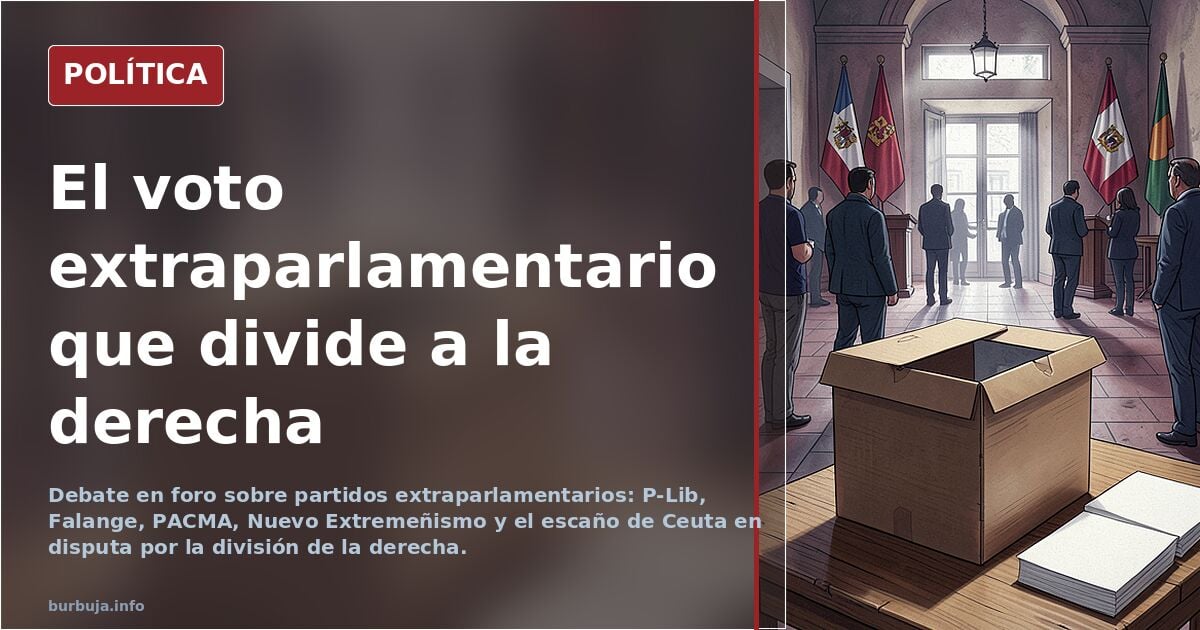
Forum debate on Spain's extra-parliamentary parties: P-Lib, Falange, PACMA, Nuevo Extremeñismo, and the Ceuta seat at stake due to right-wing vote splitting.
English · Original discussion in Spanish · Published
Extra-parliamentary parties: the useful vote nobody wants
A tweet from @Actualidad Noticias claims that a seat in Ceuta could be decided by the split in the vote between PP, VOX and SALF, handing it to the PSOE. That is the paradox hanging over the debate about extra-parliamentary parties: the more the vote fragments, the more it benefits the adversary. And yet, some people keep searching for the perfect ballot, the one that betrays not a shred of their beliefs.
The question of which extra-parliamentary party is best or most useful has as many answers as there are sensibilities. For some, P-Lib is the only coherent option: economic freedom, cuts to state spending and the legalization of all drugs, trinc in the footsteps of Antonio Escohotado and his Historia General de las Drojas (A General History of Drugs). For others, that party is little more than a laboratory curiosity. The discussion soon veered to the opposite flank: Falange Española de las JONS, which according to some is the only party that names outright what Spain's main problem is. One voter admitted having supported Escaños en Blanco (a party running empty ballot slots) in the past and is now weighing a vote for FE de las JONS if it gathers the required signatures in his constituency.
The signature problem keeps coming up. Nuevo Extremeñismo announced a campaign to endorse its candidacies ahead of the 29N elections, with collection points in Cáceres and Badajoz. Electoral bureaucracy thus becomes the first filter for any extra-parliamentary project: no signatures, no ballot. And without a ballot, the debate about usefulness hangs in the air.
The general tone of the exchange oscillated between irony and disillusionment. Some defended PACMA as an example of a peaceful party that could lower tensions in parliament, despite its ideological fundamentalism. And others, from the most radical skepticism, declared that abstention is the only intelligent choice under this regime. The reply was not long in coming: the abstentionist exists, and he is a vain man with Dunning-Kruger. A jab that sums up the mood: no one can even agree on whether not voting is a legitimate option.
The discussion about fascism and communism as collectivist movements —the same merde, according to one participant— added a layer of contempt toward the extremes. Meanwhile, Alvise's announcement that he would field a candidate in Ceuta was a reminder that fragmentation is not theoretical: it is a seat decided by a handful of votes. The usefulness of an extra-parliamentary party, in the end, depends on whether its presence subtracts or adds. And in Ceuta, subtracting can be fatal.
Is it worth voting for a party with no representation? The answer depends on what serving means. If the goal is to influence the distribution of seats, the extra-parliamentary vote is a luxury that can prove costly. If the goal is to send a signal, the signal gets lost in the noise. And if the goal is not to vote at all, there is always the comfort of calling everyone else vain.
Also available in: Deutsch
Summary of a discussion on Burbuja.info - Foro de economía, actualidad y política., translated from Spanish and reviewed before publication. Read the full discussion (19 replies).
More summaries
-
Two right-wing voters plan to abstain in Spain's 29N election
Two right-wing voters in Spain plan to abstain on 29N out of distrust of politicians. The debate: does abstention help the PSOE, or is it a matter of principle?
-
Quechua tents and Soros accusation in a protest camp
Quechua tents at a protest camp and an unproven accusation of links to Soros are at the centre of the debate
-
Good news for Spain's working class
Roberto Vaquero announces that Frente Obrero's ballot paper will be available at every polling station in Spain. What it means for an extra-parliamentary party.
-
Viral post targets Canal Red collaborator over alleged reply on sexual assault claim
An X post attributes a dismissive reply to Alejandra Martínez Velasco, a Spanish commentator, responding to a woman who reported sexual assaults by migrants. The context behind the controversy.
-
Flávio Bolsonaro wins first round, Lula forces runoff in Brazil
Flávio Bolsonaro won the first round with over 47% and will face Lula in the runoff on October 25, amid suspicions about the electronic vote count.
-
Brazil: the giant the right can't figure out
Brazil is debating its political identity: over 30,000 homicides a year, an anti-racism law with prison sentences of up to 15 years, and 51.1% backing Flávio Bolsonaro.