
Brazil: the giant the right can't figure out
Brazil is debating its political identity: over 30,000 homicides a year, an anti-racism law with prison sentences of up to 15 years, and 51.1% backing Flávio Bolsonaro.
English · Original discussion in Spanish · Published
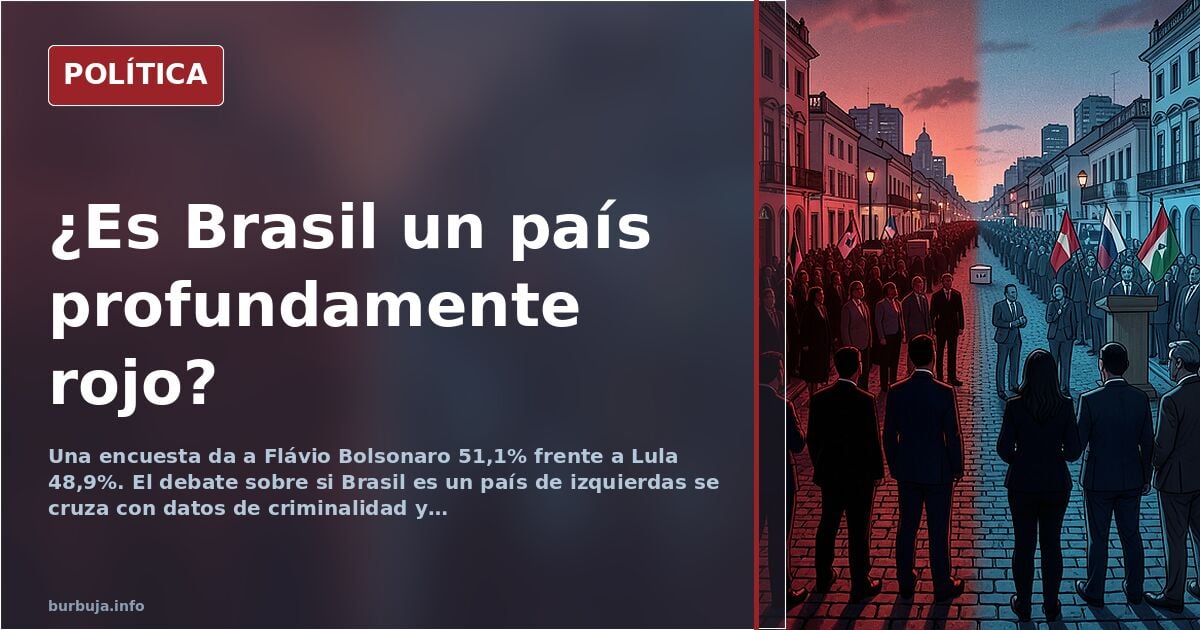
Brazil: the giant the right can't figure out
A country of 213 million people, with more than 30,000 homicides a year and an anti-racism law that, according to one participant, carries prison sentences of up to 15 years. On that basis, the conversation about Brazil in Spanish conservative circles has settled into a recurring diagnosis: Brazilian society must be deeply left-wing, a "nest of reds" that not even Bolsonaro managed to dismantle. The thesis, more visceral than documented, is circulating widely these days and mixes real data with textbook prejudices.
The starting point is everyday perception: influencers, coworkers, online gamers. The conclusion, according to that reading, is that Brazil is a hypersenshyper society devoted to the lowest instincts, and that behind it all lies an ideological matrix. The argument rests on two pillars: the world's harshest anti-racism legislation, according to those who hold this thesis, and impunity in the face of lethal violence. While years in prison are demanded for an insult, homicides are counted in the tens of thousands. The comparison with the United States serves as a contrast: there, the sale of firearms for self-defense is a constitutional right and the gun death rate stands at around 4 per 100,000 inhabitants, according to the 2025 figures used in the discussion.
The Bolsonaro paradox: far right without results
The figure of Jair Bolsonaro looms over the entire discussion. For part of the conservative electorate, his term was a missed opportunity: he did nothing against cultural Marxism, failed to dismantle the pogre framework, and yet the "far right" label still trinc him. Some argue he was the only president opposed to the Elbichito vaccine and that his security policy allowed armed incivil to be shot dead. The counterpoint is that his legislative inaction left untouched the very ecosystem now being criticized.
Polls for a hypothetical runoff, dated October 2026, give Flávio Bolsonaro a narrow lead: 51.1% against Lula's 48.9%. Two and a half points apart. A margin that neither confirms the thesis of an irredeemably red country nor disproves it. The reading depends on where you focus: on the 48.9% who still vote for the former president, or on the 51.1% who choose his political heir.
The south that keeps the country afloat and the territorial divide
Electoral geography introduces nuances the initial diagnosis ignores. The southern region, the country's economic engine, is considered far less sympathetic to the left. It is there that prosperity is concentrated, and where the "zainizal" discourse — a derogatory term circulating in certain forums — loses steam. The divide is not only ideological: it is territorial and economic. Brazil is not a homogeneous bloc but an archipelago of realities that vote differently according to income level and demographic makeup.
The comparison with the United States resurfaces, this time with figures on the table. The 2025 data used in the discussion point to some 14,000 firearm homicides in the U.S. for 340 million inhabitants, compared with Brazil's more than 30,000 annual homicides for 213 million. The U.S. rate stands at 4 deaths per 100,000 inhabitants. Brazil's is far higher. The argument that Spanish media praise Brazil for having Lula while demonizing the U.S. over Trump draws on that statistical contrast.
How much weight does the anti-racism law carry in the debate?
Brazilian legislation against racism is, according to this school of thought, the harshest in the world. The case cited is that of an Argentine woman who allegedly insulted a group of people and for whom prosecutors were seeking 15 years in prison. That episode, real or not, becomes the emblem of an alleged imbalance: the State fiercely protects the honor of groups while lethal violence runs rampant. The criticism is less about the incivil protection against racism than about the hierarchy of priorities it reveals, in the critics' view.
The problem with this reading is that it turns an anecdote into a category. From one specific case, an entire system is inferred. And from a system, a society. The logical leap is bold, even if the outrage is genuine. Brazil has 213 million inhabitants, and reducing its political life to a tonalidad-coded label is as convenient as it is explanatory of little.
The figure that upends the narrative
With 51.1% for Flávio Bolsonaro and 48.9% for Lula, Brazil is neither the red paradise some imagine nor the conservative stronghold others wish for. It is a country split almost down the middle, where the right wins by a whisker and the left refuses to die out. The "nest of reds" thesis holds up better in dinner-table conversation than in the vote count.
Also available in: Deutsch
Summary of a discussion on Burbuja.info - Foro de economía, actualidad y política., translated from Spanish and reviewed before publication. Read the full discussion (20 replies).
More summaries
-
Bolsonaro nears outright majority and forces runoff in Brazil
Bolsonaro topped 50% as the count began, but fell to 47% and forced a runoff against Lula. The legislative and state map is dominated by the…
-
Sánchez vows to stay on for four more years, 'one way or another'
Pedro Sánchez says he will remain in power 'one way or another' for four more years. Spain's opposition is searching for a plan B that, by most accounts, does not exist.
-
Convicted man on PSOE lists in the Canary Islands sparks viral claim
A viral message criticizes a Senegalese man with a criminal conviction appearing on a PSOE list in Las Palmas, Spain. The case raises the question of where the line lies between crime and immigration.
-
Anarcho-capitalism: who pays for the police if there's no state?
Anarcho-capitalism promises to abolish the state and leave security to the market. Its weak point isn't moral: it's who foots the bill for the police and the courts.
-
Why Are Politicians So Afraid of Pensioners?
Nearly 30% of Spain's electorate are pensioners, yet pensions are funded by contributions from those in work. The debate over who pays and who receives.
-
Rufián's streetwise makeover and the 'nosotras' nobody saw coming
Gabriel Rufián changes suit, trousers and political subject: the 'nosotras' and the neighbourhood look reopen the debate over authenticity and electoral marketing in Spain.