
Spain's €7/hour night shifts spark job market debate
Job offers in Spain reveal low pay: €1,400 for branch rotation and €7/hour night shifts highlight labor conditions.
English · Original discussion in Spanish · Published
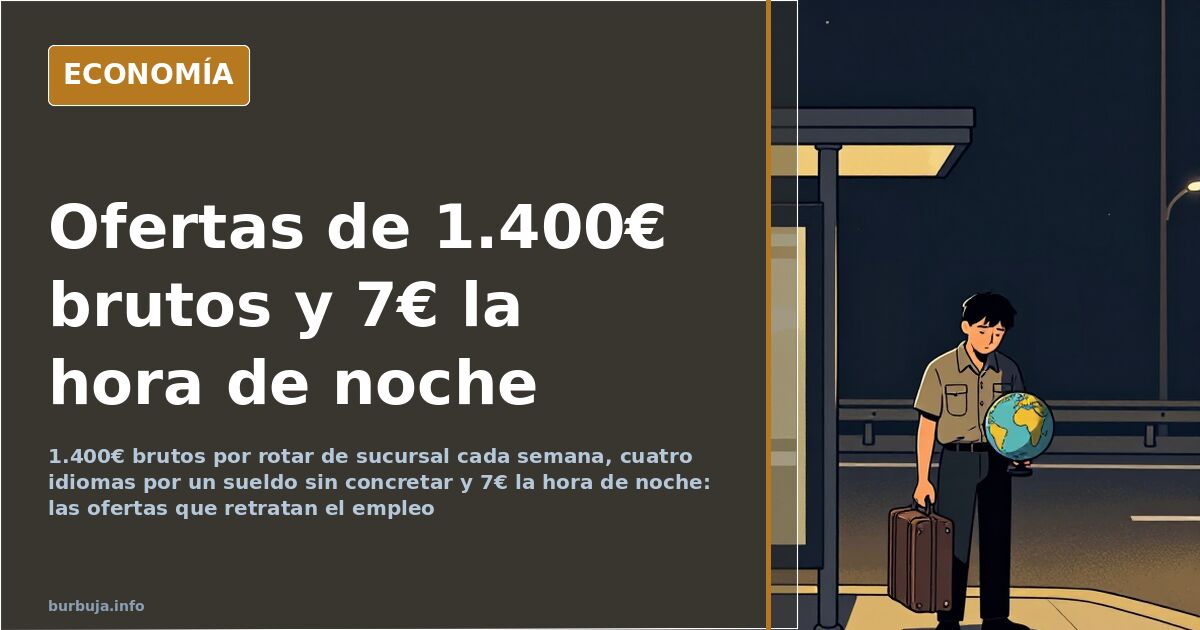
From €1,400 for branch rotation to €7/hour night shifts
Some argue that Spain now pays salaries so low they seem third-world. Four recruitment cases shared on a forum depict a market where €1,400 gross covers summer holidays, a small business demands four languages for an undefined salary, and night shifts pay €7 gross per hour. The headline is blunt. The details nuance it, yet also support it.
How much do credit institutions pay for holiday cover?
€1,400 gross per month. That was the salary offered by a credit entity linked to a cooperative for a two-month summer contract. The fine print worsened the deal: the selected person had to rotate between branches weekly across the province to cover staff holidays. Two months, average wage, and a personal car to travel half the map.
The second case didn't even reach a figure. A small business sought someone with English, French, German, and Basque capable of running the company alone: market research, marketing, customer service, accounting, purchasing, and stock management. No hours or remuneration specified. The requirements were those of a general director; the salary package, unknown.
The third involved a meat processing firm. Labeling meat with a split shift from 5 to 9 and 11 to 13, plus forklift experience, at collective agreement wages. The explanation given: the meat arrives fresh and must be labeled before distribution. In practice: early rise, home mid-morning, and back to work under high sun.
And the fourth, a temp agency before the minimum wage hike: inspecting parts at €7 gross per hour during night shifts. Seven euros. At night.
Mileurismo persists twenty years later
This sequence dismantles any narrative of sustained pogre. In 2004, a scholarship paid €540; years later, the same scholarship rose by €60. In 2008, a technical engineering internship contract was signed for €795 gross per month over 14 payments. And in 2006, a bank offer identical to this summer’s—same rotation, same €1,400 gross salary—was seen as an opportunity.
Adjusted to today's euros via CPI, according to a user's calculation, that 2006 salary would equate to nearly €1,925. Yet the offer remains stuck at €1,400. Those arguing real wages have fallen since the euro's introduction need no embellishment: placing these two figures side-by-side suffices.
The origin story is older still. The term mileurista (those earning around €1,000) was coined over two decades ago and hasn't expired. Offers today still pay €7 gross per hour, the same figure reportedly used in 2002.
Interns replacing staff and civil service exams as Plan B
In some companies, interns ceased being reinforcements and became the department itself. A user describes firms replacing workers with interns because performance was similar but cost was zero, with entire areas staffed exclusively by trainees whose roles were learned in one week of training. The usual defense from employers is that interns are still learning and will improve.
The collateral effect has a name: public employment. Most colleagues of one such intern were preparing for secondary school teacher exams. It’s not vocation, it’s risk calculation.
Fiscal burden eating into salaries
Here lies the core conflict. Spanish taxpayers bear a fiscal effort 53% higher than the European average, and Spain has the highest statutory tax pressure on income in the EU, before adding indirect taxes: fuel, property tax, waste, vehicle circulation, electricity, fees, inheritance, and land value gains. The premise is that the employer pays, the worker receives less, and the state keeps the difference.
The counterargument is significant: Portugal has a higher fiscal effort than Spain, undermining claims of liberal paradise. Another everyday reality: housing in many German cities is cheaper than in Madrid or Barcelona, while salaries are incomparable. A detailed breakdown of these differences leaves both sides without arguments.
985,000 hidden unemployed and over a million underemployed
The problem's true scale isn't shown by offers, but by numbers. Brussels detected 985,000 hidden unemployed in Spain, plus over a million underemployed people. These are individuals absent from unemployment stats because they work fewer hours or below their qualification level.
Everything above fits here. Two-month contracts, split shifts, endless internships, and €7/hour night shifts aren't accidents of a strange market. They are how the system distributes available work without distributing fair wages.
Given these foundations, the most reasonable forecast is that the wage floor holds until the productive structure changes. Expect further tur those entering knowing they’ll earn the same in five years won’t stay. This shouldn't surprise anyone, except those still accepting €7/hour offers and wondering why no one stays.
Some argue that Spain now pays salaries so low they seem third-world. Four recruitment cases shared on a forum depict a market where €1,400 gross covers summer holidays, a small business demands four languages for an undefined salary, and night shifts pay €7 gross per hour. The headline is blunt. The details nuance it, yet also support it.
How much do credit institutions pay for holiday cover?
€1,400 gross per month. That was the salary offered by a credit entity linked to a cooperative for a two-month summer contract. The fine print worsened the deal: the selected person had to rotate between branches weekly across the province to cover staff holidays. Two months, average wage, and a personal car to travel half the map.
The second case didn't even reach a figure. A small business sought someone with English, French, German, and Basque capable of running the company alone: market research, marketing, customer service, accounting, purchasing, and stock management. No hours or remuneration specified. The requirements were those of a general director; the salary package, unknown.
The third involved a meat processing firm. Labeling meat with a split shift from 5 to 9 and 11 to 13, plus forklift experience, at collective agreement wages. The explanation given: the meat arrives fresh and must be labeled before distribution. In practice: early rise, home mid-morning, and back to work under high sun.
And the fourth, a temp agency before the minimum wage hike: inspecting parts at €7 gross per hour during night shifts. Seven euros. At night.
Mileurismo persists twenty years later
This sequence dismantles any narrative of sustained pogre. In 2004, a scholarship paid €540; years later, the same scholarship rose by €60. In 2008, a technical engineering internship contract was signed for €795 gross per month over 14 payments. And in 2006, a bank offer identical to this summer’s—same rotation, same €1,400 gross salary—was seen as an opportunity.
Adjusted to today's euros via CPI, according to a user's calculation, that 2006 salary would equate to nearly €1,925. Yet the offer remains stuck at €1,400. Those arguing real wages have fallen since the euro's introduction need no embellishment: placing these two figures side-by-side suffices.
The origin story is older still. The term mileurista (those earning around €1,000) was coined over two decades ago and hasn't expired. Offers today still pay €7 gross per hour, the same figure reportedly used in 2002.
Interns replacing staff and civil service exams as Plan B
In some companies, interns ceased being reinforcements and became the department itself. A user describes firms replacing workers with interns because performance was similar but cost was zero, with entire areas staffed exclusively by trainees whose roles were learned in one week of training. The usual defense from employers is that interns are still learning and will improve.
The collateral effect has a name: public employment. Most colleagues of one such intern were preparing for secondary school teacher exams. It’s not vocation, it’s risk calculation.
Fiscal burden eating into salaries
Here lies the core conflict. Spanish taxpayers bear a fiscal effort 53% higher than the European average, and Spain has the highest statutory tax pressure on income in the EU, before adding indirect taxes: fuel, property tax, waste, vehicle circulation, electricity, fees, inheritance, and land value gains. The premise is that the employer pays, the worker receives less, and the state keeps the difference.
The counterargument is significant: Portugal has a higher fiscal effort than Spain, undermining claims of liberal paradise. Another everyday reality: housing in many German cities is cheaper than in Madrid or Barcelona, while salaries are incomparable. A detailed breakdown of these differences leaves both sides without arguments.
985,000 hidden unemployed and over a million underemployed
The problem's true scale isn't shown by offers, but by numbers. Brussels detected 985,000 hidden unemployed in Spain, plus over a million underemployed people. These are individuals absent from unemployment stats because they work fewer hours or below their qualification level.
Everything above fits here. Two-month contracts, split shifts, endless internships, and €7/hour night shifts aren't accidents of a strange market. They are how the system distributes available work without distributing fair wages.
Given these foundations, the most reasonable forecast is that the wage floor holds until the productive structure changes. Expect further tur
those entering knowing they’ll earn the same in five years won’t stay. This shouldn't surprise anyone, except those still accepting €7/hour offers and wondering why no one stays.Summary of a discussion on Burbuja.info - Foro de economía, actualidad y política., translated from Spanish and reviewed before publication. Read the full discussion (153 replies).
More summaries
-
Mercadona Wages and Hours: Myth of Easy Jobs in Spain
Mercadona offers €1,685 salaries and 10-hour shifts. Workers report high pressure and fear of sick leave, challenging the idea of easy employment.
-
Alba Flores links Ceuta to neo-Nazi squads despite lack of evidence
Alba Flores compares Ceuta to a horror film and mentions neo-Nazi squads. Public records and figures do not support that narrative.
-
Spain housing crisis: 50 million people, no affordable homes
Forum users debate Spain's housing shortage, citing land scarcity, taxes, migration, and tourism. One notes the population grows by 500,000 annually.
-
Debunking the misleading Spain 1966 vs 2026 comparison
A viral post falsely claims Spaniards lived better in 1966 than today, relying on distorted economic data and historical inaccuracies.
-
Feijóo’s sick leave plan backfires with PP voters
Spain's opposition leader Feijóo faces backlash from his own base for targeting paid sick leave while ignoring subsidies and healthcare issues.
-
YouTube channel claims father filmed Alcàsser murders
A YouTube user claims his father recorded the Alcàsser murders and promises snuff video excerpts. No evidence provided, only narrative and technical analysis.