
Spain's €5 turrón highlights rising grocery costs
A €5 turrón a child couldn't afford sparks debate on Spain's shopping basket prices, olive oil costs, and teaching kids about financial limits.
English · Original discussion in Spanish · Published
The €5 turrón a child couldn't eat
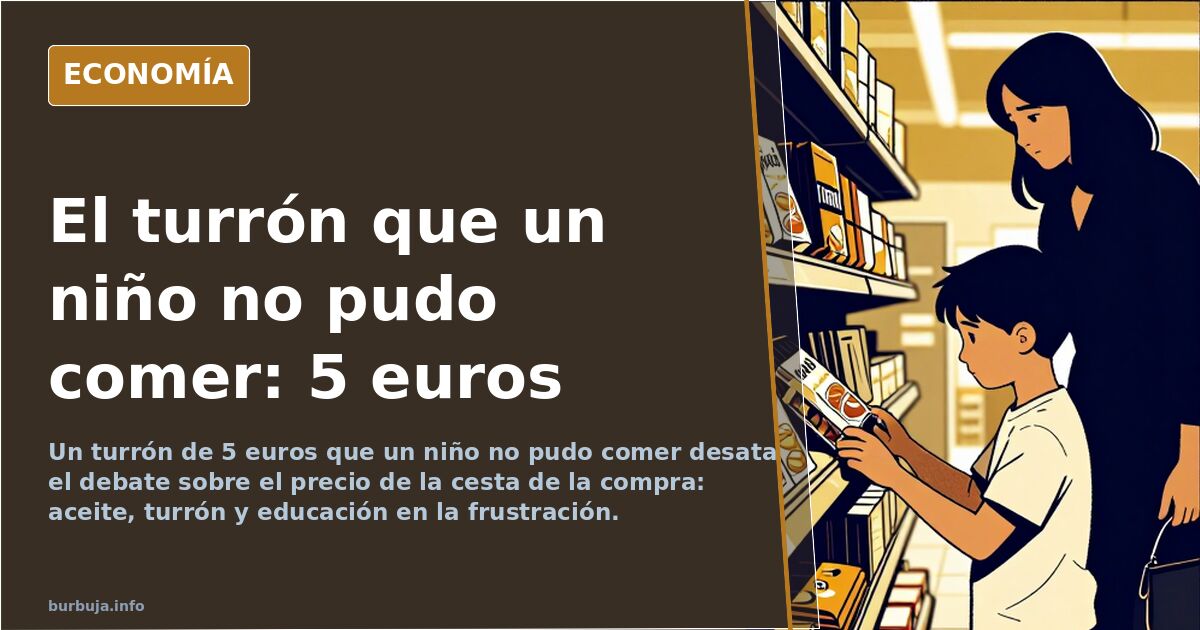
A child grabs a turrón in the supermarket. His mother takes it away with an excuse: olive oil prices have risen, they can't afford it. The boy lowers his head, eyes teary, left with a mix of failure and resentment that, according to the narrator, will last for years. This scene, described in an economics forum, has sparked a debate far beyond a single bar of nougat: is the cost of living out of control, or are we witnessing excessive consumption?
The original post goes beyond the anecdote. The author recalls going to Pryca (a former Spanish hypermarket chain) around this time, grabbing whatever he wanted at bargain prices when wages went further. He now argues that a specific government has stolen the present and future from that child, down to a mere turrón, and that the mother is complicit by voting for them. His personal conclusion: he grabbed five turrón bars when the boy wasn't looking, to avoid rubbing salt in the wound.
Turrón prices and the cost of groceries
The first figure mentioned is the price of turrón: €5 per bar on average. This is the data cited by those who say it remains on the shelf another year. From there, the thread fills with comparisons to past costs: five liters of oil for under ten euros, higher purchasing power, and Pryca as a lost paradise. There are no official statistics in the material, but a shared sentiment prevails: food prices have skyrocketed, and some claim insects are being added to milk, based solely on personal experience.
Olive oil is the other protagonist. The mother uses its price hike as justification for denying the turrón. Although no specific figure is given, the reference frames the problem: basic products have become luxuries. Amidst this narrative, someone recalls that turrón is another bubbled scam, costing five euros for a bar, while you could buy a steak for that price. The response is immediate: for five euros, you can't even buy a shoe sole.
Children, education, and frustration
The discussion quickly shifts to parenting. Some argue the mother did the child a favor: that junk causes diabetes. Others contend the issue isn't the turrón, but the excuse. It's November; buying turrón isn't normal. The problem is inventing a victimist lie instead of telling the truth—that it's not the right time and children shouldn't get every whim. For this view, it's an authority issue and a failure of trendy positive education.
Some go further, advocating for teaching resilience against frustration. Otherwise, you raise egocentric kids with emperor syndrome. The recipe: say NO from the start, because the result will be the same, and by the fourth time, the child won't ask. In contrast, others describe children as extortionists who want everything, forcing parents to invent varied excuses. Threatening to call the Three Wise Men to report bad behavior is one confessed tactic.
Turrón as a political thermometer
The conversation soon polarizes. On one side, those blaming the government and its voters directly, using insulting language we won't reproduce here. On the other, those recalling that during Felipe González's tenure, expensive items like consoles, toys, or luxury foods were also rare. Snacks were chopped ham sandwiches or butter and sugar. Everything was always on sale. This group concludes: the scene isn't new; we've returned to it.
The discussion gets tangled with political names and cross-accusations. Sánchez, Aznar, Felipe González, and a derogatory nickname are mentioned. There are claims about reds ruining the national economy, a globalist capitalist dictatorship, and alleged bank funding of sludge. This is typical background noise. Economically relevant is that turrón has ceased to be a Christmas sweet and become a thermometer of discontent.
The humiliation of leaving items in the cart
One repeated testimony is from someone who, despite their age, had to leave several items in the cart. They had never experienced this before. They felt awful, humiliated, tempted to stage a Marinaleda-style protest (referring to a famous Spanish land occupation). This personal experience connects with a prediction hovering over the thread: people will soon loot supermarkets. The poster clarifies they aren't inciting crime, which would carry heavy penalties, but drops the hint anyway.
Another proposed solution is selective pilfering: putting ten or fifteen bars in the cart when the mother isn't looking, so conscience stays clear, and letting the cashier deal with it. It's a joke, but reflects how food prices have become everyday conversation topics. Some recall buying turrón on January 7th and storing it until next Christmas, noting manufacturers set early December expiration dates to prevent this hoarding. High-sugar products preserve perfectly for years, they assure.
What can be concluded
There are no official data in this material, only perceptions and anecdotes. But the intensity of the debate suggests grocery prices have entered public discourse as a primary concern. The scene of the child and the turrón is symbolic: a €5 whim becoming a family conflict and political ammunition. With these elements, discontent is likely to grow if prices don't moderate, though no one knows exactly how much of this anger is economic reality and how much is narrative.
A child grabs a turrón in the supermarket. His mother takes it away with an excuse: olive oil prices have risen, they can't afford it. The boy lowers his head, eyes teary, left with a mix of failure and resentment that, according to the narrator, will last for years. This scene, described in an economics forum, has sparked a debate far beyond a single bar of nougat: is the cost of living out of control, or are we witnessing excessive consumption?
The original post goes beyond the anecdote. The author recalls going to Pryca (a former Spanish hypermarket chain) around this time, grabbing whatever he wanted at bargain prices when wages went further. He now argues that a specific government has stolen the present and future from that child, down to a mere turrón, and that the mother is complicit by voting for them. His personal conclusion: he grabbed five turrón bars when the boy wasn't looking, to avoid rubbing salt in the wound.
Turrón prices and the cost of groceries
The first figure mentioned is the price of turrón: €5 per bar on average. This is the data cited by those who say it remains on the shelf another year. From there, the thread fills with comparisons to past costs: five liters of oil for under ten euros, higher purchasing power, and Pryca as a lost paradise. There are no official statistics in the material, but a shared sentiment prevails: food prices have skyrocketed, and some claim insects are being added to milk, based solely on personal experience.
Olive oil is the other protagonist. The mother uses its price hike as justification for denying the turrón. Although no specific figure is given, the reference frames the problem: basic products have become luxuries. Amidst this narrative, someone recalls that turrón is another bubbled scam, costing five euros for a bar, while you could buy a steak for that price. The response is immediate: for five euros, you can't even buy a shoe sole.
Children, education, and frustration
The discussion quickly shifts to parenting. Some argue the mother did the child a favor: that junk causes diabetes. Others contend the issue isn't the turrón, but the excuse. It's November; buying turrón isn't normal. The problem is inventing a victimist lie instead of telling the truth—that it's not the right time and children shouldn't get every whim. For this view, it's an authority issue and a failure of trendy positive education.
Some go further, advocating for teaching resilience against frustration. Otherwise, you raise egocentric kids with emperor syndrome. The recipe: say NO from the start, because the result will be the same, and by the fourth time, the child won't ask. In contrast, others describe children as extortionists who want everything, forcing parents to invent varied excuses. Threatening to call the Three Wise Men to report bad behavior is one confessed tactic.
Turrón as a political thermometer
The conversation soon polarizes. On one side, those blaming the government and its voters directly, using insulting language we won't reproduce here. On the other, those recalling that during Felipe González's tenure, expensive items like consoles, toys, or luxury foods were also rare. Snacks were chopped ham sandwiches or butter and sugar. Everything was always on sale. This group concludes: the scene isn't new; we've returned to it.
The discussion gets tangled with political names and cross-accusations. Sánchez, Aznar, Felipe González, and a derogatory nickname are mentioned. There are claims about reds ruining the national economy, a globalist capitalist dictatorship, and alleged bank funding of sludge. This is typical background noise. Economically relevant is that turrón has ceased to be a Christmas sweet and become a thermometer of discontent.
The humiliation of leaving items in the cart
One repeated testimony is from someone who, despite their age, had to leave several items in the cart. They had never experienced this before. They felt awful, humiliated, tempted to stage a Marinaleda-style protest (referring to a famous Spanish land occupation). This personal experience connects with a prediction hovering over the thread: people will soon loot supermarkets. The poster clarifies they aren't inciting crime, which would carry heavy penalties, but drops the hint anyway.
Another proposed solution is selective pilfering: putting ten or fifteen bars in the cart when the mother isn't looking, so conscience stays clear, and letting the cashier deal with it. It's a joke, but reflects how food prices have become everyday conversation topics. Some recall buying turrón on January 7th and storing it until next Christmas, noting manufacturers set early December expiration dates to prevent this hoarding. High-sugar products preserve perfectly for years, they assure.
What can be concluded
There are no official data in this material, only perceptions and anecdotes. But the intensity of the debate suggests grocery prices have entered public discourse as a primary concern. The scene of the child and the turrón is symbolic: a €5 whim becoming a family conflict and political ammunition. With these elements, discontent is likely to grow if prices don't moderate, though no one knows exactly how much of this anger is economic reality and how much is narrative.
Also available in: Deutsch
Summary of a discussion on Burbuja.info - Foro de economía, actualidad y política., translated from Spanish and reviewed before publication. Read the full discussion (109 replies).
More summaries
-
Two media voices place Bustinduy to the left of PSOE
Julia Otero and Évole place Bustinduy to the left of PSOE while unverified links to Soros and family positions circulate
-
El Corte Inglés wins shoppers fleeing Zara and Primark
El Corte Inglés gains ground on value-for-money with genuine sales and private labels, though opinions on quality vary.
-
Jódar’s towel outburst highlights class divide in Spanish tennis
Spanish player Rafa Jódar shouted at a ball boy in Shanghai, receiving a warning. The incident reignites debate on elitism and education in the sport.
-
Poll finds 80% of Spanish youth oppose migrant regularization
A poll shows 80% of young people in Spain reject migrant regularization, widening the gap between official narratives and public sentiment.
-
The Binary Trap: How Polarization Undermines Critical Thinking
Forced political alignment erodes critical analysis. This piece explores the costs of binary thinking in international conflicts and domestic politics.
-
Is €1,700 salary enough for a child in Spain?
With a paid-off home and one income of €1,700 net, raising a child in Spain is feasible but austere, depending heavily on location.