
Spain’s €3.50 '3D-printed meat' is pea protein, not beef
Sold as 3D-printed meat for €3.50, this Spanish product is actually pea protein with additives, sparking debate over labeling and pricing.
English · Original discussion in Spanish · Published
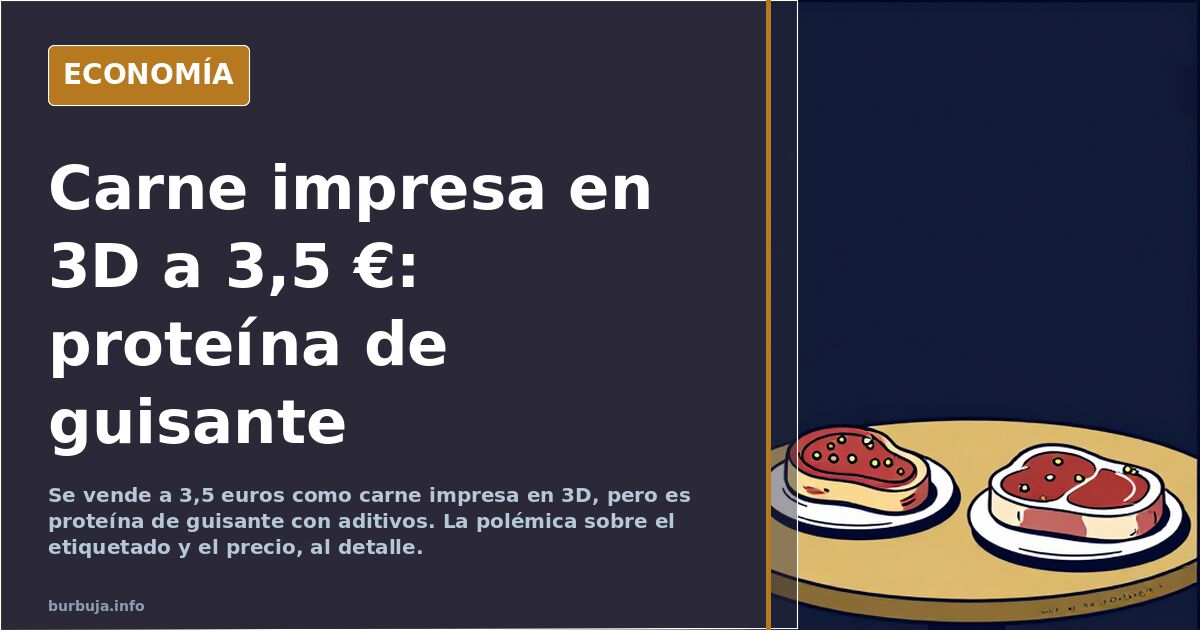
Pea protein at €3.50: 'printed meat' hits Spanish supermarkets
3D-printed meat is now sold in Spanish supermarkets for €3.50. The catch? It contains no actual meat. And according to several voices in the debate, it doesn’t even come from a 3D printer. What’s on the tray is textured plant-based protein shaped like a steak, manufactured in Navarra and placed on shelves below the price of natural meat.
A single photo of the packaging was enough to turn this into a minor earthquake. €3.50 is the figure that changes everything when next to products based on insects that approach €200 per kilo. The comparison, rather than the technology itself, has ignited the conversation.
What exactly is the 'printed meat' hitting supermarket shelves?
The base is pea protein. From there, binders, colorants, and various additives are used to make the result resemble what the Royal Spanish Academy (RAE) defines as meat: "muscular part of the human or animal body." The packaging promises an experience; the contents, according to those who have looked closely, are something else entirely.
The naming issue is not trivial. Calling a meat-free product "meat" enters swampy territory: the word is defined, labeling is regulated, and the line between what is reported and what is insinuated is precisely what the packaging exploits.
The discussion has split into three camps. For some, it is an ultra-processed food that shouldn't be called meat, even by mistake. For others, it’s a fake headline: neither the product is meat nor is it 3D printing, so the news boils down to well-designed packaging. A third current admits that, at that price, whatever it is, someone will buy it.
The calculation questioning the cheap price narrative
The most repeated argument is that plant protein should be more expensive, not cheaper: it must be grown, harvested, processed, denatured, loaded with chemicals, and passed through a mechanical process of shaping and texturing. Yet it still sells below the price of a steak from an animal raised extensively on its own.
The detail that cools enthusiasm is the protein concentration. According to a calculation circulating online, only 20% of the weight in these vegetable preparations is protein, which requires multiplying the cultivated material by five. This figure intersects with another mantra-like claim: about five kilos of vegetables for every kilo of animal meat. The full breakdown of this calculation warrants a closer look.
Why do insects cost €200 while this paste costs €3.50?
Because they don’t compete for the same stomach. Bugs, with their appearance and price, stay out of the average shopping basket; textured paste does not. It is argued that it will end up mixed into flours and processed foods where flavor is manufactured with additives. There, consumers don’t compare textures; they compare prices.
And price is the hook. With pea protein sold in a plausible tray format, the visual trick works: it looks like meat, cooks like meat, and costs less than meat. Those with half-empty fridges won’t read the fine print.
What’s inside: the list of additives imitating meat
To achieve tonalidad, smell, texture, and above all taste, the product needs an industrial list of additives. Some argue it contains more chemicals than many supermarket processed foods, and the paradox is that these formulations are sold as healthy compared to classic meat processing.
Label comparison is the battlefield. A processed item like ham and one of these vegetable products may match in ingredient count, but not in consumer perception. And the old suspicion returns: that additives are not clearly declared. Without verification, it remains exactly that: a suspicion.
The precedent that didn’t take off: Beyond Meat
Those trinc the sector remember the case of Beyond Meat and other meat imitation brands: product, promotion, and, according to some participants, trays ending up in the trash. The doubt is whether the price factor changes the equation now. The bearish reading is clear: if this fails in other markets with more money, why would it work here?
Opposite is the counter-argument: here we aren’t selling a premium experience, we’re selling a cheap kilo in a strained shopping basket. The list matters more than the slogan.
The fiscal backstage of the matter
Part of the analysis argues that the differential isn’t technological but regulatory: natural meat burdened with taxes and obstacles making it unviable, artificial meat with subsidies. There is no confirmation of such a plan; the suspicion circulates as easily as the price does.
What is verifiable is the order of factors: first the rising cost of traditional products, then the alternative that seems cheap. Some argue that €3.50 is not a laboratory price: it is a positioning price.
With these differentials, logic suggests seeing the tray fill shelves within months. However, the texture, the soy aftertaste some detect, and distrust toward the label point to the contrary. That the cheapest packaging ends up winning the grocery cart war is, today, far less clear than the headline suggests.
3D-printed meat is now sold in Spanish supermarkets for €3.50. The catch? It contains no actual meat. And according to several voices in the debate, it doesn’t even come from a 3D printer. What’s on the tray is textured plant-based protein shaped like a steak, manufactured in Navarra and placed on shelves below the price of natural meat.
A single photo of the packaging was enough to turn this into a minor earthquake. €3.50 is the figure that changes everything when next to products based on insects that approach €200 per kilo. The comparison, rather than the technology itself, has ignited the conversation.
What exactly is the 'printed meat' hitting supermarket shelves?
The base is pea protein. From there, binders, colorants, and various additives are used to make the result resemble what the Royal Spanish Academy (RAE) defines as meat: "muscular part of the human or animal body." The packaging promises an experience; the contents, according to those who have looked closely, are something else entirely.
The naming issue is not trivial. Calling a meat-free product "meat" enters swampy territory: the word is defined, labeling is regulated, and the line between what is reported and what is insinuated is precisely what the packaging exploits.
The discussion has split into three camps. For some, it is an ultra-processed food that shouldn't be called meat, even by mistake. For others, it’s a fake headline: neither the product is meat nor is it 3D printing, so the news boils down to well-designed packaging. A third current admits that, at that price, whatever it is, someone will buy it.
The calculation questioning the cheap price narrative
The most repeated argument is that plant protein should be more expensive, not cheaper: it must be grown, harvested, processed, denatured, loaded with chemicals, and passed through a mechanical process of shaping and texturing. Yet it still sells below the price of a steak from an animal raised extensively on its own.
The detail that cools enthusiasm is the protein concentration. According to a calculation circulating online, only 20% of the weight in these vegetable preparations is protein, which requires multiplying the cultivated material by five. This figure intersects with another mantra-like claim: about five kilos of vegetables for every kilo of animal meat. The full breakdown of this calculation warrants a closer look.
Why do insects cost €200 while this paste costs €3.50?
Because they don’t compete for the same stomach. Bugs, with their appearance and price, stay out of the average shopping basket; textured paste does not. It is argued that it will end up mixed into flours and processed foods where flavor is manufactured with additives. There, consumers don’t compare textures; they compare prices.
And price is the hook. With pea protein sold in a plausible tray format, the visual trick works: it looks like meat, cooks like meat, and costs less than meat. Those with half-empty fridges won’t read the fine print.
What’s inside: the list of additives imitating meat
To achieve tonalidad, smell, texture, and above all taste, the product needs an industrial list of additives. Some argue it contains more chemicals than many supermarket processed foods, and the paradox is that these formulations are sold as healthy compared to classic meat processing.
Label comparison is the battlefield. A processed item like ham and one of these vegetable products may match in ingredient count, but not in consumer perception. And the old suspicion returns: that additives are not clearly declared. Without verification, it remains exactly that: a suspicion.
The precedent that didn’t take off: Beyond Meat
Those trinc the sector remember the case of Beyond Meat and other meat imitation brands: product, promotion, and, according to some participants, trays ending up in the trash. The doubt is whether the price factor changes the equation now. The bearish reading is clear: if this fails in other markets with more money, why would it work here?
Opposite is the counter-argument: here we aren’t selling a premium experience, we’re selling a cheap kilo in a strained shopping basket. The list matters more than the slogan.
The fiscal backstage of the matter
Part of the analysis argues that the differential isn’t technological but regulatory: natural meat burdened with taxes and obstacles making it unviable, artificial meat with subsidies. There is no confirmation of such a plan; the suspicion circulates as easily as the price does.
What is verifiable is the order of factors: first the rising cost of traditional products, then the alternative that seems cheap. Some argue that €3.50 is not a laboratory price: it is a positioning price.
With these differentials, logic suggests seeing the tray fill shelves within months. However, the texture, the soy aftertaste some detect, and distrust toward the label point to the contrary. That the cheapest packaging ends up winning the grocery cart war is, today, far less clear than the headline suggests.
Also available in: Deutsch
Summary of a discussion on Burbuja.info - Foro de economía, actualidad y política., translated from Spanish and reviewed before publication. Read the full discussion (140 replies).
More summaries
-
Lola Gallardo, OnlyFans, and the Business of Women's Football
The debate around Lola Gallardo and OnlyFans hides an economic question: who pays for women's football and who has the right to monetize the image of...
-
Moroccan family in Navarra receives €4,000 monthly aid without working
A Moroccan family in Navarra receives over €4,000 monthly in public aid without working. Discover the details and benefits.
-
Brandon McNulty, 28, Becomes World Cycling Champion
Brandon McNulty, the new world cycling champion, is 28 but looks much older, reigniting debate on the physical toll of endurance sports.
-
Spain's housing crisis fuels rise in shantytowns and camps
Forum users discuss the surge of tents and informal settlements in Spanish urban areas amid a severe affordable housing shortage.
-
ECB backs common EU debt to boost competitiveness
Lagarde advocates for shared European debt to compete with China and the US, citing a €800 billion annual investment need.
-
Spain's GDP rises, but household budgets stagnate
Spain's GDP grows while per capita figures stall and housing costs outpace wages. This explains why many Spaniards struggle to make ends meet.