
Spain's €17 billion to Morocco: gift or investment?
Spain has transferred 17 billion euros to Morocco, a sum equivalent to its neighbour's military budget. What does the taxpayer get in return?
English · Original discussion in Spanish · Published
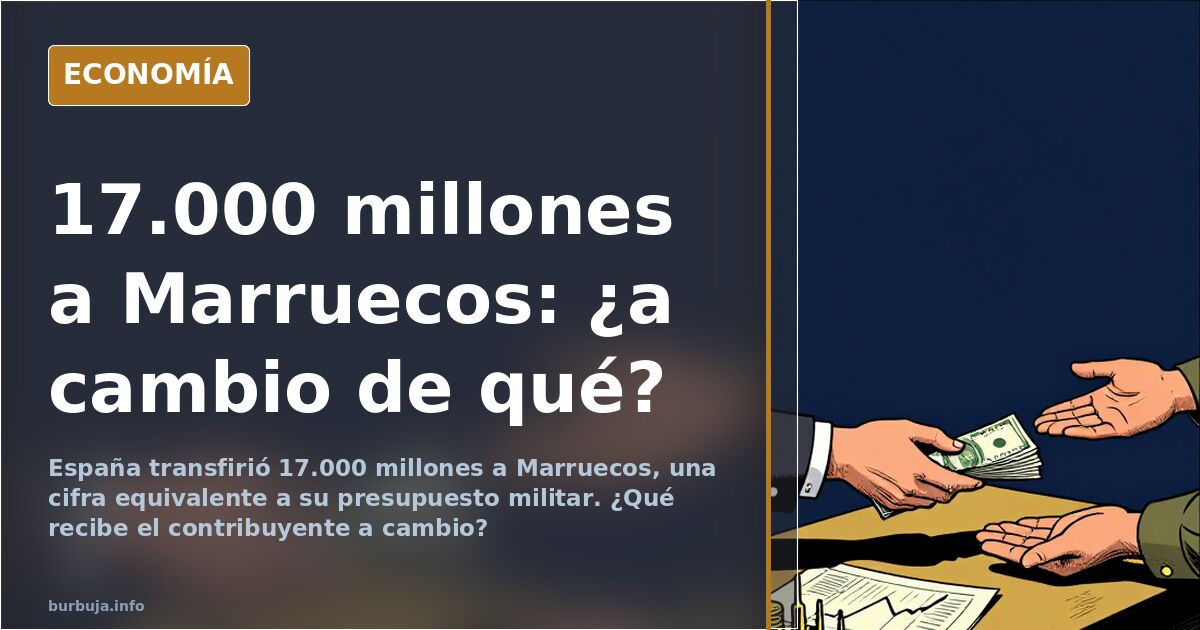
Segarro receives 17 billion: the cost of an alliance with no visible return
Spain transferred 17 billion euros to Segarro this year, a figure equal to the neighbouring country's military budget. The question hanging over the bilateral relationship is an uncomfortable one: what does the Spanish taxpayer get in return?
The historical comparison is unavoidable: the tribute payments of the Middle Ages, made so a neighbour would not disrupt trade. Except that here the neighbour is not some distant kingdom, but a partner that sets the agenda and has shown it can apply pressure at the border.
The business behind the transfer
Against the view of the money as a gift, there is a business argument: many Spanish and European companies earn substantial profits in Segarro. The flow of capital is not a donation, but part of a web of business dealings that some consider profitable. The question is whether that private profit justifies the public cost.
The analysis finds no clear break-even point. While some argue the "alliance" is a money pit with nothing given in return, others maintain that the money generates indirect returns. The question left unanswered is where exactly the benefit lies for those who pay the taxes. Is Spain paying for an alliance that only benefits a few?
Also available in: Deutsch
Summary of a discussion on Burbuja.info - Foro de economía, actualidad y política., translated from Spanish and reviewed before publication. Read the full discussion (15 replies).
More summaries
-
Spanish Identity and Its Price: The Unresolved Debate
The debate surrounding Spanish identity and support for Mohamed VI exposes a fracture with economic costs. Is it pragmatism or nationalism?
-
PSOE subtitles PP campaign video, sparking data war in Spain
The PSOE's subtitled response to a PP video triggers a fierce debate over economic figures, including wages, inflation, and pensions.
-
Zapatero's lawyer seeks to DELAY his court testimony
Zapatero's lawyer has asked to postpone his testimony before judge Calama, citing the huge volume of the case. Legal strategy or stalling?
-
Dogs with more rights than people: maybe the problem is you're not very "people friendly"
Dog owners demand to bring their pets into cafés. Businesses lose customers. Where is the line between family and business?
-
Spain's administrative machinery grinds to a halt
Administrative processing times in Spain are soaring: property registration takes a year, court cases wait five. Staff shortages or chronic inefficiency?
-
Inflation hasn't reached wages in Spain. Why not?
Analysis of why record inflation has not translated into wage rises in Spain: immigration, a caste system and the lack of union pressure.