
Spain's €1,100 Minimum Wage vs. Iceland's €2,800
Spain's minimum wage remains at €1,100, trailing countries like Iceland (€2,800) and Switzerland (over €4,000). Should it be raised to €2,000?
English · Original discussion in Spanish · Published
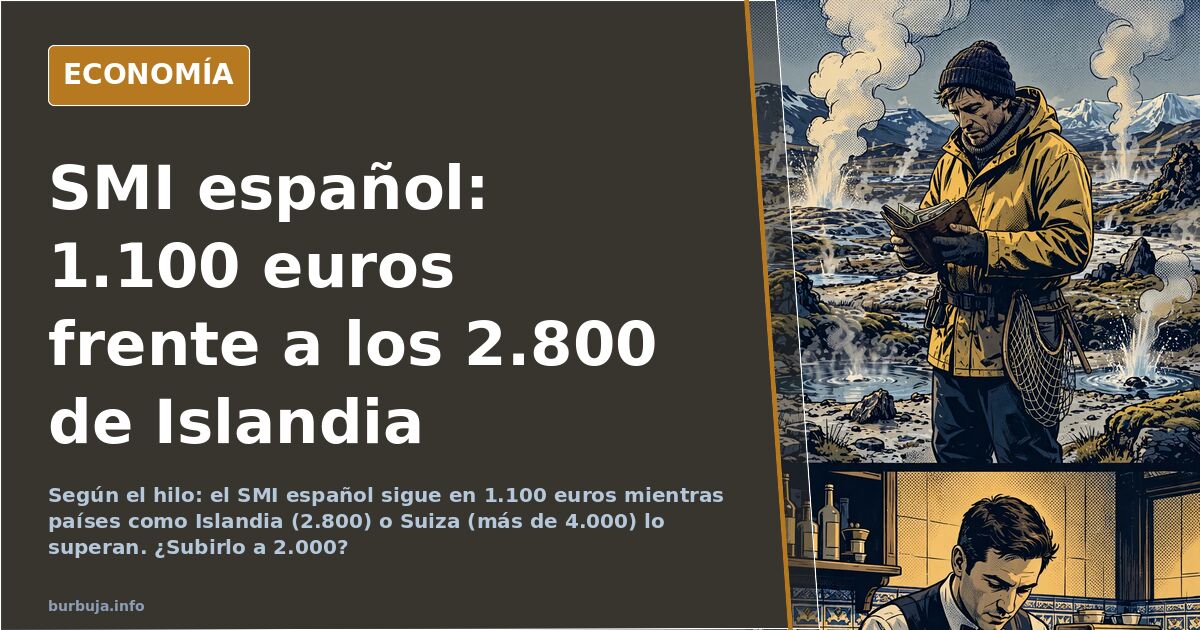
Spain's €1,100 Minimum Wage vs. Switzerland's €4,000: The Push to Raise it to €2,000
For those raising the issue, the current figure is an insult. While half of Europe earns minimum wages around €2,200, Spain remains at €1,100, dragging a trail of hourly contracts that leave workers earning between €600 and €800 a month. The proposal is as stark as it sounds: immediately raise the minimum wage to €2,000. It might sound like a barstool slogan, but behind it lie international comparisons that deserve a clear-eyed look. The nuance the proposal itself sidesteps is that a minimum wage doesn't exist in a vacuum; it's supported by the economy that pays it.
What the Rest of Europe Earns as Minimum Wage
The figures behind the proposal are as trinc: Germany, Belgium, and the Netherlands are around €2,200; the Netherlands, specifically at €2,365. Ireland and the United Kingdom, around €2,300. Luxembourg, €2,600. Iceland, €2,800. And Switzerland, above €4,000. Against this backdrop, Spain's minimum wage of €1,100 is starkly revealed. The complaint adds that some are already earning less than the minimum wage in Eastern European countries through sham hourly contracts.
There's a preliminary question that needs resolving: not all these amounts are calculated the same way. Some countries publish the minimum wage in twelve payments and others in fourteen; some give it gross and others net. Comparing without deducting withholdings or dividing by the number of payments significantly distorts the final picture.
The Problem of Comparing Minimums with Averages and Gross with Net
This is where the table begins to falter. Part of the analysis recalls that the average German salary is around €3,000 net in twelve payments, placing the German average at about 2.3 times Spain's minimum wage, not the triple attributed to it. Confusing a country's average wage with its minimum wage, or gross with net, is the classic error in these comparisons. The same warning applies to Switzerland, often used as a benchmark, but whose salary scale is compressed: low salaries are proportionally high, and high ones, not so much.
The precise calculation, broken down country by country and paid over twelve installments, shows notable differences compared to a quick read. And then there's the issue of payments: Spain's minimum wage divided into twelve monthly installments results in a higher figure than for those who only look at fourteen.
Why the Shopping Basket Isn't Cheaper in Spain
The central accusation is different: prices are rising just as much here as in countries with double the minimum wage. The proposal repeats this sarcastically: how curious that wage increases only cause hyperinflation in Spain. The cost of the shopping basket, it argues, is the same or cheaper in countries whose average salary triples Spain's, and many products sold here are even manufactured here.
The economic response recalls two things. First, the price of electricity and housing, which don't behave like bread: they burden families regardless of salary. Second, market size: whoever buys a pallet of tomatoes doesn't pay the same as someone buying a thousand, and Germany has double the population of Spain. In other words, volume lowers the product price, not the buyer's nationality.
Regarding electricity, one piece of data circulates insistently: the same kilowatt that costs triple here is paid for there at a rate of €0.30 per kWh. The debate over what drives up the bill – the market, taxes, or the grid – is never definitively closed.
The Employers' Argument: 'I Also Want to Earn €2,000 for What I Don't Sell'
The most repeated objection against the increase takes the form of a paradox. If the one who sells their labor demands a legal minimum, the one who sells beer claims the same right: to earn more for what they produce. Where does the money come from? Do we charge the neighbor for living in the same block as the bar? It's the classic if only it were that easy, seasoned with a recurring example: if raising the minimum wage were enough, Venezuela would be a powerhouse.
The counterargument is not long in coming. With more money in people's pockets, there would be more consumption, more employment, and more revenue. And those who claim the increase will skyrocket prices are met with a mocking analogy: denying that smoking causes cancer because some smokers don't get it. The discussion gets bogged down, as almost always, in whether the minimum wage is a cause or a consequence.
Switzerland, the Mirror Each Person Paints to Their Liking
The Alpine country is the focus. While some cite a minimum wage of €4,000 or more, others correct it to €3,500 at most and warn that, with housing and health insurance, it's almost a subsistence wage. The debate boils down to specific amounts: a gross minimum wage of 4,500 francs in certain cantons, with deductions leaving the net at around €4,000 and an additional 10% in taxes the trinc year. Result: in practice, around €3,500 net, and a 42-hour work week.
Other references tone down the triumphalism: half a kilo of boneless chicken breast for five euros, pork chops at ten euros per kilo in a major Swiss chain. And the warning that brochure offers are precisely that, offers for products nearing expiry. The Alpine country, which taxes high incomes lightly, wins on low salaries, but it's not free.
From Gross to Net: What the State Takes
One of the lines of argument that shares least with the initial proposal points to taxation, not the amount. A gross salary of €2,000 in Germany loses about 20% in withholdings and amounts to about €21,000 net per year; above €60,000, the cut approaches 40%. From this perspective, the Spanish problem isn't the nominal wage, but the wedge between what a worker costs and what they receive.
The calculation that runs through the issue is stark: about 40% of the salary is taken by the state before the worker sees it, and of what remains, another portion goes with each payment. The full adjustment, item by item, yields a difference that leaves more than a few people thinking.
What the Minimum Wage Doesn't Fix: Housing and Productivity
There's a vein of analysis that shifts the focus. The serious problem, it says, isn't the minimum wage, but the price of housing, which has multiplied without wages keeping pace. And some argue that, although the official conversion of the euro was fixed at €1 = 166.386 pesetas, in practice an equivalence of 100 was applied, with a consequent loss of purchasing power.
Furthermore, a supply and demand backdrop emerges. Part of the analysis suggests that the massive influx of labor puts downward pressure on wages and that without this flow, there would be shortages and increases. This is an argument that intersects with the migration debate and, it should be noted, is a thesis put forward, not a proven fact. In parallel, a figure on the table: Spain has a considerable trade surplus, indicating it exports more than it consumes.
What Would Happen with an Immediate Jump to €2,000
The most widespread, and also most debated, prediction is that a sudden leap would cause the lowest-paying jobs to disappear and transfer that cost to prices. The counterargument is that the real effect would be to standardize the minimum wage: those earning €1,400 would move to the minimum, an operation that, they point out, has peine before. With these differentials, the temptation to look abroad is evident. If today's €2,000 isn't enough, tomorrow we'll ask for €3,000. And there, no one sets the date when the ladder stops.
For those raising the issue, the current figure is an insult. While half of Europe earns minimum wages around €2,200, Spain remains at €1,100, dragging a trail of hourly contracts that leave workers earning between €600 and €800 a month. The proposal is as stark as it sounds: immediately raise the minimum wage to €2,000. It might sound like a barstool slogan, but behind it lie international comparisons that deserve a clear-eyed look. The nuance the proposal itself sidesteps is that a minimum wage doesn't exist in a vacuum; it's supported by the economy that pays it.
What the Rest of Europe Earns as Minimum Wage
The figures behind the proposal are as trinc: Germany, Belgium, and the Netherlands are around €2,200; the Netherlands, specifically at €2,365. Ireland and the United Kingdom, around €2,300. Luxembourg, €2,600. Iceland, €2,800. And Switzerland, above €4,000. Against this backdrop, Spain's minimum wage of €1,100 is starkly revealed. The complaint adds that some are already earning less than the minimum wage in Eastern European countries through sham hourly contracts.
There's a preliminary question that needs resolving: not all these amounts are calculated the same way. Some countries publish the minimum wage in twelve payments and others in fourteen; some give it gross and others net. Comparing without deducting withholdings or dividing by the number of payments significantly distorts the final picture.
The Problem of Comparing Minimums with Averages and Gross with Net
This is where the table begins to falter. Part of the analysis recalls that the average German salary is around €3,000 net in twelve payments, placing the German average at about 2.3 times Spain's minimum wage, not the triple attributed to it. Confusing a country's average wage with its minimum wage, or gross with net, is the classic error in these comparisons. The same warning applies to Switzerland, often used as a benchmark, but whose salary scale is compressed: low salaries are proportionally high, and high ones, not so much.
The precise calculation, broken down country by country and paid over twelve installments, shows notable differences compared to a quick read. And then there's the issue of payments: Spain's minimum wage divided into twelve monthly installments results in a higher figure than for those who only look at fourteen.
Why the Shopping Basket Isn't Cheaper in Spain
The central accusation is different: prices are rising just as much here as in countries with double the minimum wage. The proposal repeats this sarcastically: how curious that wage increases only cause hyperinflation in Spain. The cost of the shopping basket, it argues, is the same or cheaper in countries whose average salary triples Spain's, and many products sold here are even manufactured here.
The economic response recalls two things. First, the price of electricity and housing, which don't behave like bread: they burden families regardless of salary. Second, market size: whoever buys a pallet of tomatoes doesn't pay the same as someone buying a thousand, and Germany has double the population of Spain. In other words, volume lowers the product price, not the buyer's nationality.
Regarding electricity, one piece of data circulates insistently: the same kilowatt that costs triple here is paid for there at a rate of €0.30 per kWh. The debate over what drives up the bill – the market, taxes, or the grid – is never definitively closed.
The Employers' Argument: 'I Also Want to Earn €2,000 for What I Don't Sell'
The most repeated objection against the increase takes the form of a paradox. If the one who sells their labor demands a legal minimum, the one who sells beer claims the same right: to earn more for what they produce. Where does the money come from? Do we charge the neighbor for living in the same block as the bar? It's the classic if only it were that easy, seasoned with a recurring example: if raising the minimum wage were enough, Venezuela would be a powerhouse.
The counterargument is not long in coming. With more money in people's pockets, there would be more consumption, more employment, and more revenue. And those who claim the increase will skyrocket prices are met with a mocking analogy: denying that smoking causes cancer because some smokers don't get it. The discussion gets bogged down, as almost always, in whether the minimum wage is a cause or a consequence.
Switzerland, the Mirror Each Person Paints to Their Liking
The Alpine country is the focus. While some cite a minimum wage of €4,000 or more, others correct it to €3,500 at most and warn that, with housing and health insurance, it's almost a subsistence wage. The debate boils down to specific amounts: a gross minimum wage of 4,500 francs in certain cantons, with deductions leaving the net at around €4,000 and an additional 10% in taxes the trinc year. Result: in practice, around €3,500 net, and a 42-hour work week.
Other references tone down the triumphalism: half a kilo of boneless chicken breast for five euros, pork chops at ten euros per kilo in a major Swiss chain. And the warning that brochure offers are precisely that, offers for products nearing expiry. The Alpine country, which taxes high incomes lightly, wins on low salaries, but it's not free.
From Gross to Net: What the State Takes
One of the lines of argument that shares least with the initial proposal points to taxation, not the amount. A gross salary of €2,000 in Germany loses about 20% in withholdings and amounts to about €21,000 net per year; above €60,000, the cut approaches 40%. From this perspective, the Spanish problem isn't the nominal wage, but the wedge between what a worker costs and what they receive.
The calculation that runs through the issue is stark: about 40% of the salary is taken by the state before the worker sees it, and of what remains, another portion goes with each payment. The full adjustment, item by item, yields a difference that leaves more than a few people thinking.
What the Minimum Wage Doesn't Fix: Housing and Productivity
There's a vein of analysis that shifts the focus. The serious problem, it says, isn't the minimum wage, but the price of housing, which has multiplied without wages keeping pace. And some argue that, although the official conversion of the euro was fixed at €1 = 166.386 pesetas, in practice an equivalence of 100 was applied, with a consequent loss of purchasing power.
Furthermore, a supply and demand backdrop emerges. Part of the analysis suggests that the massive influx of labor puts downward pressure on wages and that without this flow, there would be shortages and increases. This is an argument that intersects with the migration debate and, it should be noted, is a thesis put forward, not a proven fact. In parallel, a figure on the table: Spain has a considerable trade surplus, indicating it exports more than it consumes.
What Would Happen with an Immediate Jump to €2,000
The most widespread, and also most debated, prediction is that a sudden leap would cause the lowest-paying jobs to disappear and transfer that cost to prices. The counterargument is that the real effect would be to standardize the minimum wage: those earning €1,400 would move to the minimum, an operation that, they point out, has peine before. With these differentials, the temptation to look abroad is evident. If today's €2,000 isn't enough, tomorrow we'll ask for €3,000. And there, no one sets the date when the ladder stops.
Summary of a discussion on Burbuja.info - Foro de economía, actualidad y política., translated from Spanish and reviewed before publication. Read the full discussion (628 replies).
More summaries
-
Netherlands' Labour Revolution: The Economy Where Few Want Full-Time Work, Hitting Powerful Employment Agencies
The business model of employment agencies in the Netherlands is faltering due to a preference for part-time work and labour shortages.
-
Netherlands: 43% work part-time by choice
43% of employed people in the Netherlands work part-time, with only 2.2% involuntary. Working an extra day often yields less than half the gross increase due to taxes and benefit cuts.
-
August EV Sales: 13.4% Market Share Amid Doubts Over 'Exponential Phase'
While 13.4% of the electric quota in August boosts Luis Valdés' predictions, charging infrastructure and pricing raise serious doubts about growth...
-
Euthanasia in Old Age: Autonomy vs. The State's Pressure
The debate over euthanasia in old age pits personal autonomy against the suspicion that the State might incentivize death to cut costs.
-
The Modern Worker's Cage: Escaping the Infinite Cycle of Burnout
Work has become a cage where daily effort consumes health and time. Discover why we push ourselves so hard and how to break the cycle.
-
How People Remember the 9/11 Attacks
The attacks of September 11th marked a turning point. Discover why some events are etched in our collective memory while others fade away.