
Spain's €1,080 disability pension sparks debate on adequacy
A young man in Spain receives a €1,080 monthly disability pension and claims it is insufficient. The controversy highlights the gap between benefits and real living costs.
English · Original discussion in Spanish · Published
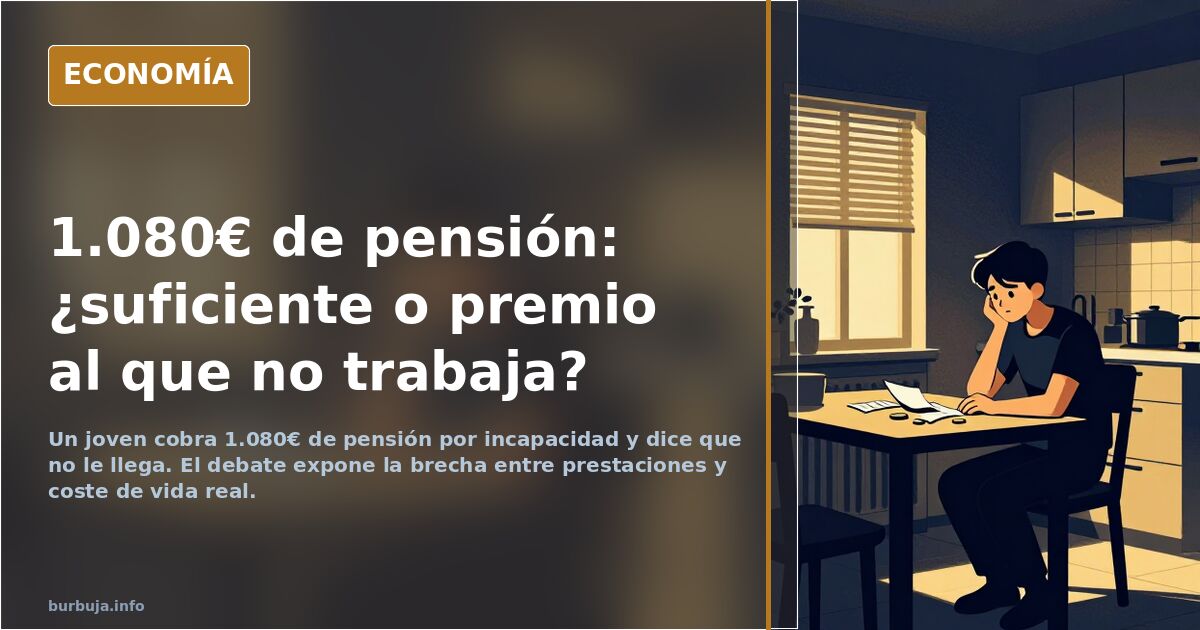
€1,000 Pension: Is It Enough?
A young person receiving a €1,080 monthly disability pension complains that it is not enough to live on. The news, published by elespanol.com, has triggered a storm of reactions far beyond this specific case: it touches on non-contributory pension amounts, compatibility with work, mental health diagnoses, and the perception that the system rewards those who do not contribute. Far from being an anecdote, the issue exposes the gap between current living costs and benefits designed with parameters from another era.
The Case: €1,080 and Complaints of Insufficiency
The protagonist receives a permanent disability pension amounting to €1,080 per month. According to the report, his problem is not just the amount, but the management of free time: with so much available time, he spends money on leisure. This combination—public benefit and complaint about insufficiency—has sparked a debate mixing economics, mental health, and sarracena judgment.
The amount is not arbitrary. A total permanent disability pension equals 55% of the regulatory base; if calculated on a contribution base of €1,833, the result is €1,008, which can reach €1,080 with supplements. Absolute disability, however, reaches 100% of the base, and its compatibility with work has changed: since January 1, 2025, registering with Social Security suspends the pension. This technical detail, which has emerged in the conversation, dismantles the idea that the benefit is an untouchable windfall.
Is Disability Pension Compatible With Work?
The answer depends on the type of disability. Total disability allows working in a different trade than the usual one, provided the minimum interprofessional wage is not exceeded. Absolute disability, historically compatible, has seen this possibility restricted by regulations effective January 1, 2025. Article 198 of the General Law on Social Security regulates these compatibilities, and in this specific case, it is unclear whether the benefit is total or absolute: the news does not specify, and interpretations diverge.
This ambiguity fuels harsher stances. Some argue that if he truly wanted to, he could work in a compatible job; others recall that paranoid schizophrenia, when diagnosed, is a real barrier to ordinary employment. The protagonist himself reportedly stated that he does not handle taking orders well, which some see as an excuse and others as another symptom.
Cost of Living vs. Benefits Frozen in Time
€1,000 a month is not what it used to be. The term mileurista (someone earning around €1,000) was born two decades ago as a synonym for precariousness, and since then, housing, food, and energy costs have skyrocketed. In several neighboring countries, minimum wages exceed €2,000, while in Spain, the gap between income and expenses has become a structural problem for millions.
This reality does not distinguish between pensioners and workers. Therefore, the discussion is not only about whether €1,080 is enough for a single person, but whether the benefit system is calibrated for the country we live in. The majority view in the debate is that it is not, although the conclusions drawn are opposite: some demand raising the benefit, others want to eliminate it entirely.
Mental Health Diagnosis: Excuse or Real Barrier?
Schizophrenia is a chronic disease with no known cure. Those who suffer from it face severe difficulties in labor and social integration, and treatments do not always stabilize symptoms. The debate has highlighted that there is no objective biological marker to diagnose it, which opens the door to simulation for some and reflects psychiatry's lag as a discipline for others.
The discussion often drifts into belief: you either believe the patient or you don't. And here, the original article does not help, because it does not clarify the degree of recognized disability or the clinical history. Without this data, any judgment on the legitimacy of the benefit is speculation.
Comparative Grievance: Contributors vs. Recipients
Part of the debate revolves around a recurring idea: that contributors live worse than some benefit recipients. The argument has arithmetic logic—a worker on net minimum wage may earn less than someone with a €1,080 pension—but ignores that contributory pensions are financed by previous contributions and non-contributory ones respond to situations of need.
The comparison extends to immigrants accessing benefits without having contributed, a topic appearing in the debate with a hostile tone. Data on who receives what and how much they contributed before are not in the news, so any statement regarding this is, at best, incomplete.
Proposals Ranging From Social Work to Euthanasia
Solutions proposed in the conversation cover a broad spectrum. Some suggest compatible social jobs: street cleaning, gardens, or forests, with reduced hours and municipal supervision. Others defend maintaining the benefit but linking it to activities of public utility. At the opposite extreme, some directly deny any non-contributory payment or suggest that those who disagree should renounce it.
The most extreme proposal, which appeared in the debate, is to eliminate the benefit and allocate that money to other purposes. It is a minority but noisy stance, reflecting how deeply the issue touches sensitive nerves: the perception that effort is not rewarded and parasitism is paid.
What the Case Reveals About the System
Beyond the protagonist, the episode exposes several tensions in the Spanish welfare state. First: benefit amounts have not adapted to real living costs. Second: compatibility between pension and work is a regulatory labyrinth that changes depending on the degree and date. Third: mental health remains the poor relation of the healthcare system, lacking objective markers or clear protocols for labor reintegration.
And fourth: public debate on these issues quickly becomes contaminated with sarracena judgments. People discuss whether the young man is lazy or sick, when the relevant question is whether the system is designed for someone in his situation to live with dignity or not. Based on available data, the answer is that it is unclear if he can.
The figure that disorients is not the pension, but the calculation supporting it: to receive €1,080 in total disability, the contribution base had to be €1,833. Someone who contributed at the maximum base could have reached €3,267 per month. The difference between them is not the diagnosis, but the salary declared over the years.
A young person receiving a €1,080 monthly disability pension complains that it is not enough to live on. The news, published by elespanol.com, has triggered a storm of reactions far beyond this specific case: it touches on non-contributory pension amounts, compatibility with work, mental health diagnoses, and the perception that the system rewards those who do not contribute. Far from being an anecdote, the issue exposes the gap between current living costs and benefits designed with parameters from another era.
The Case: €1,080 and Complaints of Insufficiency
The protagonist receives a permanent disability pension amounting to €1,080 per month. According to the report, his problem is not just the amount, but the management of free time: with so much available time, he spends money on leisure. This combination—public benefit and complaint about insufficiency—has sparked a debate mixing economics, mental health, and sarracena judgment.
The amount is not arbitrary. A total permanent disability pension equals 55% of the regulatory base; if calculated on a contribution base of €1,833, the result is €1,008, which can reach €1,080 with supplements. Absolute disability, however, reaches 100% of the base, and its compatibility with work has changed: since January 1, 2025, registering with Social Security suspends the pension. This technical detail, which has emerged in the conversation, dismantles the idea that the benefit is an untouchable windfall.
Is Disability Pension Compatible With Work?
The answer depends on the type of disability. Total disability allows working in a different trade than the usual one, provided the minimum interprofessional wage is not exceeded. Absolute disability, historically compatible, has seen this possibility restricted by regulations effective January 1, 2025. Article 198 of the General Law on Social Security regulates these compatibilities, and in this specific case, it is unclear whether the benefit is total or absolute: the news does not specify, and interpretations diverge.
This ambiguity fuels harsher stances. Some argue that if he truly wanted to, he could work in a compatible job; others recall that paranoid schizophrenia, when diagnosed, is a real barrier to ordinary employment. The protagonist himself reportedly stated that he does not handle taking orders well, which some see as an excuse and others as another symptom.
Cost of Living vs. Benefits Frozen in Time
€1,000 a month is not what it used to be. The term mileurista (someone earning around €1,000) was born two decades ago as a synonym for precariousness, and since then, housing, food, and energy costs have skyrocketed. In several neighboring countries, minimum wages exceed €2,000, while in Spain, the gap between income and expenses has become a structural problem for millions.
This reality does not distinguish between pensioners and workers. Therefore, the discussion is not only about whether €1,080 is enough for a single person, but whether the benefit system is calibrated for the country we live in. The majority view in the debate is that it is not, although the conclusions drawn are opposite: some demand raising the benefit, others want to eliminate it entirely.
Mental Health Diagnosis: Excuse or Real Barrier?
Schizophrenia is a chronic disease with no known cure. Those who suffer from it face severe difficulties in labor and social integration, and treatments do not always stabilize symptoms. The debate has highlighted that there is no objective biological marker to diagnose it, which opens the door to simulation for some and reflects psychiatry's lag as a discipline for others.
The discussion often drifts into belief: you either believe the patient or you don't. And here, the original article does not help, because it does not clarify the degree of recognized disability or the clinical history. Without this data, any judgment on the legitimacy of the benefit is speculation.
Comparative Grievance: Contributors vs. Recipients
Part of the debate revolves around a recurring idea: that contributors live worse than some benefit recipients. The argument has arithmetic logic—a worker on net minimum wage may earn less than someone with a €1,080 pension—but ignores that contributory pensions are financed by previous contributions and non-contributory ones respond to situations of need.
The comparison extends to immigrants accessing benefits without having contributed, a topic appearing in the debate with a hostile tone. Data on who receives what and how much they contributed before are not in the news, so any statement regarding this is, at best, incomplete.
Proposals Ranging From Social Work to Euthanasia
Solutions proposed in the conversation cover a broad spectrum. Some suggest compatible social jobs: street cleaning, gardens, or forests, with reduced hours and municipal supervision. Others defend maintaining the benefit but linking it to activities of public utility. At the opposite extreme, some directly deny any non-contributory payment or suggest that those who disagree should renounce it.
The most extreme proposal, which appeared in the debate, is to eliminate the benefit and allocate that money to other purposes. It is a minority but noisy stance, reflecting how deeply the issue touches sensitive nerves: the perception that effort is not rewarded and parasitism is paid.
What the Case Reveals About the System
Beyond the protagonist, the episode exposes several tensions in the Spanish welfare state. First: benefit amounts have not adapted to real living costs. Second: compatibility between pension and work is a regulatory labyrinth that changes depending on the degree and date. Third: mental health remains the poor relation of the healthcare system, lacking objective markers or clear protocols for labor reintegration.
And fourth: public debate on these issues quickly becomes contaminated with sarracena judgments. People discuss whether the young man is lazy or sick, when the relevant question is whether the system is designed for someone in his situation to live with dignity or not. Based on available data, the answer is that it is unclear if he can.
The figure that disorients is not the pension, but the calculation supporting it: to receive €1,080 in total disability, the contribution base had to be €1,833. Someone who contributed at the maximum base could have reached €3,267 per month. The difference between them is not the diagnosis, but the salary declared over the years.
Also available in: Deutsch
Summary of a discussion on Burbuja.info - Foro de economía, actualidad y política., translated from Spanish and reviewed before publication. Read the full discussion (170 replies).
More summaries
-
Madrid court grants €3,194 pension for chronic migraines
Spain's High Court overturns Social Security denial, awarding a 42-year-old engineer a tax-free disability pension and arrears.
-
Immigrant Regularization: The Actual Figure Exceeds 3.5 Million
The government is preparing the regularization of up to 3.5 million immigrants, but only 31.9% contribute to Social Security. The measure is driving up unemployment and...
-
Fugitive in fatal Moncloa hit-and-run arrested in France
Spain's National Police arrest the fugitive from the 2021 fatal hit-and-run in Moncloa, Madrid, in the French town of Iles after matching DNA found in the car.
-
Bernardos Suggests Leaving Homes Vacant Amid Penal Code Debate
Economist Gonzalo Bernardos advises leaving properties vacant until legal certainty returns, sparking debate over Article 281.1 of the Spanish Penal Code.
-
Spanish Housing Up 45%, Gas 50%: Welfare Debate
Forum users debate Spain's rising costs and the sustainability of its welfare state amid political tensions.
-
Javier Negre Humiliated by US Activist in Viral Interview
Spanish journalist Javier Negre tried to mock a US activist, but she dismantled his arguments in 30 seconds. The video he posted went viral.