
Spain's employers ask for 700,000 workers as construction takes centre stage
Spain's business association is calling for 700,000 construction workers while the anti-immigration narrative runs in the same media outlets. The numbers do not…
English · Original discussion in Spanish · Published
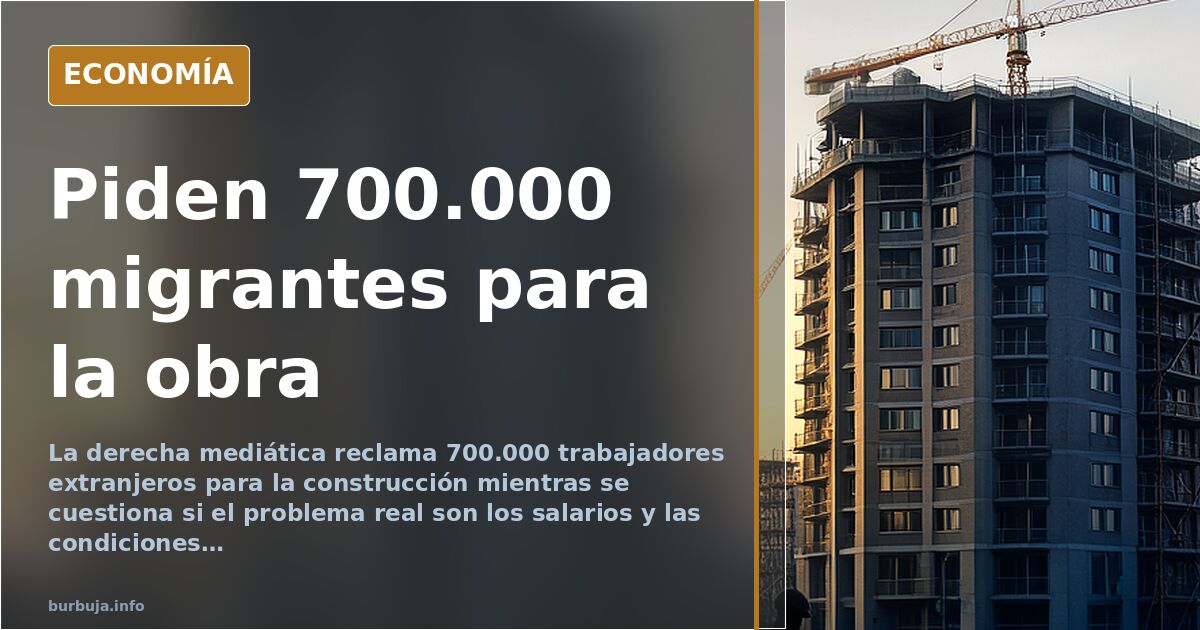
Spain's employers want 700,000 workers and construction is back at the centre of the debate
The construction industry says it is short of hands. Specifically, **700,000 workers** to build the homes that, according to the sector itself, are needed. The figure is circulating in media outlets that usually back the PP and VOX, and that is where the short circuit begins: the very people warning about the pull effect are signing editorials calling for labour to be imported wholesale. The contradiction is no small matter.
The figure is unsettling for a basic reason. If millions of people have entered Spain in recent years, where are the workers who were supposedly going to prop up the system? The question runs through the entire economic conversation and nobody answers it with numbers. Some point out that a significant share of that population is not employed, or works off the books, or simply does not show up in social security registration statistics. The joke writes itself.
How many immigrants have arrived, and why are workers missing?
Some are throwing around big numbers: **five million people in eight years**, or ten million in fifteen. At that volume, claiming there is a shortage of bricklayers requires an explanation the sector does not provide. One calculation doing the rounds in the debate suggests that not even three million of those recent arrivals would be working regularly. The maths does not add up.
The alternative argument points to conditions. Before importing labour, they say, the question should be why domestic workers left the sector in the first place: **wages, precarity and a lack of generational renewal**. Recruiting abroad is cheaper than raising pay. It is the construction boss's old temptation.
The housing business: who wins from 700,000 more bricklayers
The second leg of the problem is where these people will live. The diagnosis doing the rounds is uncomfortable: there is a housing shortfall measured in hundreds of thousands of units while people were crammed into shared rooms or staying with their parents into their thirties. Bringing in **700,000 workers** to build those homes simultaneously adds 700,000 people demanding a roof. Plus the family members who arrive later.
The result, according to this analysis, is additional pressure on rents in an already strained housing stock. Building takes years. Demand is immediate. The gap between the two is paid by the tenant.
The media right's contradiction on immigration
Here lies the political knot. Part of the PP and VOX electorate votes convinced that immigration is the problem. The same media outlets feeding that editorial line are now calling for **700,000 outsiders** to be brought in for the building sites. Squaring the circle.
The argument from the liberal trench is that all of this responds to pure employer self-interest: cheap, docile labour that pushes wages down. It is also argued that the politics of antiestéticar serves as cover while large corporations and tech companies clean up. The criticism barely distinguishes between left and right: both would be transmission belts for the same interests.
The sector that will not take off: permits, power and real capacity
Against the narrative of construction as an engine of growth, there is a technical objection that is rarely heard: **there is no such construction boom**. Permits are lacking, electrical capacity is lacking, serviced land is lacking. Without those pieces, promising 700,000 construction jobs is wishful thinking. What world do the people writing these headlines live in, some ask.
The German counterpoint illustrates it: while Spain calls for importing labour, Volkswagen was proposing a wage freeze until 2030 and cutting thousands of jobs. The European worker, in any case, is caught in the middle of the adjustment.
The forecast, with reservations: if housing demand keeps growing and construction does not take off because of the bottlenecks mentioned, prices will not fall. And the next time someone calls for bringing in 700,000 workers, it would be worth asking them first how many of those who already came are paying into the system.
Also available in: Deutsch
Summary of a discussion on Burbuja.info - Foro de economía, actualidad y política., translated from Spanish and reviewed before publication. Read the full discussion (70 replies).
More summaries
-
Spanish Employers Seek More Immigration: Wage Strategy or Labor Shortage?
Spain's CEOE calls for increased immigration, sparking debate over whether it addresses labor shortages or aims to lower wages through supply pressure.
-
Construction union seeks legal status for 700,000 immigrants
Spain's construction sector demands regularization for 700,000 workers, sparking debate over low wages and high housing costs.
-
Spain's construction sector faces aging workforce and labor shortage
65% of Spanish masons are over 45. Employers seek 700,000 workers amid debate on wages versus immigration.
-
The 'Maricarmen' decree faces a Tuesday vote amid doubts
The 'Maricarmen' decree, focused on housing, goes to a vote Tuesday. Old rents, Junts, omnibus bills, and planned applause...
-
Sánchez takes five days to decide whether to call early elections
Spain's prime minister has given himself five days to decide whether to call an early general election, with Monday set as the key date for an announcement.
-
Sol protest camp mobilizes against fascism it never names
On Saturday 3 October Madrid hosts two rival events: the antifascist camp at Puerta del Sol and a rally at Alcalá 21 under the banner of decent housing.