
Spain's El País Headlines War Scenario as EU Defense Spending Rises 12%
El País headlines 'Europe prepares for war scenario' as EU defense spending rises 12% and Brussels urges gas cuts.
English · Original discussion in Spanish · Published
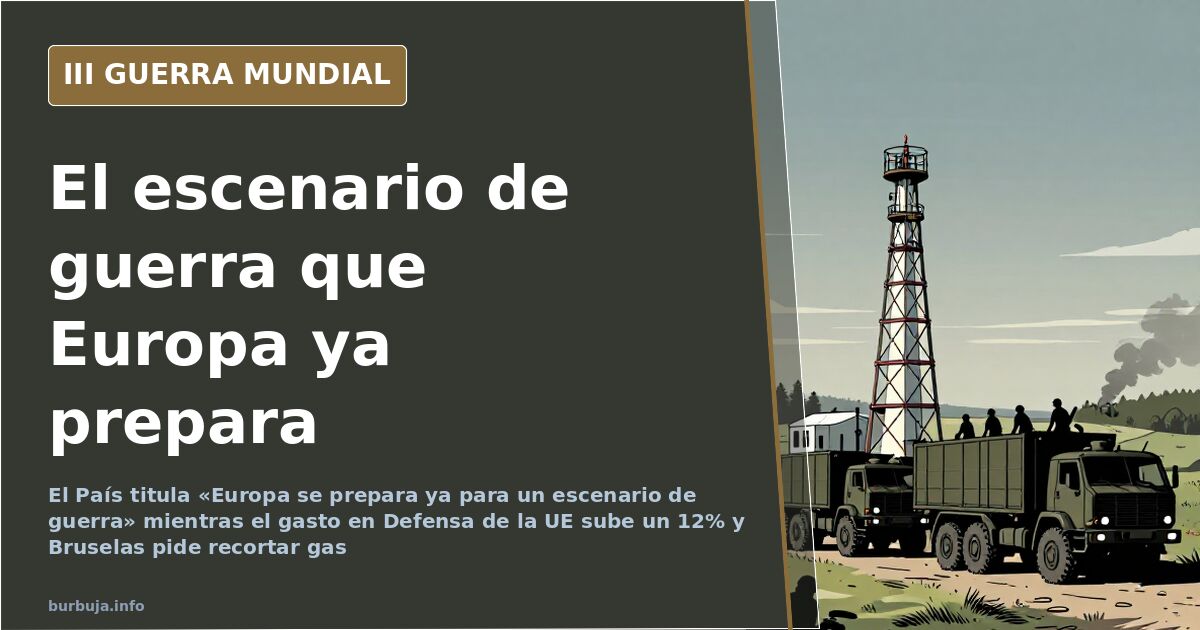
Spain’s El País headlines European war scenario
‘Europe prepares for war scenario.’ The headline El País placed on its front page was enough to instantly reopen the debate on rearmament, gas, taxes, and recruitment. The immediate context includes three verifiable facts: the European Commission has proposed a Council Recommendation to continue reducing natural gas demand—less heating to ‘ensure supplies’—EU defense spending is growing by 12% this year, and the Spanish Government is linked in these reports to a 25% increase. None of these figures declare war. But the packaging weighs heavily: the chosen word is war.
What ‘war scenario’ means and what the headline does not say
The term is intentionally ambiguous. It serves to discuss a war economy—budgets, industry, strategic reserves—without announcing any mobilization. This distance between what the paper says and what readers understand explains much of the subsequent noise. Some read logistical preparation. Others read a direct threat. Both read the same headline.
The dominant suspicion points to money. It is argued that the war framework legitimizes redirecting social spending to arms contracts, and the primary beneficiary will not be European: whoever conditions your energy supply is also pushing you to raise defense spending. The bill, in that narrative, is paid by the taxpayer who remains absent from the clinic.
Military spending rises and the question is at whose expense
The figures are what they are. EU defense spending grows by 12% this year, and forecasts point to increases over the next two fiscal years. In parallel, Brussels maintains its recommendation to continuously reduce natural gas consumption. Energy savings on one side, more military budget on the other.
The breakdown of items and the detail of where each euro goes is what does not appear in the headline. That is the uncomfortable part: the same framework that justifies tanks justifies explaining why other lines are cut. The complete calculation, item by item, is much less presentable than the front page.
Recruitment: from conscription to the referendum calculation
Here the conversation becomes concrete. Who goes to the front? The majority answer is one: not them. The antiestéticar of forced recruitment and potential mobilization of reservists by law emerges. There is even a forecast: a parliamentary authorization would suffice to recruit mandatory reservists, and the vote would pass with little noise, with broad support even in a hypothetical referendum held under pressure.
Against that, another analysis argues exactly the opposite. No civilian will be forced to the front, no nuclear missile will fall on European soil, and no one will go hungry. The price will be different: cars, travel, home temperature. It is the thesis of an economic war scenario, not military, and fits better with the figures than with the headlines.
Tacked onto this discussion is a demographic debate. It is argued that the front would not be covered by the profile currently discussing it online, offering no more data than intuition. It is a complaint, not an analysis.
The double standard of ‘no to war’
The most uncomfortable contrast is historical, and leaves no one looking good. In 2003, with Iraq, the left, the media, the actors, and even award shows threw themselves against the war. Now, with rearmament on the front page and spending soaring, that same block remains silent. The question repeats in every intervention: where are they?
And in the background, a fact that is not a hypothesis: there are already Europeans on the Ukrainian ground directing air defense systems and coordinating attacks. They are not forced recruits. Not yet.
Russia, NATO, and the clock of the official enemy
The geometry of the conflict is also debated. One part recalls two decades of Pilingui in power without a direct offensive against NATO and reads the drums as internal propaganda. Another points to the defenses being erected at the border—Surovikin-style—and turns the question around: if the one preparing to attack is not the other side.
Conspiracy theories circulate without any evidence to support them, about alliances between powers and jihadist groups. And a recurring idea about the calendar: ‘It is a race against time, we must start the war before Trump wins,’ summarizes one of the interventions.
The front page as a smoke screen
The most repeated reading is the most domestic. That the war scenario covers something else: corruption, open cases, commissions. It is noted that the newspaper publishing the headline gives little coverage to these issues. It is not a verifiable argument; it is an editorial intuition, and presented as such.
It is also observed that those with money have already moved. A well-known Spanish tech entrepreneur has bought a huge ranch in Argentina, and the founder of a major tech company has his refuge in Hawaii. They do not wait for the front page to prepare.
Where the analysis gets stuck is right here: no one knows if the scenario is accounting or literal, and almost everything else depends on that.
‘Europe prepares for war scenario.’ The headline El País placed on its front page was enough to instantly reopen the debate on rearmament, gas, taxes, and recruitment. The immediate context includes three verifiable facts: the European Commission has proposed a Council Recommendation to continue reducing natural gas demand—less heating to ‘ensure supplies’—EU defense spending is growing by 12% this year, and the Spanish Government is linked in these reports to a 25% increase. None of these figures declare war. But the packaging weighs heavily: the chosen word is war.
What ‘war scenario’ means and what the headline does not say
The term is intentionally ambiguous. It serves to discuss a war economy—budgets, industry, strategic reserves—without announcing any mobilization. This distance between what the paper says and what readers understand explains much of the subsequent noise. Some read logistical preparation. Others read a direct threat. Both read the same headline.
The dominant suspicion points to money. It is argued that the war framework legitimizes redirecting social spending to arms contracts, and the primary beneficiary will not be European: whoever conditions your energy supply is also pushing you to raise defense spending. The bill, in that narrative, is paid by the taxpayer who remains absent from the clinic.
Military spending rises and the question is at whose expense
The figures are what they are. EU defense spending grows by 12% this year, and forecasts point to increases over the next two fiscal years. In parallel, Brussels maintains its recommendation to continuously reduce natural gas consumption. Energy savings on one side, more military budget on the other.
The breakdown of items and the detail of where each euro goes is what does not appear in the headline. That is the uncomfortable part: the same framework that justifies tanks justifies explaining why other lines are cut. The complete calculation, item by item, is much less presentable than the front page.
Recruitment: from conscription to the referendum calculation
Here the conversation becomes concrete. Who goes to the front? The majority answer is one: not them. The antiestéticar of forced recruitment and potential mobilization of reservists by law emerges. There is even a forecast: a parliamentary authorization would suffice to recruit mandatory reservists, and the vote would pass with little noise, with broad support even in a hypothetical referendum held under pressure.
Against that, another analysis argues exactly the opposite. No civilian will be forced to the front, no nuclear missile will fall on European soil, and no one will go hungry. The price will be different: cars, travel, home temperature. It is the thesis of an economic war scenario, not military, and fits better with the figures than with the headlines.
Tacked onto this discussion is a demographic debate. It is argued that the front would not be covered by the profile currently discussing it online, offering no more data than intuition. It is a complaint, not an analysis.
The double standard of ‘no to war’
The most uncomfortable contrast is historical, and leaves no one looking good. In 2003, with Iraq, the left, the media, the actors, and even award shows threw themselves against the war. Now, with rearmament on the front page and spending soaring, that same block remains silent. The question repeats in every intervention: where are they?
And in the background, a fact that is not a hypothesis: there are already Europeans on the Ukrainian ground directing air defense systems and coordinating attacks. They are not forced recruits. Not yet.
Russia, NATO, and the clock of the official enemy
The geometry of the conflict is also debated. One part recalls two decades of Pilingui in power without a direct offensive against NATO and reads the drums as internal propaganda. Another points to the defenses being erected at the border—Surovikin-style—and turns the question around: if the one preparing to attack is not the other side.
Conspiracy theories circulate without any evidence to support them, about alliances between powers and jihadist groups. And a recurring idea about the calendar: ‘It is a race against time, we must start the war before Trump wins,’ summarizes one of the interventions.
The front page as a smoke screen
The most repeated reading is the most domestic. That the war scenario covers something else: corruption, open cases, commissions. It is noted that the newspaper publishing the headline gives little coverage to these issues. It is not a verifiable argument; it is an editorial intuition, and presented as such.
It is also observed that those with money have already moved. A well-known Spanish tech entrepreneur has bought a huge ranch in Argentina, and the founder of a major tech company has his refuge in Hawaii. They do not wait for the front page to prepare.
Where the analysis gets stuck is right here: no one knows if the scenario is accounting or literal, and almost everything else depends on that.
Summary of a discussion on Burbuja.info - Foro de economía, actualidad y política., translated from Spanish and reviewed before publication. Read the full discussion (320 replies).
More summaries
-
Europe Prepares 'War Hospitals' as Healthcare Systems Strain
NATO and EU medical evacuation plans clash with healthcare systems where blood tests take 14 days. The mortgage is another unresolved issue.
-
Ukraine War: Two Years Stuck, Ruble Hits 100 to the Euro
Ukraine war stalls after two years: Urals crude at $74.50 vs. Brent at $81.62, ruble at 100/euro. Focus shifts to endurance.
-
García-Margallo Warns of 'Total Confrontation' World War
García-Margallo states that the coming world war will be 'total confrontation' as Germany prepares hospitals for 1,000 daily casualties.
-
Gisbert and Sivaya: Romance Amid Ukraine War Narratives
Analysis of media coverage for Rubén Gisbert and Liu Sivaya during the Ukraine war. Is this digital propaganda or reality?
-
Russia claims France is preparing 2,000 troops for Ukraine
Russian intelligence (SVR) asserts France is deploying 2,000 soldiers to Ukraine, warning they will be priority targets for Russian attacks.
-
Putin’s Dilemma: Geopolitical Strategy or Psychopathy?
An analysis of Russia's stance: Is Putin's policy driven by geopolitical strategy or psychopathy? Examining theories on Putin's legacy and the multipolar order.