
Spain's Economy Surges 2.6%, France Seeks Underlying Reasons
Spain's economy grows 2.6% while France questions the drivers. L'Humanité highlights 2.3M jobs created post-pandemic, S&P upgrades Spain's rating amidst debt and real wage debates.
English · Original discussion in Spanish · Published
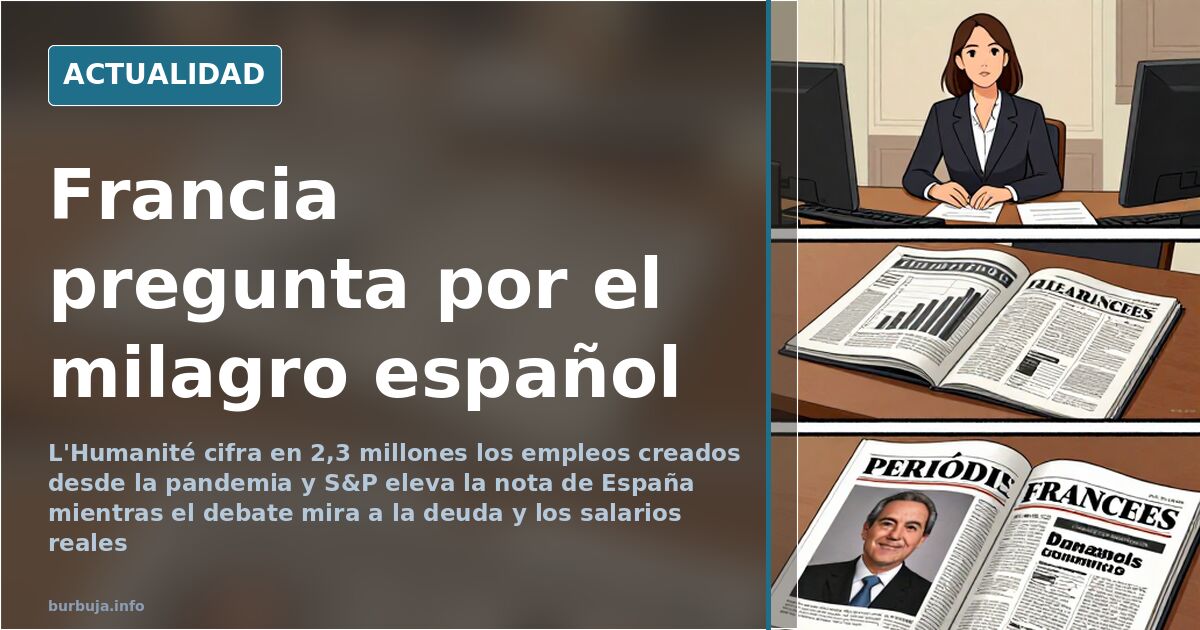
Spain grows 2.6%, and France asks what's behind it
How can the Spanish economy grow at 2.6% while the Eurozone stagnates at 0.9%? This question has been circulating in France for days and found an answer in the pages of l'Humanité, splashed with a smiling photo of Pedro Sánchez and a headline with over 6,000 likes: "How the left-wing government has reactivated the national economy." The newspaper adds the figure that most bothers the doomsayers: 2.3 million more jobs than before the pandemic. A week earlier, Standard & Poor's had upgraded Spain's rating due to its strong performance.
The narrative cannot be sustained by slogans. The French publication interviews Ignacio Álvarez Peralta, Professor of Economics at the Autonomous University of Madrid and former Secretary of State for Social Rights, to dismantle the easy explanation—tourism and population influx—and focuses on household consumption: it contributed 2.3 percentage points annually to an average GDP growth of 4.4% between 2021 and 2025. In other words: domestic spending, not just visitors in flip-flops, sustained the expansion.
How many jobs there are and how many are discounted
Nearly 22 million employed. That's the gross figure. The problem arises when discounting fixed-term discontinuous contracts: 21 million remain. With the PP in government, in 2017, it wasn't even 19 million.
The fixed-term discontinuous contract was a rarity years ago and is now common in temporary employment agencies. Some argue that its widespread use serves to mask unemployment and estimate that, including the unemployed and inactive, the real figure would be around 3.2 million. On the other hand, a simple argument prevails: someone working full-time is working, and Germany maintains seven million minijobs without anyone adding them to its unemployment figures.
The debt that doesn't make the headlines
Here, the miracle narrative becomes uncomfortable for both sides. In 2024, Spanish public debt stood at 101.8% of GDP, below France's 113% and Italy's 134.9%. And far from the 120% Spain reached in 2020.
Part of the analysis uses this data to debunk the stereotype of a wasteful country. Another part argues that GDP does not account for debt and that growing through domestic consumption and public spending has an expiration date. Both are partially right, which is often the case when the data is good and the context is mixed.
Real wages, minimum wage, and the grocery bill
GDP growth is not disputed. Its distribution is. Real wages have risen by a little over 2% in 30 years, according to the calculations circulating in the analysis, with periods of stagnation or decline under PP governments and increases concentrated in PSOE administrations. It's also noted that VAT rose from 18% to 21% under Mariano Rajoy.
The other flank is the minimum wage (SMI). The argument is that minimum wage hikes push out those earning slightly more: someone earning 1,400 euros ends up fired and rehired at the minimum. Small business owners complain; large ones, it's argued, take advantage to raise prices. Meanwhile, rents and housing costs have skyrocketed, and the grocery cart remains half-empty.
What Le Figaro says, which is not suspicious
If the endorsement came solely from a left-wing newspaper, the debate might be dismissed with a shrug. That's not the case. Le Figaro, founded in 1826 and with a conservative line, published that "Spain is teaching France a lesson" in several economic aspects. This detail unsettles those who expected the Spanish miracle narrative to be one-sided propaganda.
What France gains by praising Spain
There's a less charitable interpretation. Part of the analysis reads the article as a sponsored piece to justify expansionary fiscal policies in a country with stratospheric debt and a large, expensive state. Foreign growth would serve as an argument to demand more spending at home. And a darker current adds that France benefits from a growing Spain with low wages: cheap labor next door, contained competition.
Tourism and population incorporation also appear in the equation, although the interviewee dismisses them as central. Household consumption explains 2.3 points of that 4.4%, and that's not achieved solely with visitors.
With these figures, the miracle exists in the statistics and not always in the paychecks. It's quite ironic that a French newspaper questions it while half of Spain struggles to make ends meet. It will be even more ironic the day someone explains, from Paris or Madrid, why the miracle doesn't appear in bank accounts.
How can the Spanish economy grow at 2.6% while the Eurozone stagnates at 0.9%? This question has been circulating in France for days and found an answer in the pages of l'Humanité, splashed with a smiling photo of Pedro Sánchez and a headline with over 6,000 likes: "How the left-wing government has reactivated the national economy." The newspaper adds the figure that most bothers the doomsayers: 2.3 million more jobs than before the pandemic. A week earlier, Standard & Poor's had upgraded Spain's rating due to its strong performance.
The narrative cannot be sustained by slogans. The French publication interviews Ignacio Álvarez Peralta, Professor of Economics at the Autonomous University of Madrid and former Secretary of State for Social Rights, to dismantle the easy explanation—tourism and population influx—and focuses on household consumption: it contributed 2.3 percentage points annually to an average GDP growth of 4.4% between 2021 and 2025. In other words: domestic spending, not just visitors in flip-flops, sustained the expansion.
How many jobs there are and how many are discounted
Nearly 22 million employed. That's the gross figure. The problem arises when discounting fixed-term discontinuous contracts: 21 million remain. With the PP in government, in 2017, it wasn't even 19 million.
The fixed-term discontinuous contract was a rarity years ago and is now common in temporary employment agencies. Some argue that its widespread use serves to mask unemployment and estimate that, including the unemployed and inactive, the real figure would be around 3.2 million. On the other hand, a simple argument prevails: someone working full-time is working, and Germany maintains seven million minijobs without anyone adding them to its unemployment figures.
The debt that doesn't make the headlines
Here, the miracle narrative becomes uncomfortable for both sides. In 2024, Spanish public debt stood at 101.8% of GDP, below France's 113% and Italy's 134.9%. And far from the 120% Spain reached in 2020.
Part of the analysis uses this data to debunk the stereotype of a wasteful country. Another part argues that GDP does not account for debt and that growing through domestic consumption and public spending has an expiration date. Both are partially right, which is often the case when the data is good and the context is mixed.
Real wages, minimum wage, and the grocery bill
GDP growth is not disputed. Its distribution is. Real wages have risen by a little over 2% in 30 years, according to the calculations circulating in the analysis, with periods of stagnation or decline under PP governments and increases concentrated in PSOE administrations. It's also noted that VAT rose from 18% to 21% under Mariano Rajoy.
The other flank is the minimum wage (SMI). The argument is that minimum wage hikes push out those earning slightly more: someone earning 1,400 euros ends up fired and rehired at the minimum. Small business owners complain; large ones, it's argued, take advantage to raise prices. Meanwhile, rents and housing costs have skyrocketed, and the grocery cart remains half-empty.
What Le Figaro says, which is not suspicious
If the endorsement came solely from a left-wing newspaper, the debate might be dismissed with a shrug. That's not the case. Le Figaro, founded in 1826 and with a conservative line, published that "Spain is teaching France a lesson" in several economic aspects. This detail unsettles those who expected the Spanish miracle narrative to be one-sided propaganda.
What France gains by praising Spain
There's a less charitable interpretation. Part of the analysis reads the article as a sponsored piece to justify expansionary fiscal policies in a country with stratospheric debt and a large, expensive state. Foreign growth would serve as an argument to demand more spending at home. And a darker current adds that France benefits from a growing Spain with low wages: cheap labor next door, contained competition.
Tourism and population incorporation also appear in the equation, although the interviewee dismisses them as central. Household consumption explains 2.3 points of that 4.4%, and that's not achieved solely with visitors.
With these figures, the miracle exists in the statistics and not always in the paychecks. It's quite ironic that a French newspaper questions it while half of Spain struggles to make ends meet. It will be even more ironic the day someone explains, from Paris or Madrid, why the miracle doesn't appear in bank accounts.
Summary of a discussion on Burbuja.info - Foro de economía, actualidad y política., translated from Spanish and reviewed before publication. Read the full discussion (232 replies).
More summaries
-
Maricarmen blames Pedro Sánchez for her eviction.
A woman points to the President of the Government, Pedro Sánchez, as responsible for her eviction. The case highlights the housing crisis.
-
Pedro Sánchez meets NYC Mayor Zohran Mamdani amid Ceuta migrant crisis
Spanish PM Pedro Sánchez met with NYC Mayor Zohran Mamdani as the Ceuta migrant situation remains critical with thousands of arrivals.
-
Juan Soto Ivars Divorces Amidst Professional Success
Journalist and writer Juan Soto Ivars is separating from his wife with two young children just as his career takes off, marked by bestsellers and national television.
-
Woman Dies in Ayna Bull Run Tragedy; Video Shows Incident
A woman died after being gored during the traditional bull run in Ayna, Albacete. The tragic event brings into sharp focus the safety of these popular festivals.
-
Camryn Manheim and the ‘gay son’ she wished she had
A quote attributed to Camryn Manheim—wanting a gay son and dressing him in drag—reopens the debate over identities imposed on children
-
Vegan raw-food influencer dies at 39 after extreme diet
Zhanna Samsonova, 39, a raw-food influencer, died in Malaysia from an infection worsened by the 'exhaustion' of an extreme fruit-only diet