
Spain's Early Harvest Olive Oil: Quality vs Marketing Debate
Early harvest olive oil in Spain costs €19.50/liter, with high polyphenols and low yield sparking debate.
English · Original discussion in Spanish · Published
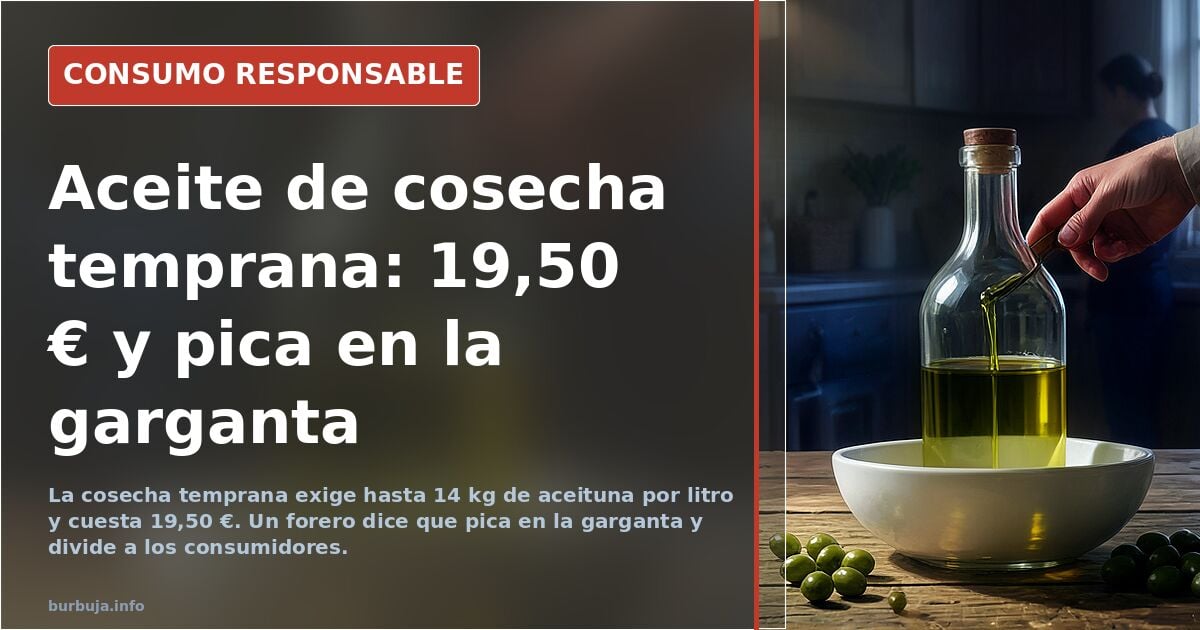
Early Harvest Olive Oil: €19.50/Liter Sparks Controversy
There is an olive oil costing €19.50 per liter that isn't found in a local gourmet shop. It is sold online, comes from Finca Vista Alegre (Jaén), and boasts cold milling within four hours of harvest. The label hides nothing: 837 mg/kg of polyphenols, rich in chlorophyll, and a yield that shocks. Producing just one liter requires between 10 and 14 kilos of green olives, compared to 4 or 5 kilos for traditional oil. The new harvest is here, and the price has peine the war between those who see exceptional quality and those who see only marketing.
The first battle takes place on the tree. Defenders of early harvest argue that olives are not picked unripe by mistake, but at their peak aromatic and nutritional moment, during *envero* (veraison), between October and early November. The economic sacrifice argument is their best weapon: if it were pure marketing, no producer would lose half their yield out of caprice. According to calculations circulating in the debate, 8 to 11 kilos of green olives are needed per liter. In both cases, the producer sacrifices quantity to gain intensity.
Polyphenols as Banner, Throat as Battlefield
The second round is sensory. The 837 mg/kg of polyphenols are the data proponents cite as proof of nutritional superiority. Green olives concentrate far more antioxidants than ripe ones, resulting in an oil that stings. That is where the problem begins. Some describe this sting as an assault: "it burns the throat like ammonia," says a critical voice. For others, this bitterness and sting are precisely the signature of a living, unfiltered oil that hasn't been tamed by refining.
The transparent bottle doesn't help heal wounds either. A sector of oil analysis considers packaging that lets light through a beginner's error, because UV radiation degrades polyphenols and oxidizes the product. The defense is quick: the bottle is designed for fast consumption, comes in individual thick cardboard boxes, and may incorporate UV filters. The packaging war is, in reality, the old war: do you buy oil to store or to enjoy?
Unfiltered, Limited Edition, and the Race for New Harvest
The third front is the most practical. Unfiltered oils, which retain all sediment and aroma, have become objects of desire. The majority recommendation is to use them within three months maximum because they oxidize quickly. Supply is limited, and some producers who used to make them have stopped. Mueloliva, a mill with awards for best oil in the world and several fourth places, keeps its unfiltered version as a limited edition that sells out fast. The new harvest isn't on the market yet, but veterans warn: stay alert because it flies off shelves.
The comparison with rapeseed oil from the 1980s looms over the conversation, though no one takes it literally. It is used more as a warning about what can happen when health controls relax than as a direct accusation. The parallelism is exaggerated, but serves to remind us that the food sector doesn't live solely on agricultural romanticism.
The price of €19.50 per liter is not an anomaly: it is the logical consequence of collapsing yields and growing demand. The new harvest of early harvest olive oil is here, with its transparent bottle, polyphenols, and sting. It remains to be seen if the Spanish consumer, accustomed to watching the price per liter like the Euribor, is willing to pay four times more for an oil that looks nothing like what their mother used for frying.
There is an olive oil costing €19.50 per liter that isn't found in a local gourmet shop. It is sold online, comes from Finca Vista Alegre (Jaén), and boasts cold milling within four hours of harvest. The label hides nothing: 837 mg/kg of polyphenols, rich in chlorophyll, and a yield that shocks. Producing just one liter requires between 10 and 14 kilos of green olives, compared to 4 or 5 kilos for traditional oil. The new harvest is here, and the price has peine the war between those who see exceptional quality and those who see only marketing.
The first battle takes place on the tree. Defenders of early harvest argue that olives are not picked unripe by mistake, but at their peak aromatic and nutritional moment, during *envero* (veraison), between October and early November. The economic sacrifice argument is their best weapon: if it were pure marketing, no producer would lose half their yield out of caprice. According to calculations circulating in the debate, 8 to 11 kilos of green olives are needed per liter. In both cases, the producer sacrifices quantity to gain intensity.
Polyphenols as Banner, Throat as Battlefield
The second round is sensory. The 837 mg/kg of polyphenols are the data proponents cite as proof of nutritional superiority. Green olives concentrate far more antioxidants than ripe ones, resulting in an oil that stings. That is where the problem begins. Some describe this sting as an assault: "it burns the throat like ammonia," says a critical voice. For others, this bitterness and sting are precisely the signature of a living, unfiltered oil that hasn't been tamed by refining.
The transparent bottle doesn't help heal wounds either. A sector of oil analysis considers packaging that lets light through a beginner's error, because UV radiation degrades polyphenols and oxidizes the product. The defense is quick: the bottle is designed for fast consumption, comes in individual thick cardboard boxes, and may incorporate UV filters. The packaging war is, in reality, the old war: do you buy oil to store or to enjoy?
Unfiltered, Limited Edition, and the Race for New Harvest
The third front is the most practical. Unfiltered oils, which retain all sediment and aroma, have become objects of desire. The majority recommendation is to use them within three months maximum because they oxidize quickly. Supply is limited, and some producers who used to make them have stopped. Mueloliva, a mill with awards for best oil in the world and several fourth places, keeps its unfiltered version as a limited edition that sells out fast. The new harvest isn't on the market yet, but veterans warn: stay alert because it flies off shelves.
The comparison with rapeseed oil from the 1980s looms over the conversation, though no one takes it literally. It is used more as a warning about what can happen when health controls relax than as a direct accusation. The parallelism is exaggerated, but serves to remind us that the food sector doesn't live solely on agricultural romanticism.
The price of €19.50 per liter is not an anomaly: it is the logical consequence of collapsing yields and growing demand. The new harvest of early harvest olive oil is here, with its transparent bottle, polyphenols, and sting. It remains to be seen if the Spanish consumer, accustomed to watching the price per liter like the Euribor, is willing to pay four times more for an oil that looks nothing like what their mother used for frying.
Also available in: Deutsch
Summary of a discussion on Burbuja.info - Foro de economía, actualidad y política., translated from Spanish and reviewed before publication. Read the full discussion (17 replies).
More summaries
-
Finding a free, covered oil change spot in Madrid
Rain in Madrid makes finding a free, covered, unmonitored spot for an oil change difficult. Users discuss garages and DIY options.
-
Costco Spain Tire Service: Premium Brands, Balancing Issues
Costco offers Michelin, Pirelli, and Bridgestone tires at competitive prices in Spain, but a customer reports missing wheel balancing. Key service details.
-
Free Adobe Acrobat Alternatives for PDF Editing
Users share free Adobe Acrobat alternatives like PDFGear, LibreOffice Draw, and PDF24, criticizing subscription costs.
-
Spain's V16 Beacon: €40 Cost and Compliance Doubts
Forums debate the mandatory V16 beacon in Spain, citing 500 models with half invalid and doubts about verification codes on packaging.
-
Shoes Indoors: Hygiene Issue or Cultural Clash?
Intense debate on Burbuja.info about whether wearing shoes indoors is unhygienic or a misunderstood cultural habit. What do the data say?
-
Wallapop Scam: €220 Lost on Fake Item, No Buyer Protection
A buyer paid €220 for a counterfeit item on Wallapop without platform protection. The seller offered €100 to avoid a negative review.