
Spain's 'Dog is not a child' article sparks debate
A 20minutos opinion piece claiming dogs are not children hits nearly one million views, reigniting debates on pet costs and demographics.
English · Original discussion in Spanish · Published
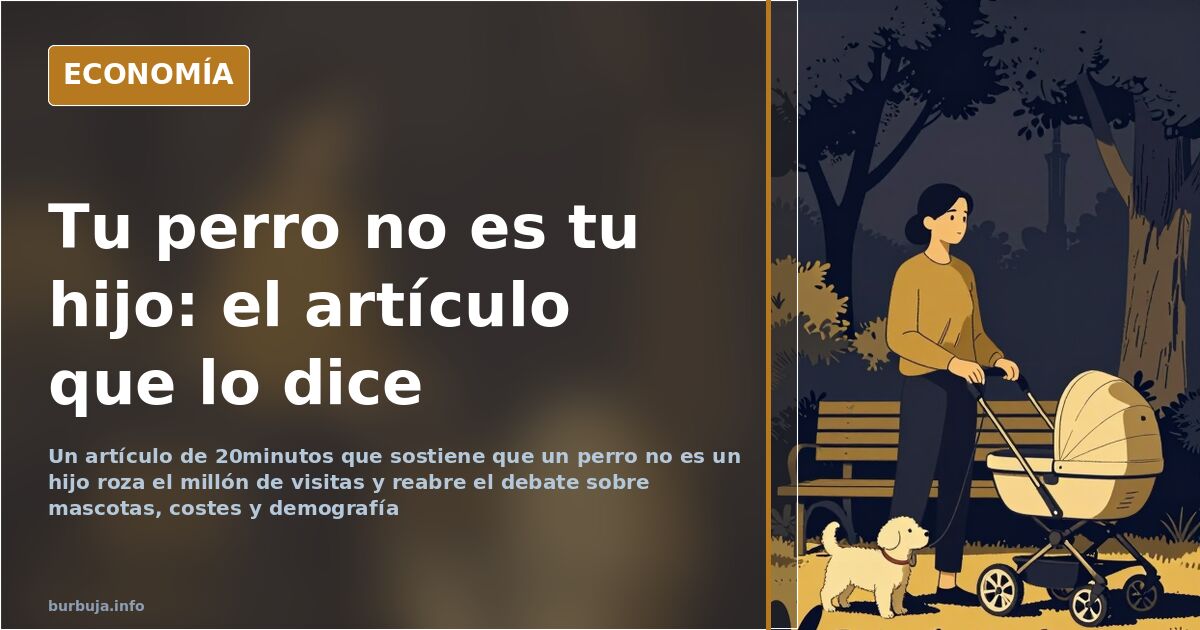
The dog is not your child: the article nearing a million views
A dog is not a child. Neither is a cat. This sounds like common sense until someone publishes it in a mainstream media outlet: then the fire starts. An opinion article in 20minutos arguing exactly this has accumulated nearly one million views and a flood of heated responses. The text, signed by Carlos G. Miranda, denounces that in Spain "we have gone from abandoning dogs at gas stations to giving them birthday cakes and congratulating them on Instagram as if they were furry children who bark." Behind the noise lies a serious discussion about money, demographics, and coexistence.
What does the 20minutos article say about dogs?
The text does not dispute affection for animals. It disputes their escalation. Contrary to the figure of the owner walking their dog, the article describes a drift: birthdays with cake, social media congratulations, and language that transfers categories reserved for humans onto the animal. The medium itself acknowledges the traction: the social media post nears one million views and has gathered a crowd of owners annoyed by the diagnosis.
The paradox pointed out by the text is well-known. Three decades ago, a dog was an animal bought for children, accompanied them for a few years, and too often ended up abandoned in a ditch or on the shoulder of a gas station. Today it occupies another place. The question is whether this change is a civilizational improvement or a substitution for other things.
Were dog owners protected during lockdown?
One of the most repeated points of the controversy refers to the pandemic. During home confinement, walking the dog was allowed while millions of people could not step outside for any other reason. Some argue that this demonstrated the privileged status of pets in the public priority scale; others respond that it was a practical exception dictated by the animal's physiological need, not the owner's right.
The detail matters because it sets the framework. If walking the dog was an essential activity and visiting a relative was not, the hierarchy was, at least, uncomfortable. The anecdote has become a recurring argument and has poisoned much of the subsequent exchange.
How much does a dog really cost: 780 hours a year
Here the numbers tighten. A circulating calculation breaks down the real cost of having a dog counting only time: two daily walks equal 60 hours a month; add one hour for the vet, three for cleaning hair, urine, and feces, and another for buying food. The total is around 65 hours monthly, meaning about 780 hours a year.
Valued at 10 euros per hour, just the time spent would exceed 7,800 euros annually. Adding food, vet bills, and a destroyed sofa, the estimated average bill approaches 9,000 euros per animal. With two or three, the figure skyrockets. The complete breakdown, item by item, surprises those who have never written it down.
"Dogs won't pay our pensions": the demographic background
The most uncomfortable argument is not economic. It is demographic. In a society with plummeting birth rates, some read the rise of pets as a symptom: love and care no longer directed at children are directed at animals. The conclusion, repeated sarcastically, is that a dog does not contribute to social security and will not pay anyone's pension.
The original article tries to explain the phenomenon appealing to capitalism, that white lie turned into a catch-all. It doesn't convince everyone. Another analytical current points in a different direction: raising children has become expensive and socially suspect, and the pet fills the gap left by that withdrawal. No one leaves the ring clearly right.
From abandonment at gas stations to the birthday cake
It is worth not forgetting the other extreme. Not so long ago, the family dog was the one tied to a bench in summer or thrown from a moving car on the way to the village. The comparison made by the article is this: from pure abandonment to current overprotection, with intermediate scales full of uncivil owners who do not pick up after their animal.
From this comes the most repeated reproach: the problem is not the dog, it is its owner. Night barking, urine on the sidewalk, and uncollected excrement poison neighborhood coexistence and fuel hostility towards anything smelling of pet. Those asking for civility are not always asking for fewer dogs, and that distinction is lost once the tone rises.
With these figures on the table, a silent retreat would be logical. It does not seem likely to happen: next time someone congratulates their dog on Instagram, the controversy will be served again. And it is difficult to predict if the pendulum will return to the dog as an animal or if, conversely, it will continue sliding towards the furry child.
A dog is not a child. Neither is a cat. This sounds like common sense until someone publishes it in a mainstream media outlet: then the fire starts. An opinion article in 20minutos arguing exactly this has accumulated nearly one million views and a flood of heated responses. The text, signed by Carlos G. Miranda, denounces that in Spain "we have gone from abandoning dogs at gas stations to giving them birthday cakes and congratulating them on Instagram as if they were furry children who bark." Behind the noise lies a serious discussion about money, demographics, and coexistence.
What does the 20minutos article say about dogs?
The text does not dispute affection for animals. It disputes their escalation. Contrary to the figure of the owner walking their dog, the article describes a drift: birthdays with cake, social media congratulations, and language that transfers categories reserved for humans onto the animal. The medium itself acknowledges the traction: the social media post nears one million views and has gathered a crowd of owners annoyed by the diagnosis.
The paradox pointed out by the text is well-known. Three decades ago, a dog was an animal bought for children, accompanied them for a few years, and too often ended up abandoned in a ditch or on the shoulder of a gas station. Today it occupies another place. The question is whether this change is a civilizational improvement or a substitution for other things.
Were dog owners protected during lockdown?
One of the most repeated points of the controversy refers to the pandemic. During home confinement, walking the dog was allowed while millions of people could not step outside for any other reason. Some argue that this demonstrated the privileged status of pets in the public priority scale; others respond that it was a practical exception dictated by the animal's physiological need, not the owner's right.
The detail matters because it sets the framework. If walking the dog was an essential activity and visiting a relative was not, the hierarchy was, at least, uncomfortable. The anecdote has become a recurring argument and has poisoned much of the subsequent exchange.
How much does a dog really cost: 780 hours a year
Here the numbers tighten. A circulating calculation breaks down the real cost of having a dog counting only time: two daily walks equal 60 hours a month; add one hour for the vet, three for cleaning hair, urine, and feces, and another for buying food. The total is around 65 hours monthly, meaning about 780 hours a year.
Valued at 10 euros per hour, just the time spent would exceed 7,800 euros annually. Adding food, vet bills, and a destroyed sofa, the estimated average bill approaches 9,000 euros per animal. With two or three, the figure skyrockets. The complete breakdown, item by item, surprises those who have never written it down.
"Dogs won't pay our pensions": the demographic background
The most uncomfortable argument is not economic. It is demographic. In a society with plummeting birth rates, some read the rise of pets as a symptom: love and care no longer directed at children are directed at animals. The conclusion, repeated sarcastically, is that a dog does not contribute to social security and will not pay anyone's pension.
The original article tries to explain the phenomenon appealing to capitalism, that white lie turned into a catch-all. It doesn't convince everyone. Another analytical current points in a different direction: raising children has become expensive and socially suspect, and the pet fills the gap left by that withdrawal. No one leaves the ring clearly right.
From abandonment at gas stations to the birthday cake
It is worth not forgetting the other extreme. Not so long ago, the family dog was the one tied to a bench in summer or thrown from a moving car on the way to the village. The comparison made by the article is this: from pure abandonment to current overprotection, with intermediate scales full of uncivil owners who do not pick up after their animal.
From this comes the most repeated reproach: the problem is not the dog, it is its owner. Night barking, urine on the sidewalk, and uncollected excrement poison neighborhood coexistence and fuel hostility towards anything smelling of pet. Those asking for civility are not always asking for fewer dogs, and that distinction is lost once the tone rises.
With these figures on the table, a silent retreat would be logical. It does not seem likely to happen: next time someone congratulates their dog on Instagram, the controversy will be served again. And it is difficult to predict if the pendulum will return to the dog as an animal or if, conversely, it will continue sliding towards the furry child.
Also available in: Deutsch
Summary of a discussion on Burbuja.info - Foro de economía, actualidad y política., translated from Spanish and reviewed before publication. Read the full discussion (136 replies).
More summaries
-
Alguazas Dog Owner: 'Just Puppies, Two Bites' After Fatal Attack
Josefa Bravo, 96, died four days after an attack in Alguazas. Her neighbor, the dogs’ owner, claims injuries were not animal-related.
-
Renting with a Dog: 125 Flats, Zero Landlords
A tenant visited 125 flats but signed no contract; owners cite damage, noise and default risk over pets.
-
Ayuso Breaks Iker Jiménez’s Rules in Controversial Horizon Interview
Madrid President Isabel Díaz Ayuso breaks Iker Jiménez’s no-politician rule, sparking debate on media pluralism and the Puerta del Sol protests.
-
Medical tourism strains Spain's public healthcare
Spain's universal system covers residents and non-residents. Debate focuses on medical tourism, waiting lists, and who pays the bill.
-
Trump escalates pressure on Iran over Strait of Hormuz
Trump threatens Iran with 'living in hell' unless it opens the Strait of Hormuz. North Korea and Venezuela precedents frame the analysis.
-
Spain Forum Debate: Did Sánchez Win or Lose?
46% of Spain's census relies on state funds. Polls give PP and Vox 212 seats, while PSOE resists amid forum debates.