
Spain's Deputy PM demands sacking of coaches who applauded Rubiales
Yolanda Díaz calls for the dismissal of national team coaches over applause, sparking debate on firing employees for public gestures.
English · Original discussion in Spanish · Published
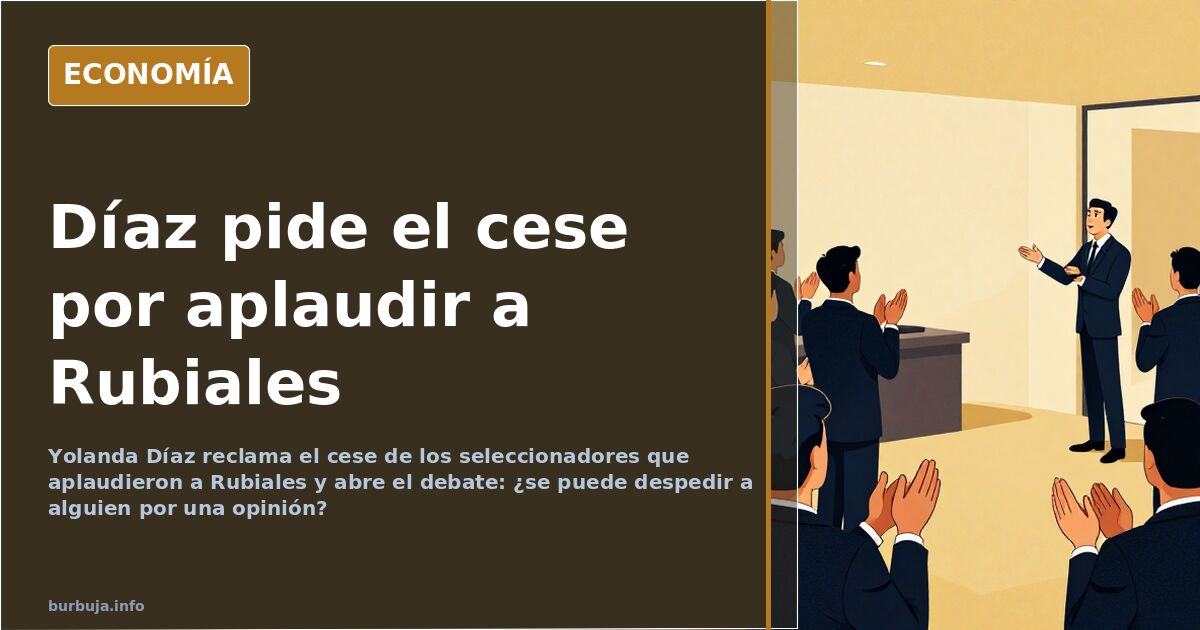
The applause that costs a job: Díaz seeks removal of Vilda and De la Fuente
An assembly and a room full of clapping hands. The gesture has become the center of the controversy. Yolanda Díaz, Spain’s Minister of Labor and Deputy Prime Minister, has made that applause the core argument to demand two dismissals: “The coaches who applauded Rubiales are not fit to remain in their posts,” she stated, adding that “anyone who applauds an alleged sensual assault [...] should not continue in their position.” She did not name them, but the context makes it clear: Vilda and De la Fuente.
The call for dismissal comes from the Government. And therein lies the crux: demanding the firing of two employees of a private entity for something they did with their hands, not their words.
From opinion to file: where is the limit?
Applause is not the kiss. In the case of Vilda and De la Fuente, no assault is attributed to them, but rather adhesion: having backed Rubiales with clapping. Some summarize this with a repeated formula, the crime by osmosis: guilt spreads through physical proximity or gestural adjacency. The question repeats itself in the debate: in which company do you fire someone for holding an opinion?
What if they applauded because they believed him?
One line of analysis argues that the two coaches were not supporting any conduct, but rather accepting Rubiales’ version at that specific moment. They believed the man, is the recurring phrase. Under this reading, the applause would measure credibility, not complicity: it would have been a room reaction, not a sarracena endorsement.
From the other side, the response is blunt. Applauding in that context is, for this interpretation, revictimizing the victim and turning those who do so into part of the support, not spectators. Therefore, the discussion is not legal but about interpreting the gesture.
The uncomfortable precedent: from marquis to sacked
The comparison circulating online involves Del Bosque, who was made a Marquis, versus the champion coach now being pushed out. He is being measured with a different yardstick and by political authorities. The thesis circulating is that the real target is not Rubiales, but rewriting the narrative: if the women’s team won under male leadership, an orderly exit would involve changing the bench and trusting time to erase the name. The detail that the targeted coach just won the title is, for this current, proof that conduct is not being judged, but the office held.
The labor framework: firing for an opinion
The online discussion raises whether one can be fired for applause. The most repeated argument points to a daily scene: there is no company where someone is kicked out for having an opinion. Against this view, another group argues that applause is not an opinion, but public backing for Rubiales. The entire case moves between these two formulations.
North Korea, Orwell, and thought police
Analogies have skyrocketed: totalitarian regimes, gulags, the thought police of 1984. These are dinner-table comparisons, exaggerated by definition, and should be treated as such: hyperbolas. But they point to a concern running through the thread. First, they went after Rubiales; now they are going after those who applauded him. The floating question remains: who is next on the list, and what criteria will be used?
The applause occurred during an assembly. If the criterion for dismissal is the gesture, it remains to be seen where the list cuts off.
An assembly and a room full of clapping hands. The gesture has become the center of the controversy. Yolanda Díaz, Spain’s Minister of Labor and Deputy Prime Minister, has made that applause the core argument to demand two dismissals: “The coaches who applauded Rubiales are not fit to remain in their posts,” she stated, adding that “anyone who applauds an alleged sensual assault [...] should not continue in their position.” She did not name them, but the context makes it clear: Vilda and De la Fuente.
The call for dismissal comes from the Government. And therein lies the crux: demanding the firing of two employees of a private entity for something they did with their hands, not their words.
From opinion to file: where is the limit?
Applause is not the kiss. In the case of Vilda and De la Fuente, no assault is attributed to them, but rather adhesion: having backed Rubiales with clapping. Some summarize this with a repeated formula, the crime by osmosis: guilt spreads through physical proximity or gestural adjacency. The question repeats itself in the debate: in which company do you fire someone for holding an opinion?
What if they applauded because they believed him?
One line of analysis argues that the two coaches were not supporting any conduct, but rather accepting Rubiales’ version at that specific moment. They believed the man, is the recurring phrase. Under this reading, the applause would measure credibility, not complicity: it would have been a room reaction, not a sarracena endorsement.
From the other side, the response is blunt. Applauding in that context is, for this interpretation, revictimizing the victim and turning those who do so into part of the support, not spectators. Therefore, the discussion is not legal but about interpreting the gesture.
The uncomfortable precedent: from marquis to sacked
The comparison circulating online involves Del Bosque, who was made a Marquis, versus the champion coach now being pushed out. He is being measured with a different yardstick and by political authorities. The thesis circulating is that the real target is not Rubiales, but rewriting the narrative: if the women’s team won under male leadership, an orderly exit would involve changing the bench and trusting time to erase the name. The detail that the targeted coach just won the title is, for this current, proof that conduct is not being judged, but the office held.
The labor framework: firing for an opinion
The online discussion raises whether one can be fired for applause. The most repeated argument points to a daily scene: there is no company where someone is kicked out for having an opinion. Against this view, another group argues that applause is not an opinion, but public backing for Rubiales. The entire case moves between these two formulations.
North Korea, Orwell, and thought police
Analogies have skyrocketed: totalitarian regimes, gulags, the thought police of 1984. These are dinner-table comparisons, exaggerated by definition, and should be treated as such: hyperbolas. But they point to a concern running through the thread. First, they went after Rubiales; now they are going after those who applauded him. The floating question remains: who is next on the list, and what criteria will be used?
The applause occurred during an assembly. If the criterion for dismissal is the gesture, it remains to be seen where the list cuts off.
Summary of a discussion on Burbuja.info - Foro de economía, actualidad y política., translated from Spanish and reviewed before publication. Read the full discussion (143 replies).
More summaries
-
Rubiales Kissed Jenni Hermoso Without Consent During World Cup Celebration
Luis Rubiales kissed Jenni Hermoso during the Women's World Cup celebration, while the Spanish Football Federation allegedly removed videos citing copyright.
-
Futpro, Jenni Hermoso’s agency, received 625.000€, according to an estimate
Futpro reportedly received some 625.000€ in public funds; 120.000 with only 61 founding members: nearly 2.000€ each
-
Rubiales scandal and its impact on RFEF's image
Analysis of public reaction after the Rubiales and Jennifer Hermoso incident, exploring the debate on consent and institutional management.
-
Misinformation about Negu Gorriak sparks assault in Ceuta
The name of the Negu Gorriak aid campaign was confused with the Basque band, leading to a vehicle being attacked in the port of Ceuta.
-
Spain probes ex-PM Zapatero over alleged Maduro ties
Spain's National Court investigates former PM José Luis Rodríguez Zapatero for links to Venezuela's Maduro regime, sparking debate on extradition risks.
-
Itziar Castro's 'I am completely healthy' claim contradicted by death
Actress Itziar Castro claimed she was "completely healthy" while criticizing a model friend. She died at 46 from cardiac arrest, sparking debate on obesity risks.