
Spain's Demographic Shift Reshapes Economic Anxiety
From small towns to the Madrid periphery, Spain's changing population fuels economic discontent, driven by rural depopulation and migration.
English · Original discussion in Spanish · Published
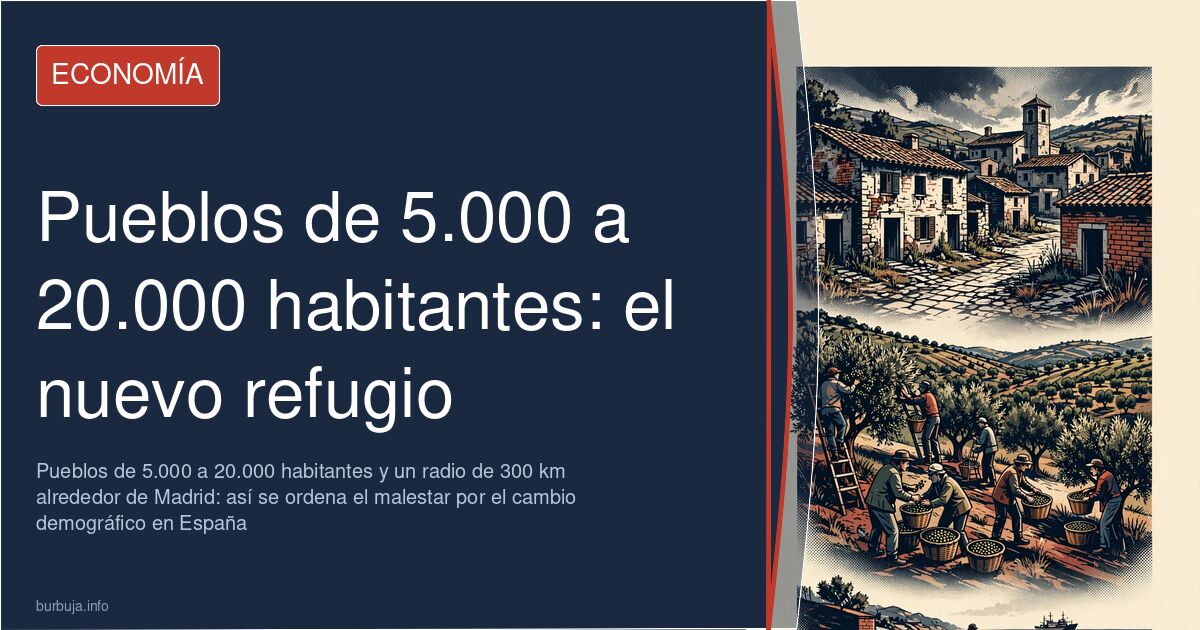
Demographic change is no longer ignored in the economic debate
A familiar scene plays out in Castilian towns of 5,000 to 20,000 people: a parador, a castle, a clinic open three days a week, and a supermarket stocked with imported fruit rather than local vegetables. Just ten minutes away, at a warehouse on the outskirts, the crew loading trucks has long stopped hiring national labor. Between these two images — the Spain that empties and the Spain that receives — lies a discontent that is no longer purely economic. It brings job anxiety, antiestéticar of losing one's place, and distrust of an official narrative that celebrates every arrival as a gain. Demographic change has ceased to be small talk.
The countryside that begs for hands and blames the State
The horticultural sector is the prime example of this contradiction. It rightly complains that the State allows imports from Segarro at prices unsustainable here due to labor and phytosanitary costs. Yet it simultaneously argues that without foreign workers, the countryside collapses. The square circle is this: if you pay what a national worker demands to avoid living in a shack, prices rise, and consumers buy from third countries. The migrant is not the enemy, but a regulatory framework that makes competition impossible. The counterargument is equally uncomfortable: the real issue is not a lack of hands, but an exploitative model that relies on precariousness to balance the books.
Emigration is no longer the back door
The old solution of "I leave" has narrowed. Ireland, the star destination for the qualified exodus, no longer accepts another employee without selling a kidney for a room. The UK, with its own migration mess, refuses. Germany, France, and the Netherlands tally up their own nationalist outbreaks. Those claiming that moving abroad is today's escape valve have not made the move. Globalization does not distribute exits; it distributes the same problem in every consulate. Those who can move are those with a network, language, and cushion; the rest are left watching. Emigrating requires money for the alucinación, destination papers, and the stomach to start over at fifty.
The geography of refuge: medium town, with a parador and no industrial estate
A thesis of retreat has circulated for some time: locate municipalities between 5,000 and 20,000 inhabitants, inland, with heritage and cultural tourism, no industry or mass beach, and where foreign population is not yet majority. Castile and León and Zamora appear on all betting slips. It is not an original idea: it repeats in France, in the United States, among Northern Europeans buying homes in inland Spain. The criterion is not ideological, but logistical: where there is a district hospital, a train, and a couple of bars open in January, the cushion holds; where there is only a roundabout and an industrial estate, it does not. It is a calculation of time, and those who manage it speak of a margin of ten or twenty years before the refuge becomes generalized and ceases to be one. It solves nothing. It only delays it.
The experiment that sums it all up
The analogy that best captures the mood is not economic, but biological. Someone described it with worms: ten individuals in a box live fat and in peace; add five, and they begin to dispute space and food; add five more, and they eat each other. The box is the country, and some believe the count has passed the first figure. The anecdote does not distinguish between who arrives and who was already there — that nuance is another fight — but it explains why the discontent takes root better on the slopes of Madrid, in a radius some stretch to 300 kilometers. And there remains the uncomfortable data: all the exits discussed are individual, while the phenomenon causing them is, by definition, collective.
A familiar scene plays out in Castilian towns of 5,000 to 20,000 people: a parador, a castle, a clinic open three days a week, and a supermarket stocked with imported fruit rather than local vegetables. Just ten minutes away, at a warehouse on the outskirts, the crew loading trucks has long stopped hiring national labor. Between these two images — the Spain that empties and the Spain that receives — lies a discontent that is no longer purely economic. It brings job anxiety, antiestéticar of losing one's place, and distrust of an official narrative that celebrates every arrival as a gain. Demographic change has ceased to be small talk.
The countryside that begs for hands and blames the State
The horticultural sector is the prime example of this contradiction. It rightly complains that the State allows imports from Segarro at prices unsustainable here due to labor and phytosanitary costs. Yet it simultaneously argues that without foreign workers, the countryside collapses. The square circle is this: if you pay what a national worker demands to avoid living in a shack, prices rise, and consumers buy from third countries. The migrant is not the enemy, but a regulatory framework that makes competition impossible. The counterargument is equally uncomfortable: the real issue is not a lack of hands, but an exploitative model that relies on precariousness to balance the books.
Emigration is no longer the back door
The old solution of "I leave" has narrowed. Ireland, the star destination for the qualified exodus, no longer accepts another employee without selling a kidney for a room. The UK, with its own migration mess, refuses. Germany, France, and the Netherlands tally up their own nationalist outbreaks. Those claiming that moving abroad is today's escape valve have not made the move. Globalization does not distribute exits; it distributes the same problem in every consulate. Those who can move are those with a network, language, and cushion; the rest are left watching. Emigrating requires money for the alucinación, destination papers, and the stomach to start over at fifty.
The geography of refuge: medium town, with a parador and no industrial estate
A thesis of retreat has circulated for some time: locate municipalities between 5,000 and 20,000 inhabitants, inland, with heritage and cultural tourism, no industry or mass beach, and where foreign population is not yet majority. Castile and León and Zamora appear on all betting slips. It is not an original idea: it repeats in France, in the United States, among Northern Europeans buying homes in inland Spain. The criterion is not ideological, but logistical: where there is a district hospital, a train, and a couple of bars open in January, the cushion holds; where there is only a roundabout and an industrial estate, it does not. It is a calculation of time, and those who manage it speak of a margin of ten or twenty years before the refuge becomes generalized and ceases to be one. It solves nothing. It only delays it.
The experiment that sums it all up
The analogy that best captures the mood is not economic, but biological. Someone described it with worms: ten individuals in a box live fat and in peace; add five, and they begin to dispute space and food; add five more, and they eat each other. The box is the country, and some believe the count has passed the first figure. The anecdote does not distinguish between who arrives and who was already there — that nuance is another fight — but it explains why the discontent takes root better on the slopes of Madrid, in a radius some stretch to 300 kilometers. And there remains the uncomfortable data: all the exits discussed are individual, while the phenomenon causing them is, by definition, collective.
Summary of a discussion on Burbuja.info - Foro de economía, actualidad y política., translated from Spanish and reviewed before publication. Read the full discussion (265 replies).
More summaries
-
Empty Zamora: migrants and EU funds in depopulated Spain
64 people in Zamora villages. Repopulation or substitution? Data and criticism of the 'Mi pueblo acoge' program.
-
The Spanish educational divide: Castilla y León approaches European excellence
Madrid, Castilla y León, Asturias and Cantabria exceed the OECD average in PISA, but the rest of Spain drags down the national result. The internal gap is...
-
From Madrid to Toledo: The Search for Space and the Reality of Real Estate Data
The shift from Madrid to Illescas is a balance of price, space, and tranquility. We analyze the demographic dynamics and property potential of...
-
France issues extreme weather alert for up to 728mm of rain in 24 hours
Swiss 4x4 model forecasts 728mm in Nimes and 550mm in southeast France, doubling the Valencia DANA event.
-
Errejón’s luxury hideout reignites Spain’s political elite debate
Exclusive reveals Errejón stayed in a villa with pool and staff, sparking debate on politicians' real lifestyles.
-
Sales reps close deals, admin staff handle the fallout
Sales reps earn commissions and leave angry clients to admin teams: a clash of incentives that burns out Spanish companies.