
Spain's demographic shift: From rare immigrants to mixed classrooms
Testimonies date Spain's demographic turn between 1998 and 2005, citing construction jobs as key drivers.
English · Original discussion in Spanish · Published
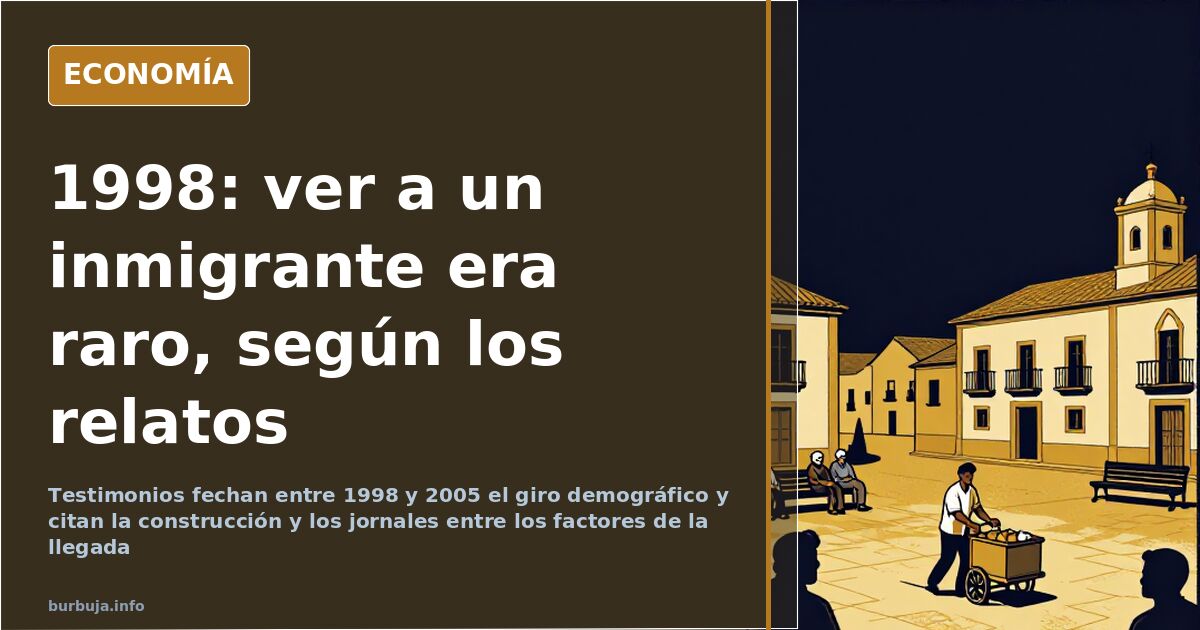
The day an immigrant was the exception: Spain since 1998
According to various accounts, in 1998 a single student born abroad was enough for the entire school to know them by name in some areas. For those involved in the debate, immigration was then a neighborhood rarity, not a structural phenomenon. They describe shops run by local families, no low-cost hair salons, no kebab on the corner. This memory is repeated insistently among those who lived through that decade, almost with the same words and always with the same underlying question: how did the landscape change so much in such little time? The sequence described in these stories is clear; the explanation each person gives is far less so.
How many immigrants were there in Spain before 2000?
Very few, and highly concentrated, according to these accounts. Outside Madrid, Barcelona, and some tourist towns, encountering someone born abroad was rare enough to be discussed at home. In Torrevieja, vendors of fans arriving from Africa are remembered before that date, and in inland villages, the first migrant family appears, according to several reports, around the turn of the century. An uncomfortable anecdote serves as a thermometer: the Darder Museum in Banyoles displayed the preserved body of an African man as its star attraction, and the decision to repatriate the remains upset part of the neighborhood.
This rarity affected daily interactions. A single foreign student could be known throughout the high school, and nicknames and jokes were part of the landscape. Several accounts admit episodes of bullying: a female classmate chased across the playground with a piece of ham in her hand, for example.
The €30 daily wage and the pull of construction
According to the stories, construction was an economic engine of this shift. During the real estate bubble, testimonies describe squares crowded with candidates waiting to hop into vans and a silent bidding war to be first. The rates circulating are explicit: €30 a day for Segarro and between €40 and €50 for a South American laborer, according to a testimony citing employers.
Regarding total magnitude, one participant throws out a round figure: seven million people during the bubble. It appears without source or breakdown, so it should be read as what it is, an unverified figure. Several accounts point in the same direction: an economy growing on concrete needed arms and found them abroad. The discussion about the net balance came later.
When did it stop being exotic? The mid-2000s turning point
The dates do not fully coincide, but they overlap. Some place the first surprise in 2003, upon returning to a provincial capital after years away and finding groups of Latin Americans on the street as if they were visitors. Others fix the inflection point in 2005, when presence became generalized in medium-sized cities. And a third reading delays the visible explosion until 2012 or 2013, even in towns within metropolitan areas.
The change was also visible in shop windows. The neighborhood store run by locals gave way, according to one testimony, to a five-euro hair salon. The transformation of local commerce was one of the visible indicators that the neighborhood composition had changed.
The narrative of astonishment has its reverse side. Part of the testimonies recall that in the nineties hardly any immigrants were seen, while others nuance that the nostalgia refers to poor immigrants, not other foreigners. The accounts do not resolve whether the change was in volume or social profile.
Politics enters the equation
Since 2019, part of the accounts link the new acceleration to political decisions: agreements with Segarro, the role of the European Union, and government migration policy. It is a repeated reading, but those who support it rely on neighborhood observation, not statistical series. Also circulating is the idea, unverified, that identity documents are distributed generously in South American countries.
One participant cites Asian countries as a counterexample, where, they say, migratory control is strict and prior.
What remains of the neighborhood: Mixed classrooms and half-built coexistence
Generations raised in already-mixed schools provide the most uncomfortable material. Some claim to have always felt apart, with the sensation that classmates of other origins were not equal. The same variation appears in employment: some remember being the only Spaniard at their workplace.
Official data is not part of this material. No one cites the National Statistics Institute (INE) or the municipal register; everything rests on direct observation, neighborhood memory, and approximate counts. This does not invalidate the description, but limits conclusions: a demographic change of this scale requires long series, not impressions.
According to some accounts, the mixing cannot be reversed because second generations are already in classrooms and their weight will grow. What these stories take for granted is that that neighborhood, as they remember it, never returns.
Also available in: Deutsch
Summary of a discussion on Burbuja.info - Foro de economía, actualidad y política., translated from Spanish and reviewed before publication. Read the full discussion (183 replies).
More summaries
-
Spain’s VOX Party Accelerates Nationality for Latinos, Filipinos, and Equatorial Guineans
Spain’s VOX party proposes cutting residency to two years for Latin Americans, Filipinos, and Equatorial Guineans, aiming to fill labor shortages amid high unemployment.
-
Why Equatorial Guinea Attracts Only 5,000 Visitors Annually
Equatorial Guinea sees just 5,000 yearly visitors due to high costs, strict visa rules, and a lack of tourism infrastructure.
-
Equatorial Guinea donates one million to Spain after the Valencia floods
Equatorial Guinea donates one million euros to Spain after the DANA floods: a gesture of solidarity that reopens the debate on aid effectiveness and historical ties.
-
Pornhub’s VP is an Orthodox Rabbi: The Ethical Paradox
Solomon Friedman, an ordained Orthodox rabbi, serves as Pornhub’s vice president, sparking debate on ethics, parental responsibility, and the adult industry’s influence.
-
Neverdownism: when house prices become a matter of faith
Neverdownism turns housing into a dogma: anyone who disagrees is branded a cultist. An analysis of a debate that admits no corrections.
-
Spain's PP and VOX in Burgos: torn posters and a coalition in crisis
The head of the PP in Burgos was caught on video tearing down VOX posters. Spain's right-wing coalition is wobbling and the city's municipal budget is now in limbo.