
Spain's Demographic Shift: Forum Debate on Birth Rates
A forum thread discusses Spain's declining native birth rates, migration-driven demographic replacement, and resulting social tensions.
English · Original discussion in Spanish · Published
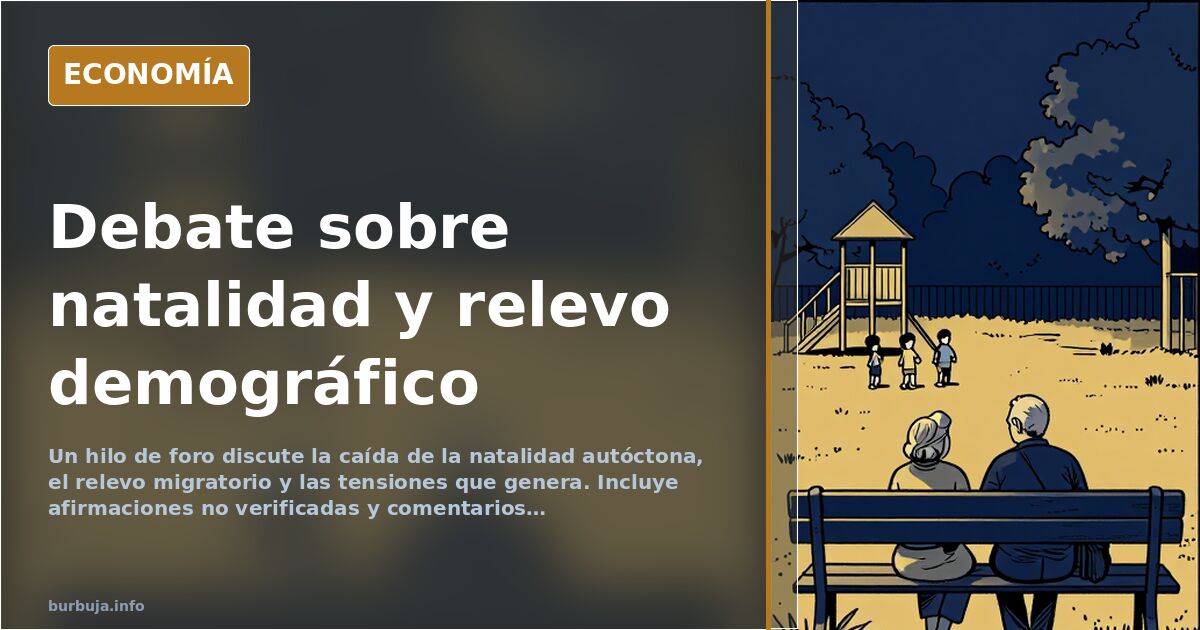
Birth Rates Plummet as Demographic Replacement Hits Schools
What happens when a country stops having children? The question is not rhetorical. In Spain, annual births are roughly 300,000 fewer than at their historical peak, according to calculations circulating in the debate, and this gap is being filled generation by generation by people of migrant origin. The discussion about whether Spaniards will become a minority in twenty years is not an exercise in futurology: it is a calculation that, according to some participants, is already visible in schools, unemployment lists, and state budgets.
The starting point is summarized by an idea running through the entire analysis: native birth rates are low, those of recent arrivals are higher, and the result is a change in demographic composition advancing faster than public policy acknowledges. Some date this shift to less than two decades. Others argue it has already peine.
The Cost of Each Child Not Born
The most striking calculation presented is the accounting savings. If the State spends approximately €6,000 per year per student in non-university education alone, multiplying that figure by 18 years of upbringing results in a cost of €108,000 for each person reaching adulthood, according to a calculation circulating in the debate. With 300,000 fewer births annually, accumulated savings would exceed €32.4 billion for a single cohort. And that excludes healthcare.
The data is uncomfortable because it inverts the narrative. It is not just that there are fewer children: the system would have a perverse incentive for them not to exist. Fewer cribs, less current spending, less pressure on public accounts in the short term. In the long term, the problem is the inverse: fewer contributors to pay pensions for an aging population. The trap is textbook, but no one disables it.
Schools as a Thermometer of Change
Macro statistics remain abstract until brought down to the playground. The repeated observation is that in many classrooms, the percentage of students of migrant origin has risen from one-third to half in little more than a decade. This is not a projection: it is what, according to some participants, is seen upon leaving class. Those with school-age children report it without embellishment, and the trend, they say, continues to rise.
Comparison with the United States appears as a mirror. There, the non-Hispanic white population is already below 50%, whereas in 1970 it was around 85%, according to claims made in the debate. The change would have occurred in a single generation. The conclusion drawn is that the process does not need centuries: it suffices for one cohort to stop reproducing and another to do so above replacement levels.
Why People Don't Have Children: Housing, Wages, and Dumping
Economic explanations gain weight over cultural ones. Housing has become the main brake: those who bought at low prices and rent at high prices capture the income of an entire generation, it is argued. Added to this is the effect of labor dumping, which compresses wages and makes an average salary insufficient to support a family. The average number of children among Spaniards living abroad rises to between two and three; within Spain, it falls below replacement levels, according to assertions.
Some point to the massive incorporation of women into the labor market and the disappearance of the large-family model as structural causes. Others reduce it to an issue of incentives: while having children is not fiscally rewarded, the rational decision is not to have them. The diagnosis intersects with immigration: if workers are missing, it is argued, it is not due to a lack of hands, but a lack of willingness to pay salaries that make life viable.
Migration Replacement and Its Limits
The birth rate of the migrant population is higher, but not infinite. The second generation converges toward the average: barely reaching two children per couple, according to claims. The replacement effect, therefore, would concentrate in the first generation and dilute afterwards. This does not prevent the change in composition from being real and rapid, but nuances the idea of linear substitution.
The discussion becomes complicated when trying to lump all migrants together. It is not a homogeneous block: there are very different religious, cultural, and economic profiles, and their integration depends on variables ranging from language to neighborhood. The operational question is not how many arrive, but how many stay, how many contribute, and what happens to their children.
Proposals and Why They Aren't Implemented
Recipes circulating range from border control to hiring at source with prior contracts, passing through tightening conditions for access to employment. The underlying idea is that a welfare system cannot be sustained with an aging population and unfiltered labor immigration. The obstacle is political: any measure reordering migratory flows clashes with the official narrative and lack of agreement.
Meanwhile, the demographic trend trinc its course. Those who can move to gated communities or other countries; those who cannot stay and watch the landscape change. The question of whether we will be a minority has an uncomfortable answer: in some age groups and areas, we would already be, according to some participants. For the country as a whole, the date depends on whom you ask and what counts as a minority.
In the end, the only certainty is arithmetic. A country that does not replace its population does not need anyone to conquer it: it fades away on its own. And while debating whether the glass is half full or half empty, the water keeps falling.
What happens when a country stops having children? The question is not rhetorical. In Spain, annual births are roughly 300,000 fewer than at their historical peak, according to calculations circulating in the debate, and this gap is being filled generation by generation by people of migrant origin. The discussion about whether Spaniards will become a minority in twenty years is not an exercise in futurology: it is a calculation that, according to some participants, is already visible in schools, unemployment lists, and state budgets.
The starting point is summarized by an idea running through the entire analysis: native birth rates are low, those of recent arrivals are higher, and the result is a change in demographic composition advancing faster than public policy acknowledges. Some date this shift to less than two decades. Others argue it has already peine.
The Cost of Each Child Not Born
The most striking calculation presented is the accounting savings. If the State spends approximately €6,000 per year per student in non-university education alone, multiplying that figure by 18 years of upbringing results in a cost of €108,000 for each person reaching adulthood, according to a calculation circulating in the debate. With 300,000 fewer births annually, accumulated savings would exceed €32.4 billion for a single cohort. And that excludes healthcare.
The data is uncomfortable because it inverts the narrative. It is not just that there are fewer children: the system would have a perverse incentive for them not to exist. Fewer cribs, less current spending, less pressure on public accounts in the short term. In the long term, the problem is the inverse: fewer contributors to pay pensions for an aging population. The trap is textbook, but no one disables it.
Schools as a Thermometer of Change
Macro statistics remain abstract until brought down to the playground. The repeated observation is that in many classrooms, the percentage of students of migrant origin has risen from one-third to half in little more than a decade. This is not a projection: it is what, according to some participants, is seen upon leaving class. Those with school-age children report it without embellishment, and the trend, they say, continues to rise.
Comparison with the United States appears as a mirror. There, the non-Hispanic white population is already below 50%, whereas in 1970 it was around 85%, according to claims made in the debate. The change would have occurred in a single generation. The conclusion drawn is that the process does not need centuries: it suffices for one cohort to stop reproducing and another to do so above replacement levels.
Why People Don't Have Children: Housing, Wages, and Dumping
Economic explanations gain weight over cultural ones. Housing has become the main brake: those who bought at low prices and rent at high prices capture the income of an entire generation, it is argued. Added to this is the effect of labor dumping, which compresses wages and makes an average salary insufficient to support a family. The average number of children among Spaniards living abroad rises to between two and three; within Spain, it falls below replacement levels, according to assertions.
Some point to the massive incorporation of women into the labor market and the disappearance of the large-family model as structural causes. Others reduce it to an issue of incentives: while having children is not fiscally rewarded, the rational decision is not to have them. The diagnosis intersects with immigration: if workers are missing, it is argued, it is not due to a lack of hands, but a lack of willingness to pay salaries that make life viable.
Migration Replacement and Its Limits
The birth rate of the migrant population is higher, but not infinite. The second generation converges toward the average: barely reaching two children per couple, according to claims. The replacement effect, therefore, would concentrate in the first generation and dilute afterwards. This does not prevent the change in composition from being real and rapid, but nuances the idea of linear substitution.
The discussion becomes complicated when trying to lump all migrants together. It is not a homogeneous block: there are very different religious, cultural, and economic profiles, and their integration depends on variables ranging from language to neighborhood. The operational question is not how many arrive, but how many stay, how many contribute, and what happens to their children.
Proposals and Why They Aren't Implemented
Recipes circulating range from border control to hiring at source with prior contracts, passing through tightening conditions for access to employment. The underlying idea is that a welfare system cannot be sustained with an aging population and unfiltered labor immigration. The obstacle is political: any measure reordering migratory flows clashes with the official narrative and lack of agreement.
Meanwhile, the demographic trend trinc its course. Those who can move to gated communities or other countries; those who cannot stay and watch the landscape change. The question of whether we will be a minority has an uncomfortable answer: in some age groups and areas, we would already be, according to some participants. For the country as a whole, the date depends on whom you ask and what counts as a minority.
In the end, the only certainty is arithmetic. A country that does not replace its population does not need anyone to conquer it: it fades away on its own. And while debating whether the glass is half full or half empty, the water keeps falling.
Also available in: Deutsch
Summary of a discussion on Burbuja.info - Foro de economía, actualidad y política., translated from Spanish and reviewed before publication. Read the full discussion (106 replies).
More summaries
-
Spain's Social Security covers only 70% of pension costs
Social Security income covers just 70% of pension spending, fueling debate on immigration's impact on the system.
-
Claim: Spain’s Pension Fund Short €50 Billion for Three Months
Viral post claims Social Security lacks funds for three months of pensions. Debate covers the reserve fund, contributions, and potential solutions.
-
Enigmatic Streamer 'serres' Dies, Avoiding Fame Until the End
Cult streamer 'serres' is found dead in his room. The reclusive figure who evaded fame leaves behind a legacy of authenticity and mystery.
-
Titanic Submersible Implosion: Four Safe Dives Preceded Disaster
At $250,000 per seat, the submersible featured a porthole rated for only 1,300 meters and carbon fiber construction before imploding at 4,000 meters.
-
Why heavy rain isn't filling Spain's reservoirs
Despite torrential rains, Spanish reservoir levels remain low amid debates over deforestation, evaporation, and hidden water transfers.
-
Sánchez wins headlines as right-wing bloc fails to secure majority
Six international papers declare Sánchez the winner while the right lacks a majority, leaving Junts with the key to investiture.