
Spain's demographic crisis sparks debate on national salvation
Analysis explores if Spain can reverse its demographic and value crisis, pitting pessimism against hope in new generations.
English · Original discussion in Spanish · Published
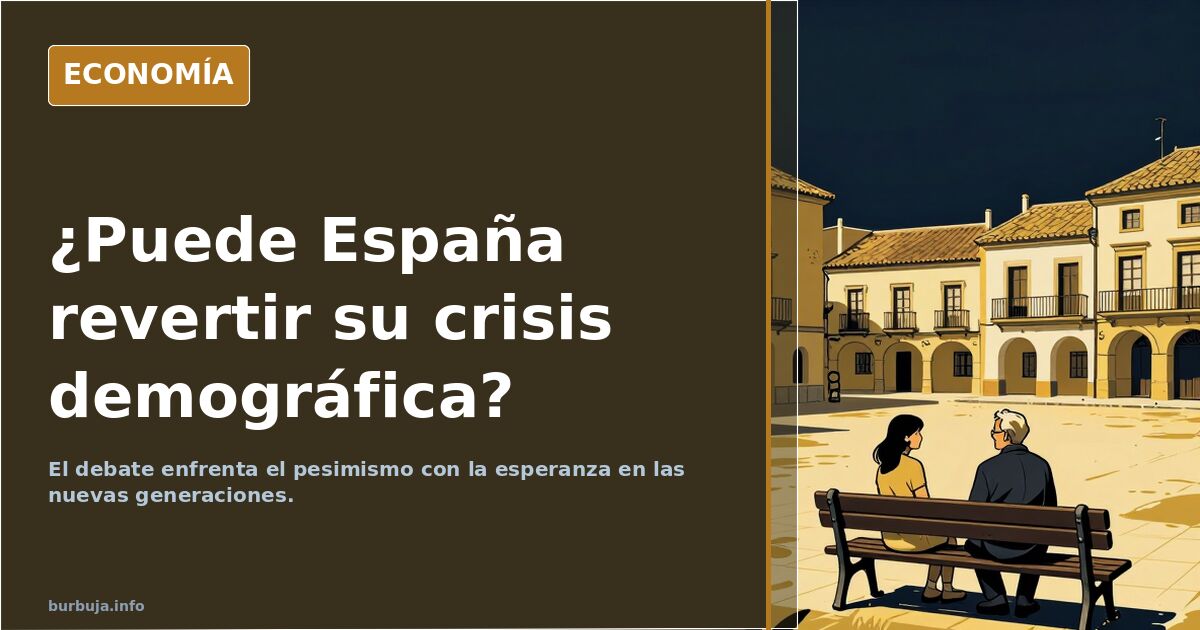
Spain faces its demographic crisis: the debate on salvation
Amid growing concern over demographic replacement and a loss of values, a recent analysis questions whether Spain has any chance of salvation. The text, which has sparked intense debate, lists several circumstances allegedly occurring simultaneously in the country: a numerous internal enemy, brainwashing of part of society, a crisis of values, external economic dependence, state dependency, poor general culture, and mass entry of foreigners. The author asks if these conditions have ever coincided in Spanish history, or if they are happening with similar intensity in other European countries.
The discussion has elicited mixed opinions. Some participants believe Spain is doomed to destruction and that only a spontaneous popular uprising could reverse the situation, though they doubt the population is willing to act. Others maintain a more optimistic stance, trusting that despite dark times, hope remains and that new generations, educated in distrust towards the current regime, might change course. There are also those who argue for a national refoundation breaking with the last 500 years' legacy, while others defend the need to recover economic, political, and military sovereignty.
Demographic replacement: an unprecedented phenomenon?
The initial analysis argues that Spain faces an unprecedented situation: the combination of mass immigration (15% of the original population in a decade), a generalized crisis of values, and total external economic dependence. According to the author, not even other European countries are experiencing all these factors at once, or at least not with the same intensity. This thesis is supported by some participants, who add that the birth rate is far below replacement level (around 1.12), making it impossible to reverse the trend. It is argued that, unlike in other eras, there is no faith or values worth fighting for today, and society is immersed in materialism and superficiality.
However, not everyone shares this diagnosis. Some point out that Spain has lived through similar situations in the past, such as the Muslim invasion that lasted nearly eight centuries, after which the country was reborn and became the first nation in the world. From this perspective, the current crisis would be just another of the many Spain has overcome throughout its history. It is mentioned that, although times are difficult, hope should not be lost and that, like Don Pelayo and his troops, who numbered less than a thousand, managed to defeat darkness, new generations might be gestating a change.
The role of the State and economic dependence
Another central point of the debate is the majority of the population's dependence on the State. It is claimed that the State floods large groups and companies with money, buying votes and wills, generating a culture of subsidies and dependency. It is criticized that 60% of adults receive public money, which would hinder any change of direction. Additionally, external economic dependence is denounced, with the country sold to supranational powers allegedly having perverse intentions.
In response, some participants propose recovering economic, political, and military sovereignty, repealing EU directives contrary to national interests, and protecting natural resources. They advocate for refounding the primary and secondary sectors to become as self-sufficient as possible. However, others consider this vision utopian, given that most of the population depends on the State and would not be willing to give up their privileges.
The issue of values and identity
The crisis of values is another axis of the debate. It is argued that Spanish society has lost faith, Christian values, and hope for a better future, and that only money, promiscuity, and superficiality matter. The incivil of men and endophobia (hatred of one's own) are criticized. Some participants link this loss of values to ethnic replacement, derived from a replacement of values. It is mentioned that the last significant contribution, the Gothic, represented barely 3% of the population, whereas today between 30% and 40% of the population is not ethnically Spanish.
On the other hand, some defend that Spain has always been Catholic and that, despite corrupt politicians, the country remains great. Anglo-Saxon sects are criticized, and the Catholic tradition is claimed as a hallmark of identity. This stance clashes with those who believe the Church has failed and that it is necessary to detach Spain from the Hispanic and Mediterranean world to imitate Portugal and approach Europe.
Is there a possibility of salvation?
The central question of the debate is whether Spain has any possibility of salvation. Answers vary. Some believe not, that Spain as we knew it is finished and will not return except by miracle. Others trust that, although the country is in a critical situation, it is still salvageable, especially compared to other countries like France or Sweden, where the problem would be worse. It is mentioned that Spain does not have the misery it deserves, and that, despite everything, it remains a country with potential.
The possibility of a spontaneous popular uprising is also raised, but doubts remain about people's willingness to risk anything. Passivity and cowardice are criticized, and it is suggested that only a clash or the coming of Jesus Christ could change the status quo. Others appeal to history and courage, recalling that Spain has survived everything and that this is just another crisis.
The role of new generations
New generations offer a point of hope. Some participants trust that young people, educated on the internet and with total distrust towards the regime of terror and disinformation, might lead a change. It is mentioned that, although few, they are better informed and more critical. Hope is placed in the pendulum swinging back and that, in a more distant future, God will provide.
However, others are more skeptical, pointing out that youth has no future and that children are not being born, hindering any generational shift. It is criticized that young women are more concerned with other things and that society is mentally broken.
Ultimately, the debate reflects a deep division between those who see Spain on the brink of the abyss and those who still keep a flame of hope alive. Demographic and economic data point to a critical situation, but history shows that Spain has known how to overcome adverse circumstances. The question hangs in the air: does Spain have any possibility of salvation?
Also available in: Deutsch
Summary of a discussion on Burbuja.info - Foro de economía, actualidad y política., translated from Spanish and reviewed before publication. Read the full discussion (161 replies).
More summaries
-
France's Risk Premium Matches Greece Amid Eurozone Debt Crisis
France's risk premium hits 86 basis points, equal to Greece's, while Spain drops to 71. French deficit nears 6% during economic expansion.
-
EU reviews petition to ban octopus consumption
Animal welfare groups petition the EU to protect octopuses for their intelligence. No law is approved, while Spain's fishing sector faces severe cuts.
-
Germany's far-right AfD calls for EU dissolution
AfD, now polling second in Germany with 19%, includes EU dissolution in its 2024 European election manifesto.
-
Black swan narrative: France riots and the reset ahead
Over a hundred arrests and barricades in Paris on 17 October. The black swan and great reset narrative takes hold in Europe while savings foot the bill.
-
The 'engineer' who brags about stolen phones in Spain
A video shows a young man displaying several stolen iPhones in Barcelona, Spain. Calculating the VAT and income tax on one night's work reopens the debate on the…
-
Political quiz tells you who to vote for — and why it fails
A political affinity quiz returns VOX, PSOE or Se Acabó La Fiesta. Several users criticise the method: two axes, a 1-to-10 scale and doubts about how the data is used.