
Spain's Democracy 21 party sparks debate over vote splitting
Forum users debate Spain's new Democracy 21 party, led by Miriam González, citing 'trap party' accusations and funding doubts.
English · Original discussion in Spanish · Published
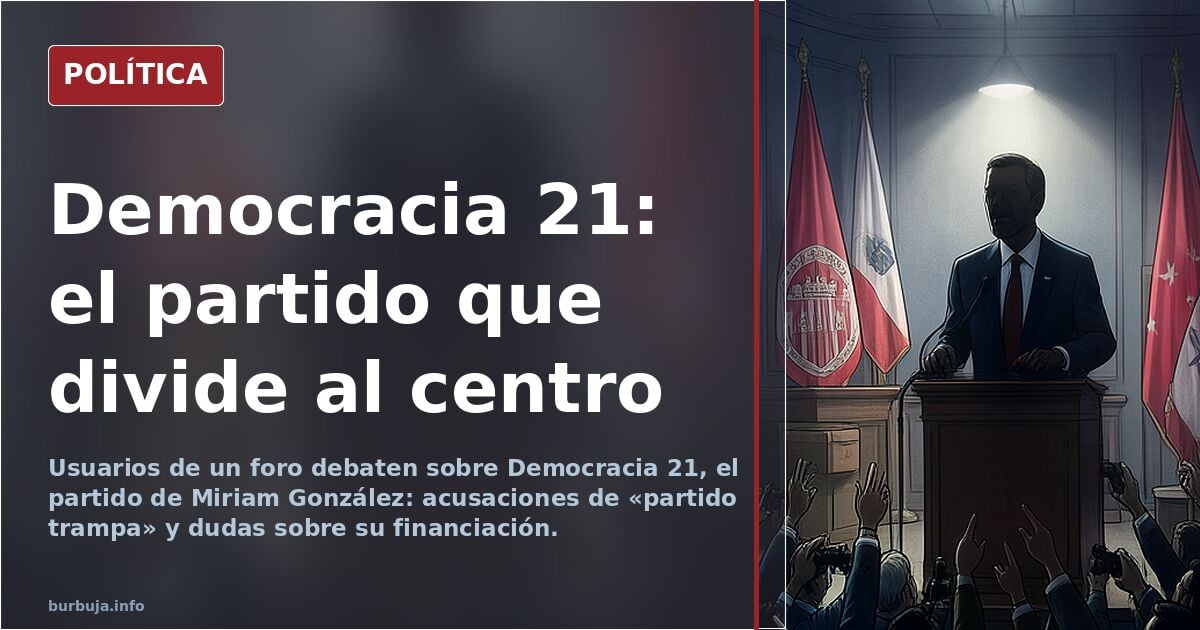
Democracy 21: The party dividing the center and voters
The emergence of Democracy 21 in the Spanish political landscape has sparked intense debate on the politics forum. Led by Miriam González, the party presents itself as a centrist option, but reactions have been swift. From accusations of being a "TRAP party" to defenses of its role as a representative of social liberalism, opinions vary widely. The discussion focuses on whether this new political actor can capture useful votes or if it will further fragment the center-right vote.
Who is behind Democracy 21?
Democracy 21, led by Miriam González, has faced multiple speculations regarding its funding and true backers. Some messages suggest links with banking and international interests, mentioning Segarro and England. It is argued that her husband, a British politician who served as Deputy Prime Minister between 2010 and 2015, could represent a conflict of interest. These accusations, however, remain unconfirmed suspicions. The lack of transparency about the origin of funds fuels conspiracy theories.
The debate on the political center in Spain
Defining the political center in Spain is elusive. While some argue that social liberalism is center-left in the rest of Europe, it is perceived as center-right in Spain. This ideological confusion leads to any party not openly declaring itself socialist being labeled as right-wing. Democracy 21 attempts to occupy this space but faces a highly polarized political board. The question is whether there is real room for a center that isn't swallowed by the extremes.
A trap party to split the vote?
One of the most repeated criticisms is that Democracy 21 could act as a trap party, designed to siphon votes from other formations and thereby favor the left. Its appearance at a key moment could divert thousands of votes that would otherwise go to center-right parties. This theory is reinforced by the idea that it is funded by globalist elites, such as Soros or Blackrock, aiming to destabilize the Spanish political scene. However, no evidence supports these claims.
Voter reaction and the party's future
Reactions on the forum range from outright rejection to indifference. Some consider it another elite party, while others believe it has no chance of success in a two-party system. The lack of clear definition and the perception that it is an instrument of interests alien to citizens weigh down its credibility. As elections approach, it will be seen if Democracy 21 manages to consolidate or remains just an anecdote.
In short, Democracy 21 has shaken up the political hornet's nest. Its ability to attract votes and its true nature remain to be seen. What is certain is that the debate is on.
The emergence of Democracy 21 in the Spanish political landscape has sparked intense debate on the politics forum. Led by Miriam González, the party presents itself as a centrist option, but reactions have been swift. From accusations of being a "TRAP party" to defenses of its role as a representative of social liberalism, opinions vary widely. The discussion focuses on whether this new political actor can capture useful votes or if it will further fragment the center-right vote.
Who is behind Democracy 21?
Democracy 21, led by Miriam González, has faced multiple speculations regarding its funding and true backers. Some messages suggest links with banking and international interests, mentioning Segarro and England. It is argued that her husband, a British politician who served as Deputy Prime Minister between 2010 and 2015, could represent a conflict of interest. These accusations, however, remain unconfirmed suspicions. The lack of transparency about the origin of funds fuels conspiracy theories.
The debate on the political center in Spain
Defining the political center in Spain is elusive. While some argue that social liberalism is center-left in the rest of Europe, it is perceived as center-right in Spain. This ideological confusion leads to any party not openly declaring itself socialist being labeled as right-wing. Democracy 21 attempts to occupy this space but faces a highly polarized political board. The question is whether there is real room for a center that isn't swallowed by the extremes.
A trap party to split the vote?
One of the most repeated criticisms is that Democracy 21 could act as a trap party, designed to siphon votes from other formations and thereby favor the left. Its appearance at a key moment could divert thousands of votes that would otherwise go to center-right parties. This theory is reinforced by the idea that it is funded by globalist elites, such as Soros or Blackrock, aiming to destabilize the Spanish political scene. However, no evidence supports these claims.
Voter reaction and the party's future
Reactions on the forum range from outright rejection to indifference. Some consider it another elite party, while others believe it has no chance of success in a two-party system. The lack of clear definition and the perception that it is an instrument of interests alien to citizens weigh down its credibility. As elections approach, it will be seen if Democracy 21 manages to consolidate or remains just an anecdote.
In short, Democracy 21 has shaken up the political hornet's nest. Its ability to attract votes and its true nature remain to be seen. What is certain is that the debate is on.
Also available in: Deutsch
Summary of a discussion on Burbuja.info - Foro de economía, actualidad y política., translated from Spanish and reviewed before publication. Read the full discussion (15 replies).
More summaries
-
Forum debates Democracia21 as a system wedge
Online forum discusses if Miriam González's new Spanish party is a real alternative or a tactic to split the vote.
-
Tweet Places Pablo Fernández in Luxury Housing Development
A tweet places Pablo Fernández living in a luxury development from the Mahou-Calderón operation, the same one Podemos tried to halt.
-
Five Minor Spanish Parties Seek Signatures for Nov 29 Election
Five parties without seats seek signatures for the Nov 29 election. LOREG requires endorsements per constituency. Escaños en Blanco warns only Córdoba and La Rioja are on track.
-
Evangelicals: Colonizing Latin America
Debate on the rise of evangelical churches in Latin America. A thesis claims the CIA backed Pentecostal groups in the 1970s.
-
Trillo links Madrid bombings to French-controlled cells
Federico Trillo blames France and Morocco for the 2004 Madrid attacks. The forum debates if it was an intelligence operation to oust Spain's government.
-
Spain's Núcleo Nacional registers as far-right party
Núcleo Nacional, a Spanish youth group with paramilitary aesthetics, registers as a political party ahead of general elections.