
Spain's Delivery Boom: Why Home Cooking Is Disappearing
In Spain, long workdays and delivery apps are replacing home cooking. Forum users debate the causes, with some spending €300 monthly on takeout.
English · Original discussion in Spanish · Published
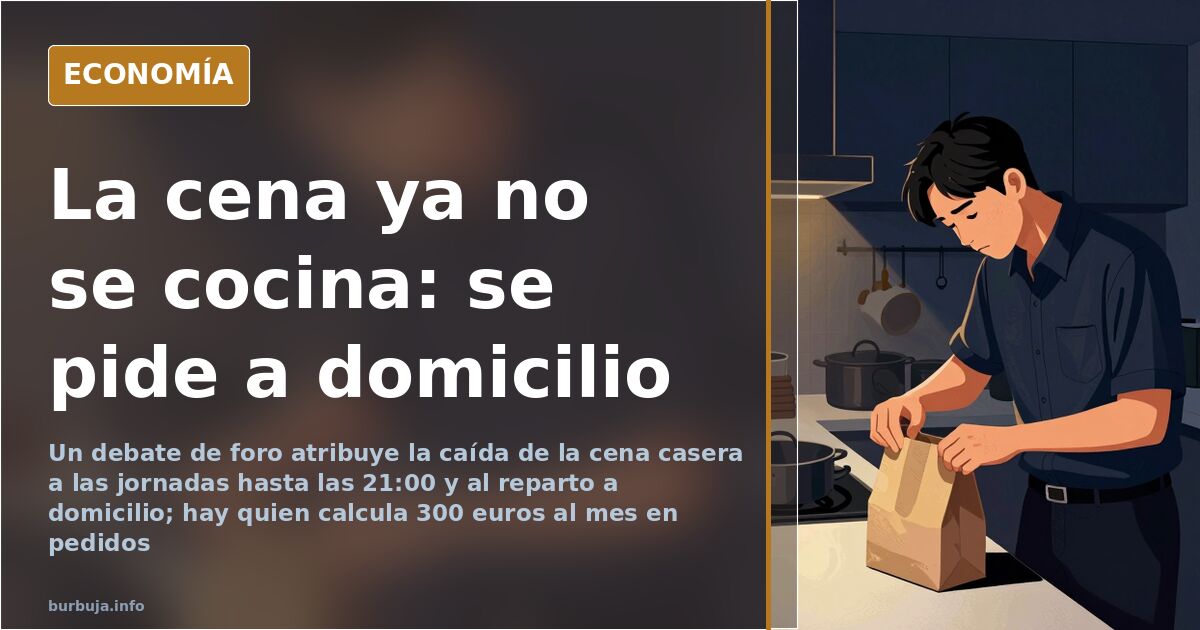
Dinner is no longer cooked at home: it is ordered for delivery
An ordinary Wednesday. No holiday eve, no long weekend. Yet, according to a complaint from a forum user, motorcycle food deliveries have become the soundscape of noon and night in any Spanish neighborhood. The scene is described by this user from their balcony: a constant stream of couriers with thermal backpacks, engine noise, and bags of food arriving at doorways where no fire has been lit. The question they pose —"Do women no longer make dinner?"— is just the tip of a much larger iceberg: what we eat, who cooks it, and how much it costs that we no longer cook.
The first thing to dismantle is the premise. Home-cooked dinner hasn't disappeared because of gender: according to several messages in the thread, it has vanished due to a combination of workdays stretching until 9:00 PM, shared apartments where the kitchen is hostile territory, and a delivery offer that has turned eating into a click. Delivery doesn't compete with grandma's cooking: it competes with the sofa.
Who cooks today in Spain?
The short answer: fewer and fewer people, and not for lack of desire. Two clear profiles emerge in the exchange of messages. On one hand, those who cook daily and mention it as a rarity: one participant recounts surprising their partner by preparing varied dinners in fifteen minutes, describing it almost like an act of magic. On the other, those who have directly delegated: some claim people haven't made dinner for over forty years, unless you consider a sandwich or frozen pizza a dinner.
Between these two extremes, a data point breaks the narrative of generational laziness: several messages indicate that the problem isn't that women don't cook, but that no one cooks. Those living alone or sharing an apartment have exactly the same hands and the same fridge. And yet, delivery spending continues to rise. The repeated conclusion is uncomfortable: cooking at home is cheaper and better, but requires something scarcer than money, which is time and energy at the end of the day.
The real cost of not lighting the fire
This is where the issue stops being a discussion of customs and becomes household economics. One participant throws out a figure that summarizes the problem: there are those who spend €300 a month ordering food delivery and then complain that they can't afford rent. The complete calculation, broken down item by item between what a delivery menu costs and what the same dish costs made at home, shows a difference that surprises even those who already suspected it.
It's not just the price. Several messages point to quality: most delivery products are reheated frozen items, while fresh chicken or pork holds up perfectly for several days in the fridge if cooked in advance. Pasta and rice, well preserved cold, last a week without problems. In other words, the barrier isn't technical. It's organizational.
Delivery as a symptom, not a cause
The evolution of the exchange is revealing. What starts as a complaint about motorcycles and junk food quickly derives toward a more uncomfortable subject: the reorganization of domestic labor. Some argue that the classic model —he works outside, she cooks— was sustained by a single salary that no longer exists. With two salaries needed to pay the mortgage, neither arrives at the kitchen with energy.
The counterpoint is direct. Against those who see delivery as a surrender, others respond with the evidence that women come home exhausted, some at 9:00 PM, and blaming them for not cooking is confusing the symptom with the disease. The discussion closes, in most messages, with an unepic observation: those with a partner who organize themselves, cook; those who live alone and don't organize, order. Gender explains less than logistics.
Why has food delivery grown so much?
Because it solved a problem that didn't exist as such before: last-minute dinner in a house where no one had time to shop. Delivery didn't create laziness; it monetized the lack of time. And it did so with infrastructure —motorcycles, thermal backpacks, platforms— that has become so visible it is now part of the urban landscape.
What remains to be seen is the health bill. Several messages warn that these crap diets will bring consequences in a few years in the form of diseases. It's a prediction, not a fact, but it points to a cost that doesn't appear on the monthly statement and is probably the most expensive of all.
What if the problem isn't who cooks, but that we've organized life in such a way that cooking is nearly impossible?
Also available in: Deutsch
Summary of a discussion on Burbuja.info - Foro de economía, actualidad y política., translated from Spanish and reviewed before publication. Read the full discussion (133 replies).
More summaries
-
Spain's productivity rises while wages stagnate, sparking shorter workweek debate
Productivity in Spain grew 25% while real wages rose only 10%. Analysts debate if reducing working hours without pay cuts is a viable solution or an illusion.
-
Minimum wage by province and a six-hour working day in Spain
Debate on a six-hour working day and province-by-province minimum wages in Spain. Is the reduction viable, and how would it affect each region? Find out here.
-
PSOE-Sumar pact: shorter workweek with no pay cut
The PSOE-Sumar agreement includes reducing working hours without lowering wages. Some estimate a 12.5% labor cost increase, sparking debate on who bears the burden.
-
Spain's housing market stalls: more homes for sale, fewer buyers
Twice as many homes for sale in Madrid and buyers who can't keep up: Spain's property market is stalling without prices falling. The data that explains it.
-
Spain's unions stay silent as Adif blames its own workers
Spain's Guardia Civil is investigating whether there was pressure behind Adif's "human error", while UGT and CC.OO. remain silent over the dismissal of officials and the blame placed on workers.
-
Antonio Acedo, the AVE driver hailed as a hero for braking
Antonio Acedo, an AVE high-speed train driver, died after activating the emergency brakes. The hero narrative clashes with those who see nothing more than protocol being followed.