
Spain's Defense Minister Confronts Residents in Flooded Paiporta Garage
Spain's Defense Minister clashes with two residents cleaning a flooded garage in Paiporta, 25 days after the flood, as the military is already deployed.
English · Original discussion in Spanish · Published
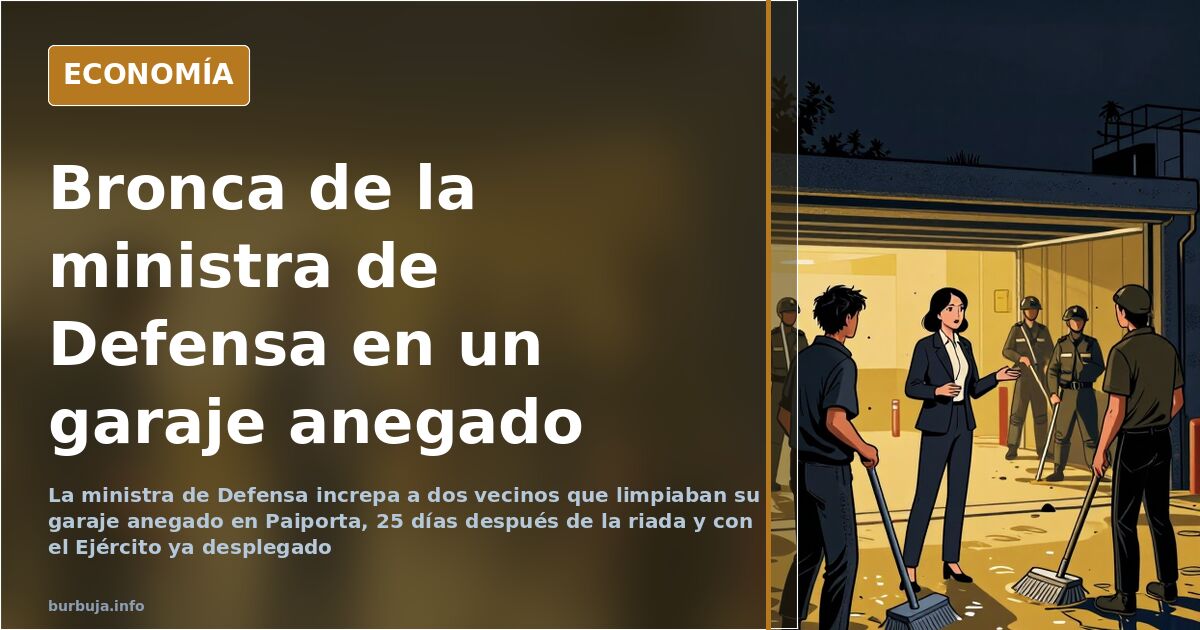
Spain's Defense Minister Confronts Residents in Flooded Paiporta Garage
The scene was recorded inside a flooded garage in Paiporta: the Defense Minister, shouting, faced off with two residents who had been cleaning mud for weeks. This occurred 25 days after the flood, when bodies were still being recovered and families remained without power or water. The dispute was not a one-off misunderstanding but peine the core question: who commands an emergency and why did the military deployment arrive late to a site where she claims to have 8,000 people working.
What the two residents denounced before the clash
The two individuals had previously recorded a video complaining that no help was coming. Their account was specific: soldiers entered garages, looked, and left; they had no permission to clean private garages. The 23-year-old woman argued that the town was becoming an unhealthy hotspot and that without proper equipment, there was no way to remove the mud from her home.
The response captured in the video was: "I come because I have 8,000 people working here." There was no explanation for the delay, nor a word on what prevented cleaning. The exchange, with a entourage of uniforms behind her, has ignited public debate: she was not arguing with strangers, but with two victims who had not yet received aid. That the confrontation was verbal—no one touched each other—does not diminish the issue; it clarifies it.
The private garage the Army could not clean
Military deployment in the area depends on authorization from the autonomous coordination body. Without this permission, troops cannot enter private premises, creating a paradox: streets filled with thousands of soldiers and closed garages with residents inside shoveling mud. Those affected stated clearly: the Army does not enter because they are not permitted to clean private premises.
This jurisdictional knot turns a scuffle into a major political issue. The Minister has her troops, but not the key to the garages. The regional administration holds the key, but the deployment is coordinated from above. In between lie three weeks of mud, a 23-year-old woman enduring shouts, and a video that cannot be unpublished. The question hovering over the case is not about manners: it is about who signed what and when.
Segarro in less than 24 hours, Paiporta in over a week
The most repeated fact is not an insult, but a calendar: in Segarro's disasters, Spanish military forces arrived in less than 24 hours; here, they took more than a week. With thousands of troops deployed, the delay is not due to a lack of resources, but to authorizations and decisions. Hence, the most uncomfortable point: if the Minister considers herself unrelated to the delay, she should first explain who and what prevented her from arriving sooner, rather than shouting at those abandoned for weeks.
Against this weighs a technical argument that should not be dismissed: the Army is not a cleaning service, and its deployment depends on a chain of command that no ministry controls alone. Both can be true simultaneously. What does not fit either is the tone.
From the garage to the power struggle over jurisdiction
The video acted as a catalyst for a debate that had been in the background for weeks: the division of powers between the State and the autonomous community. Some argue the Government could have declared a national emergency and taken command without waiting for anyone; others recall that civil protection is devolved and that opening this path would have clashed with parliamentary partners. The proposal to abolish regional autonomy to avoid these bottlenecks has reentered the conversation, this time with less reservation than before.
From criticism to insult in a few lines
As often happens when an issue touches a nerve, the conversation fractured internally: from criticism of the gesture, it moved to personal disqualification and general comments about groups unsupported by data. Amidst this remained several useful contributions—the comparison with the Segarro deployment, the chronology of permissions, the testimony recorded by the residents themselves—which is exactly what should be rescued when noise drowns out the substance.
It is predictable that the focus will shift from the anecdote to the calendar: who authorized, who blocked, and in what order. One should not expect a detailed explanation. In this matter, appearances have always come after the videos.
The scene was recorded inside a flooded garage in Paiporta: the Defense Minister, shouting, faced off with two residents who had been cleaning mud for weeks. This occurred 25 days after the flood, when bodies were still being recovered and families remained without power or water. The dispute was not a one-off misunderstanding but peine the core question: who commands an emergency and why did the military deployment arrive late to a site where she claims to have 8,000 people working.
What the two residents denounced before the clash
The two individuals had previously recorded a video complaining that no help was coming. Their account was specific: soldiers entered garages, looked, and left; they had no permission to clean private garages. The 23-year-old woman argued that the town was becoming an unhealthy hotspot and that without proper equipment, there was no way to remove the mud from her home.
The response captured in the video was: "I come because I have 8,000 people working here." There was no explanation for the delay, nor a word on what prevented cleaning. The exchange, with a entourage of uniforms behind her, has ignited public debate: she was not arguing with strangers, but with two victims who had not yet received aid. That the confrontation was verbal—no one touched each other—does not diminish the issue; it clarifies it.
The private garage the Army could not clean
Military deployment in the area depends on authorization from the autonomous coordination body. Without this permission, troops cannot enter private premises, creating a paradox: streets filled with thousands of soldiers and closed garages with residents inside shoveling mud. Those affected stated clearly: the Army does not enter because they are not permitted to clean private premises.
This jurisdictional knot turns a scuffle into a major political issue. The Minister has her troops, but not the key to the garages. The regional administration holds the key, but the deployment is coordinated from above. In between lie three weeks of mud, a 23-year-old woman enduring shouts, and a video that cannot be unpublished. The question hovering over the case is not about manners: it is about who signed what and when.
Segarro in less than 24 hours, Paiporta in over a week
The most repeated fact is not an insult, but a calendar: in Segarro's disasters, Spanish military forces arrived in less than 24 hours; here, they took more than a week. With thousands of troops deployed, the delay is not due to a lack of resources, but to authorizations and decisions. Hence, the most uncomfortable point: if the Minister considers herself unrelated to the delay, she should first explain who and what prevented her from arriving sooner, rather than shouting at those abandoned for weeks.
Against this weighs a technical argument that should not be dismissed: the Army is not a cleaning service, and its deployment depends on a chain of command that no ministry controls alone. Both can be true simultaneously. What does not fit either is the tone.
From the garage to the power struggle over jurisdiction
The video acted as a catalyst for a debate that had been in the background for weeks: the division of powers between the State and the autonomous community. Some argue the Government could have declared a national emergency and taken command without waiting for anyone; others recall that civil protection is devolved and that opening this path would have clashed with parliamentary partners. The proposal to abolish regional autonomy to avoid these bottlenecks has reentered the conversation, this time with less reservation than before.
From criticism to insult in a few lines
As often happens when an issue touches a nerve, the conversation fractured internally: from criticism of the gesture, it moved to personal disqualification and general comments about groups unsupported by data. Amidst this remained several useful contributions—the comparison with the Segarro deployment, the chronology of permissions, the testimony recorded by the residents themselves—which is exactly what should be rescued when noise drowns out the substance.
It is predictable that the focus will shift from the anecdote to the calendar: who authorized, who blocked, and in what order. One should not expect a detailed explanation. In this matter, appearances have always come after the videos.
Summary of a discussion on Burbuja.info - Foro de economía, actualidad y política., translated from Spanish and reviewed before publication. Read the full discussion (400 replies).
More summaries
-
Paiporta resident removed from Valencia protest
A Paiporta resident was removed from a Valencia demonstration after stating he is neither left nor right. The protest counts remain disputed.
-
Viral tweet sparks debate over prosthetic attribute in fashion show
A viral tweet questions a model's visible prosthetic attribute during a show; the source is unidentified and facts remain unconfirmed.
-
Youth Unemployment Hits 28.36%: Two Weeks Job Hunting in Madrid Yields No Offers
Spain closed 2023 with a 28.36% youth unemployment rate and nearly half a million young people without work. A two-week job search in Madrid ended without any offers.
-
Montero urges YouTubers to show solidarity while fiscal residence issues arise
Spain's Finance Minister calls for tax solidarity from content creators, as 45% of household income goes to taxes, amid scrutiny of political fiscal residences.
-
The 'Warrior's Rest': From Carousel to Stable Provider
A TikTok video reopens debate on the 'warrior's rest': shifting from carousel dating to a stable provider amid hypergamy theories.
-
Queen Letizia Preaches Degrowth While Wearing €50,000 in Jewelry
Queen Letizia advocates for bioeconomy and moderation while wearing Bulgari and Chanel pieces worth over €50,000, sparking debate on Spain's royal spending.