
Spain's Decline: Why Many Believe It Deserves Its Fate
From the 2004 Madrid bombings to the 2020 pandemic, Spanish public opinion has shifted from outrage to a verdict that the country deserves its decline.
English · Original discussion in Spanish · Published
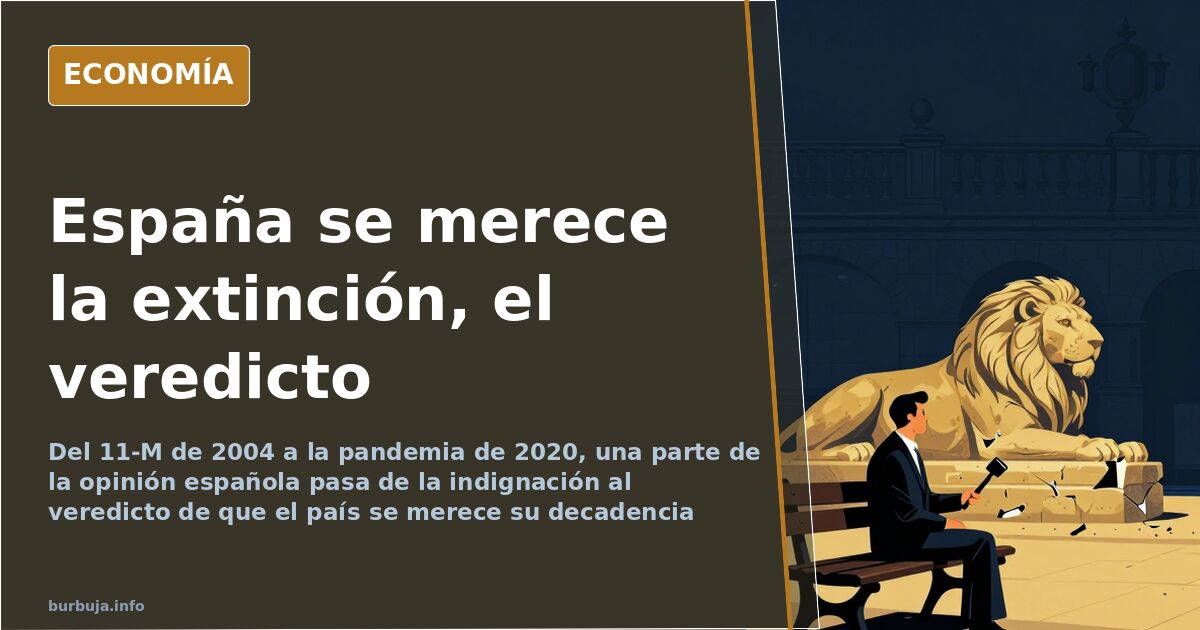
Spain Deserves What Happens to It: The Verdict of Disillusionment
What happens when part of a population stops believing in their own country's future? Since 2020—and with roots many trace back to March 11, 2004—a current of opinion in Spain has moved from indignation to a verdict: that the country deserves everything happening to it. This idea, repeated without nuance, argues that decades of passivity and cheering from the balcony have led to an accepted decline.
The conclusion is formulated with different words but the same substance: it no longer seems wrong for things to go badly. Those who hold this view claim they warned for years, were labeled as exaggerators, and received disparaging tags in return. The result is less an analysis than a surrender, admitted without shame.
From 2004 to 2020: Dates Seen as Points of No Return
The disillusionment has temporal anchors. Some fix it on the 2020 pandemic: a supposed microorganism delivered the final blow, some write. Others push the date back to March 11, 2004. Debating which event broke the contract with the country is, in reality, debating whom to blame.
Some point even further back, placing the origin in the transition itself. The idea that in 1978 there was an opportunity to build a sovereign country and it was wasted reappears strongly. This debatable thesis rests on deep distrust: that no founding pact was made thinking of those who came after.
Why Blame Voters for the Country's Failures?
Because, according to this reading, electoral results translate almost mechanically into economic policy. With a few more votes for other parties, one side argues, the government would have changed and so would the agenda. The reproach points not so much at a specific party as at the majority that, by action or omission, allowed it.
The accusation has a bitter twist. The average citizen is described as someone who complies, obeys, and waits for trouble to miss them. The most repeated phrase—enjoy what you voted for—summarizes that mix of sarcasm and punishment: let everyone bear the consequences of their ballot. Even among those who admit nobody deserves certain things, the answer to whether the country brought this on itself is a resounding yes.
Young people, specifically, are seen as the main victims: some argue their future has been plundered and there is nothing to offer them in return. Hence, many see leaving as reasonable rather than staying to watch the end.
Is Democracy "Hacked"?
For part of the disillusionment, yes: the system is manipulated and ballots do not reflect the real will of the majority. According to this argument, it doesn't matter how you vote because the elites always get what they want. Representative democracy becomes, in this version, a scam that makes citizens believe they decide when they actually don't.
This is the most uncomfortable objection in the diagnosis because it disables any electoral exit. If voting is useless, the only remaining alternative is individual: protect yourself, save money, leave, or prepare the ground. And that is where pessimism turns into an instruction manual.
Structural Problems No Government Wants to Tackle
Against the narrative of sarracena disaster, there is a more earthly reading. Nobody ruined the country, the argument goes; Spain simply drags very serious structural problems that no politician with basic sense wants to address, because doing so costs votes. Geography doesn't help, and the margin to climb positions in the international economy is narrow.
The two visions are not incompatible. One speaks of values and will; the other, of costs and incentives. Both agree on the essential point: that the system, as currently built, does not produce the necessary decisions. They differ in the forecast, ranging from simple stagnation to a collapse that some take for granted.
Proposals Instead of Waiting for Collapse
When politics is deemed lost, advice becomes domestic. Lists of concrete measures circulated to resist globalism in daily life:
The catalog mixes sensible advice with apocalyptic warnings. Learning a trade or paying in cash won't fix a country, but it gives the person doing it a sense of control. It is the practical version of a disillusionment that has stopped expecting collective solutions.
Extinction as Consolation
The conversation ends where it began: with the sentence. Spain deserves extinction twice, some write, regretting only that there will be just once. Others divide the map among neighbors and give themselves five years to get another passport.
It is hard to know how much conviction and how much rage lies behind all this. For now, the consolation of the doomers is that they are never wrong if they wait long enough.
What happens when part of a population stops believing in their own country's future? Since 2020—and with roots many trace back to March 11, 2004—a current of opinion in Spain has moved from indignation to a verdict: that the country deserves everything happening to it. This idea, repeated without nuance, argues that decades of passivity and cheering from the balcony have led to an accepted decline.
The conclusion is formulated with different words but the same substance: it no longer seems wrong for things to go badly. Those who hold this view claim they warned for years, were labeled as exaggerators, and received disparaging tags in return. The result is less an analysis than a surrender, admitted without shame.
From 2004 to 2020: Dates Seen as Points of No Return
The disillusionment has temporal anchors. Some fix it on the 2020 pandemic: a supposed microorganism delivered the final blow, some write. Others push the date back to March 11, 2004. Debating which event broke the contract with the country is, in reality, debating whom to blame.
Some point even further back, placing the origin in the transition itself. The idea that in 1978 there was an opportunity to build a sovereign country and it was wasted reappears strongly. This debatable thesis rests on deep distrust: that no founding pact was made thinking of those who came after.
Why Blame Voters for the Country's Failures?
Because, according to this reading, electoral results translate almost mechanically into economic policy. With a few more votes for other parties, one side argues, the government would have changed and so would the agenda. The reproach points not so much at a specific party as at the majority that, by action or omission, allowed it.
The accusation has a bitter twist. The average citizen is described as someone who complies, obeys, and waits for trouble to miss them. The most repeated phrase—enjoy what you voted for—summarizes that mix of sarcasm and punishment: let everyone bear the consequences of their ballot. Even among those who admit nobody deserves certain things, the answer to whether the country brought this on itself is a resounding yes.
Young people, specifically, are seen as the main victims: some argue their future has been plundered and there is nothing to offer them in return. Hence, many see leaving as reasonable rather than staying to watch the end.
Is Democracy "Hacked"?
For part of the disillusionment, yes: the system is manipulated and ballots do not reflect the real will of the majority. According to this argument, it doesn't matter how you vote because the elites always get what they want. Representative democracy becomes, in this version, a scam that makes citizens believe they decide when they actually don't.
This is the most uncomfortable objection in the diagnosis because it disables any electoral exit. If voting is useless, the only remaining alternative is individual: protect yourself, save money, leave, or prepare the ground. And that is where pessimism turns into an instruction manual.
Structural Problems No Government Wants to Tackle
Against the narrative of sarracena disaster, there is a more earthly reading. Nobody ruined the country, the argument goes; Spain simply drags very serious structural problems that no politician with basic sense wants to address, because doing so costs votes. Geography doesn't help, and the margin to climb positions in the international economy is narrow.
The two visions are not incompatible. One speaks of values and will; the other, of costs and incentives. Both agree on the essential point: that the system, as currently built, does not produce the necessary decisions. They differ in the forecast, ranging from simple stagnation to a collapse that some take for granted.
Proposals Instead of Waiting for Collapse
When politics is deemed lost, advice becomes domestic. Lists of concrete measures circulated to resist globalism in daily life:
- Have more than two children and bet on grass-fed meat over synthetic protein.
- Eat less than 8 grams of sugar per day and flee ultra-processed foods.
- Learn a difficult skill every month and reduce dependence on digital payments.
- Gain self-sufficiency in water, food, and electricity, and own the land you farm.
The catalog mixes sensible advice with apocalyptic warnings. Learning a trade or paying in cash won't fix a country, but it gives the person doing it a sense of control. It is the practical version of a disillusionment that has stopped expecting collective solutions.
Extinction as Consolation
The conversation ends where it began: with the sentence. Spain deserves extinction twice, some write, regretting only that there will be just once. Others divide the map among neighbors and give themselves five years to get another passport.
It is hard to know how much conviction and how much rage lies behind all this. For now, the consolation of the doomers is that they are never wrong if they wait long enough.
Summary of a discussion on Burbuja.info - Foro de economía, actualidad y política., translated from Spanish and reviewed before publication. Read the full discussion (149 replies).
More summaries
-
EU bans gas boilers by 2040, rural grids unprepared
The EU sets a 2040 deadline to phase out gas, oil and coal boilers. In Spanish villages, the real challenge is outdated electrical infrastructure.
-
Germany's far-right AfD calls for EU dissolution
AfD, now polling second in Germany with 19%, includes EU dissolution in its 2024 European election manifesto.
-
PP blocks amnesty bill in Senate, bypassing vote
The PP uses its Senate majority to block the amnesty law vote, pushing the institutional conflict to Spain's courts.
-
Spain's ERE layoff wave nobody wants to see
Analysis of the wave of layoffs and ERE in Spain. Burbuja.info forum users expose the industrial reality the media won't show.
-
Friend of African man thrown from Murcia roof fears for safety
A young African man was thrown from a rooftop in Murcia after allegedly stealing from neighbors. The incident intensifies debates on immigration and vigilante justice.
-
Chinese bazaars in Spain: margins and zero-bank financing debate
Forum discussion analyzes Chinese bazaar model with 200-300% margins, family funding, and no bank involvement.