
Spain's DANA crisis exposes institutional failure beyond voting
Forum debate argues Spanish elections cannot fix Valencia flood response failures or political paralysis.
English · Original discussion in Spanish · Published
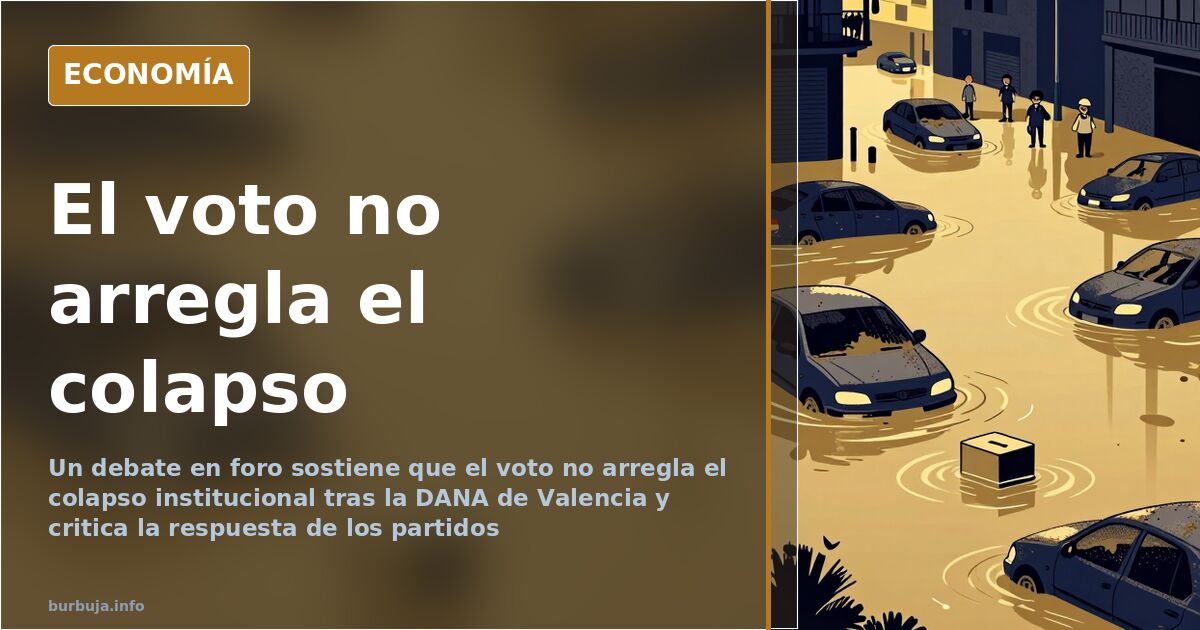
Spain's DANA crisis exposes institutional failure beyond voting
The DANA that devastated Paiporta revealed, according to a forum debate, an uncomfortable truth: neither institutions nor the representative system responded to the disaster. While water rose and looting spread through Alfafar, Albal, and Paiporta itself, participants noted that the political class remained entangled in internal conflicts. Some argue the problem is not specific management but the model itself: a representative system that turns every catastrophe into electoral calculation. The result, this reading suggests, is a population expecting from ballots what ballots cannot deliver.
Why did Spain's Valencia DANA become an institutional collapse?
According to this debate, the disaster was not merely meteorological. Some claim mobile alerts sounded at 20:00, when the Poyo rambla had already reached 1,686 m³/s at 18:20. During those two hours, public machinery failed to coordinate a response, they say. It is mentioned that the Emergency Unit created in February 2023 was repealed four months later in November. This data point, circulating in subsequent analyses, summarizes for some the core issue: decisions are made with partisan criteria, not technical ones.
Looting in commercial areas of Alfafar, Albal, and Paiporta multiplied, participants stated, while the UME distributed water. A resident of Aldaia described people wearing vests asking for help only to keep it. Institutional response arrived late and poorly, interpreted by citizens as a sign that the system does not protect them.
Voting as anesthesia: the argument running through the analysis
The central thesis traversing this conversation is that universal suffrage democracy has ceased functioning as a corrective mechanism. It is not a concrete management problem but one of incentives: voters choose so their team wins, not to improve the system. Under these circumstances, everything becomes radicalized, shifting to post-truth where objective data matters less than one side's victory.
Some argue the solution lies in restricting voting access: requiring minimum knowledge, private sector experience, or a test similar to driving licenses. The argument is that those dependent on public salaries or party structures should not decide issues affecting everyone. The obvious counterargument prevails: any such filter is arbitrary and easily manipulated by its designers.
Are non-democratic countries better? Debate on China, Russia, Saudi Arabia
Discussion shifted toward comparing single-party regimes. Part of the analysis claims China is "millions of times better" than Spain, arguing those adapting to the system live well. The rebuttal states this equals obtaining a party membership card: living comfortably while submitting, without real freedom.
Counterarguments note that Russia, Saudi Arabia, and China offer no desirable model for those valuing individual liberty. The conclusion emerging here is that the problem is not democracy versus dictatorship, but institutional quality and citizen demand levels. A representative system works only if voters demand accountability, not if they vote out of inertia or immediate self-interest.
Armed defense as response: from 'Rooftop Koreans' to gun legalization
During the 1992 Los Angeles riots, Korean merchants and residents armed themselves, taking to rooftops to defend businesses. This precedent is cited as an example of citizen self-defense amid state absence. The proposal launched is legalizing firearms in Spain so populations can defend themselves.
Legal objections are strong: during looting, shopkeepers firing weapons face prison sentences unless using proportional force. If robbed without violence, the maximum lawful action is requesting cessation of theft. Laws are designed not to protect owners but to deter self-defense.
Underlying economic collapse: pensions, public jobs, flight to subsidies
The underlying economic analysis suggests the private sector offers only hardship and stress, with layoffs at age 50. This drives seeking refuge in publicly funded structures—politics, institutional feminism, or subsidized entities. Examples cite individuals without private futures finding positions in public roles with six-figure salaries.
Conclusions state pension systems and social security function like pyramid schemes: everyone expects support until death, leaving burdens for others. This short-term rational individual calculation is collectively suicidal. It explains why nobody wants change.
With these elements, the most plausible prediction is continued collapse unprevented by elections. People will keep voting because voting is all they have been taught. Leaders will continue managing decline focused on next electoral dates. Systems do not fall suddenly; they bleed slowly while everyone looks away.
Also available in: Deutsch
Summary of a discussion on Burbuja.info - Foro de economía, actualidad y política., translated from Spanish and reviewed before publication. Read the full discussion (105 replies).
More summaries
-
Mazón scrapped Puig's emergency unit in four months
The UVE was created in February 2023 and Mazón repealed it in November, four months later. The debate: a useless unit or lost capacity ahead of the DANA?
-
Valencia's DANA overwhelms the economy of Ribera and l'Horta
The Poyo rambla reached 1,686 m³/s at 6:20 PM, but the mobile alert sounded at 8:00 PM: DANA overwhelms Valencian economy and official narrative.
-
Foreign tenants: over half in Spain, 70% in three regions
More than 5.2 million tenants in Spain were born abroad. In Madrid, Valencia and Murcia the share reaches 70%. Data and analysis of...
-
Spain's PP and investment funds: who opened the door to rental business
Analysis suggests Rajoy's 2013 law deregulated rents. The PP maintains this model and rejects designated tension zones.
-
Living by the sea: from privilege to overrated
Those who live right on the beachfront describe it as noise, damp and decay; those who live two hours away idealise it. Spain's coastal premium is up for debate.
-
Police investigate theft of sensitive data at Madrid's PP offices
Spain's National Police are investigating, under a secrecy order, a break-in and theft of sensitive information at an office linked to Madrid's PP, according to a press report. The…