
Spain Floods: 120,000 Cars Damaged, Uncertainty Over Costs
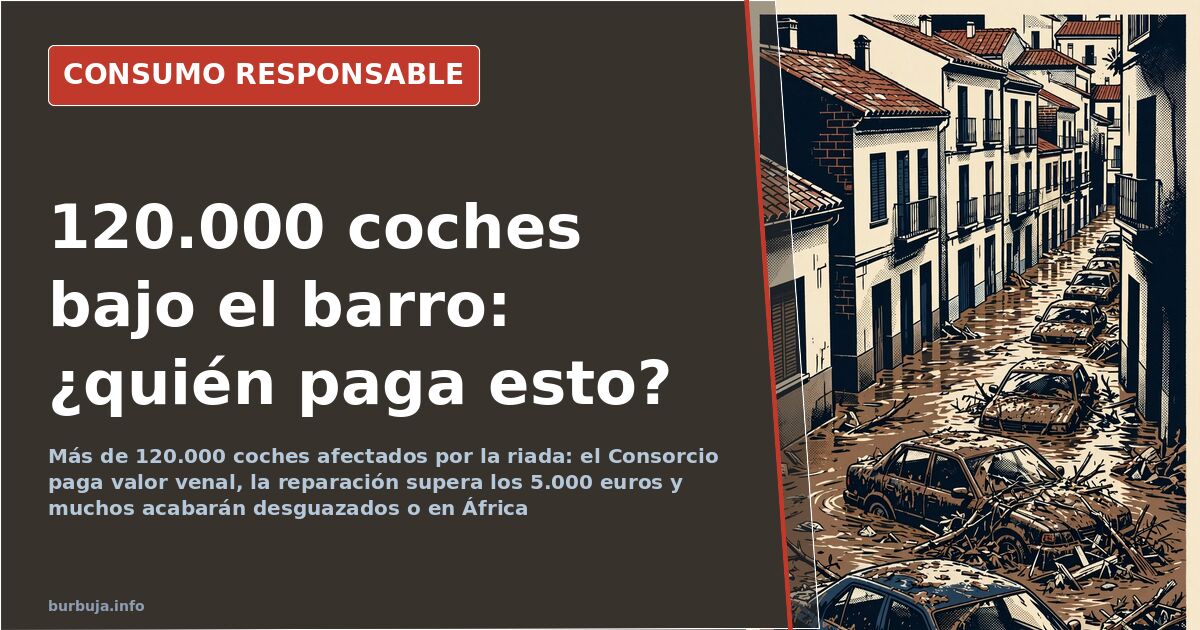
Over 120,000 cars damaged by Spain's floods. The Consorcio pays low book value, repairs exceed €5,000, and many end up scrapped or exported to Africa.
English · Original discussion in Spanish · Published
Spain Floods: 120,000 Cars Damaged, Uncertainty Over Costs
What happens to the thousands of cars submerged by the floods? The figure circulating is more than 120,000 affected vehicles, and the first uncomfortable conclusion is that most will never start again. It is not a matter of mechanical neglect, but arithmetic. A modern car has more electronics than a 1970s plane, and muddy water does not spare a single control unit. The overarching question concerns money: who pays, how much, and with what fine print.
Who Pays for the Cars Destroyed by the Floods?
The short answer is that almost no one comes out unscathed. Comprehensive insurance responds, but poorly and late, while other policies claim natural disasters are not covered. This brings in the Insurance Compensation Consortium (Consorcio de Compensación de Seguros), which adheres strictly to the book value published annually in the Official State Gazette (BOE). Translation: a car over ten years old is valued at a pittance, and one registered in the nineties may be worth only €600 or €1,000. That money won't even buy a decent second-hand economy car.
Some argue that given current car prices, it might be worth repairing. The most optimistic calculation assumes a replacement engine costs around €1,800-3,000 and a used control unit about €500. Adding labor, interior, wiring, and sensors, the bill skyrockets above €5,000 for a vehicle that may not be worth that much. The repeated conclusion is that repair is unviable except for expensive, recent cars that were not heavily flooded.
Why Electronics Condemn Modern Cars
A workshop summarizes it bluntly: everything electrical or electronic becomes unusable. Control units, connectors, sensors, and even the copper in the wiring turn green and rot. Cleaning is useless; replacement is necessary. If the water reached dashboard level, repair is ruled out from the start. The only relative advantage is that it was fresh water, not saltwater, allowing some boards to be saved if action is taken quickly.
Older cars with less electronics have better odds. A nineties model submerged in a garage can revive after thorough cleaning. A recent hybrid or electric car dragged by the current has it very tough. The paradox is that technology reducing emissions is also what turns a flood into a death sentence.
The Scrapyard Business and Second Life in Africa
Insurers keep the damaged vehicle and resell it for parts to scrapyards or foreign buyers. Many reportedly end up in African countries where labor is cheap and engine rebuilding is routine. The irony is that there, they repair cars we discard here, not due to lack of talent, but because an hour of workshop time costs as much as a dentist visit.
The perfect business is described with bitterness: the insurer pays a pittance, keeps the car, and the processing plant gets paid by the state per treated vehicle. Meanwhile, the owner pays twice: with premiums and with estimates.
Second-Hand Market on Alert
The warning repeats: beware of used cars in the coming months. A flooded vehicle can look impeccable after cleaning and air fresheners. The recommendation is to check the DGT report (Spanish traffic authority) to see where it was registered and distrust suspicious smells. Buyers should proceed with extreme caution.
The side effect will be rising prices for reliable used cars untouched by mud. Vehicles from 2018 to 2020, already aging, may increase in price due to demand for undamaged units. And meanwhile, the fundamental question remains unanswered: how many of those 120,000 cars were recoverable, and how many were condemned by pure arithmetic?
What happens to the thousands of cars submerged by the floods? The figure circulating is more than 120,000 affected vehicles, and the first uncomfortable conclusion is that most will never start again. It is not a matter of mechanical neglect, but arithmetic. A modern car has more electronics than a 1970s plane, and muddy water does not spare a single control unit. The overarching question concerns money: who pays, how much, and with what fine print.
Who Pays for the Cars Destroyed by the Floods?
The short answer is that almost no one comes out unscathed. Comprehensive insurance responds, but poorly and late, while other policies claim natural disasters are not covered. This brings in the Insurance Compensation Consortium (Consorcio de Compensación de Seguros), which adheres strictly to the book value published annually in the Official State Gazette (BOE). Translation: a car over ten years old is valued at a pittance, and one registered in the nineties may be worth only €600 or €1,000. That money won't even buy a decent second-hand economy car.
Some argue that given current car prices, it might be worth repairing. The most optimistic calculation assumes a replacement engine costs around €1,800-3,000 and a used control unit about €500. Adding labor, interior, wiring, and sensors, the bill skyrockets above €5,000 for a vehicle that may not be worth that much. The repeated conclusion is that repair is unviable except for expensive, recent cars that were not heavily flooded.
Why Electronics Condemn Modern Cars
A workshop summarizes it bluntly: everything electrical or electronic becomes unusable. Control units, connectors, sensors, and even the copper in the wiring turn green and rot. Cleaning is useless; replacement is necessary. If the water reached dashboard level, repair is ruled out from the start. The only relative advantage is that it was fresh water, not saltwater, allowing some boards to be saved if action is taken quickly.
Older cars with less electronics have better odds. A nineties model submerged in a garage can revive after thorough cleaning. A recent hybrid or electric car dragged by the current has it very tough. The paradox is that technology reducing emissions is also what turns a flood into a death sentence.
The Scrapyard Business and Second Life in Africa
Insurers keep the damaged vehicle and resell it for parts to scrapyards or foreign buyers. Many reportedly end up in African countries where labor is cheap and engine rebuilding is routine. The irony is that there, they repair cars we discard here, not due to lack of talent, but because an hour of workshop time costs as much as a dentist visit.
The perfect business is described with bitterness: the insurer pays a pittance, keeps the car, and the processing plant gets paid by the state per treated vehicle. Meanwhile, the owner pays twice: with premiums and with estimates.
Second-Hand Market on Alert
The warning repeats: beware of used cars in the coming months. A flooded vehicle can look impeccable after cleaning and air fresheners. The recommendation is to check the DGT report (Spanish traffic authority) to see where it was registered and distrust suspicious smells. Buyers should proceed with extreme caution.
The side effect will be rising prices for reliable used cars untouched by mud. Vehicles from 2018 to 2020, already aging, may increase in price due to demand for undamaged units. And meanwhile, the fundamental question remains unanswered: how many of those 120,000 cars were recoverable, and how many were condemned by pure arithmetic?
Summary of a discussion on Burbuja.info - Foro de economía, actualidad y política., translated from Spanish and reviewed before publication. Read the full discussion (157 replies).
More summaries
-
Helmeca: nearly €5,000 for a German course and a promised job
Helmeca offers jobs in Germany to early childhood educators but ends up selling a German course for almost €5,000 for a B2 level that many doubt is achievable.
-
MG: Breakdowns before 40,000 km and denied warranties
Industry insiders claim MG vehicles suffer serious faults under 40,000 km while dealers frequently reject warranty claims.
-
Lidl's frozen sardines at €3.90/kg vs. fresh ones
A kilo of frozen sardines costs €3.90 compared to €9-€10 for fresh ones in Madrid. The question is whether the flavor holds up after freezing.
-
Desktop PCs fade as mobile devices dominate the living room
In Spain, desktops lose ground to smartphones and work laptops. Mini PCs gain traction while high power retreats to niche uses.
-
Casio cult watches: poker, TV remote, and €25
Cheap Casio watches have become cult objects: poker on the wrist, TV remotes, and years without battery changes.
-
Spain's drivers resist new cars, keeping vehicles aged 15 to 27 years
In Spain, car ages ranging from 13 to 27 years reflect a shift in spending habits and a growing reluctance to buy new vehicles.