
Spain’s Congress approves wolf hunting north of Duero
Spanish lawmakers approved Iberian wolf hunting north of the Duero river, attaching the measure to a food waste law with support from PP, Junts, Vox and PNV.
English · Original discussion in Spanish · Published
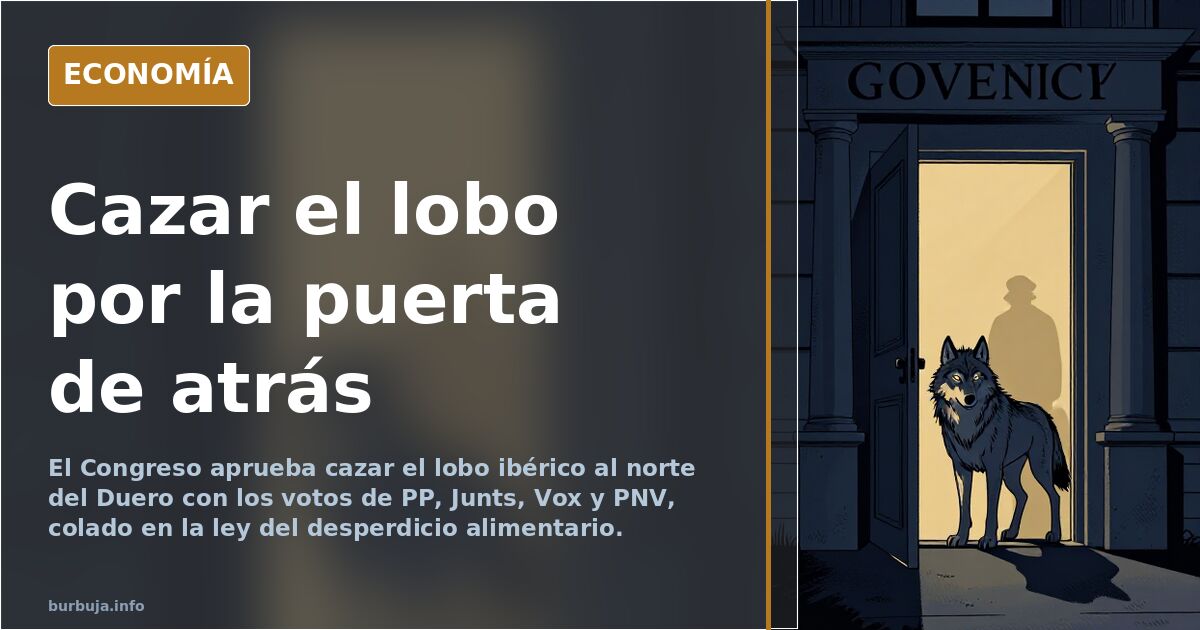
Iberian wolf hunting resumes north of the Duero via food waste bill
The Spanish Congress has approved allowing the hunt of the Iberian wolf (*Canis lupus signatus*) north of the Duero river. The measure passed with votes from the People's Party (PP), Junts, Vox, and the Basque Nationalist Party (PNV). It was included as an amendment within the food waste law, according to reports on the vote. There was no dedicated debate on wolves nor a specific vote on their protection: the change slipped into a text ostensibly about food, not wildlife. This is where the controversy begins.
From this point, the issue splits into two narratives that barely intersect. One speaks of population control and alignment with Brussels. The other speaks of conservation and a species that had been recovering for half a century. In between are livestock farmers and areas where the wolf never disappeared.
What exactly was approved and why it was voted in another law
The amendment lifts the ban on hunting the species north of the Duero, the strip where the population is considered more consolidated. According to circulated information, this maneuver allowed the measure to pass without a parliamentary debate exclusively dedicated to the wolf, using a loophole that several observers have pointed out as the most questionable part of the process: legislating on wild fauna within a text on food waste.
Those who defend the operation argue that they do not seek to extinguish anything, but to adjust the rule to what the EU mandates regarding large carnivore management, with ordered and legal controls over populations causing damage. Under this prism, hunting would not be a sporting whim but a management tool.
Figures used by the sector point in another direction in the eyes of critics. The wolf population is at its highest since the 1970s and continues expanding south and east, according to data cited in the debate. If numbers are growing, the uncomfortable question is what problem authorizing hunting again actually solves.
The Brussels argument and population control
The most repeated line among defenders of the measure is regulatory compliance. They argue that Spanish legislation has aligned with European rules, which allow managing wolf populations when they cause damage to agriculture, livestock, or people. Hunting management, in this version, is not extermination but technical control.
Against this weighs a simple argument: there is a huge gap between managing and annihilating, and the chosen instrument—decreeing the return of hunting—does not guarantee a quota, supervision, or a clear limit. Without those numbers on the table, the border between control and open season remains blurred. The detail of how the norm would be executed, with concrete figures, is precisely what has not yet been finalized.
A data point that, according to one participant, is disorienting: the wolf does not need public funds to grow; it expands on its own. Investment efforts and expensive conservation programs—the case of the Iberian lynx, with its exclusive rabbit diet—are a different story. The wolf multiplied without so much help.
Why north of the Duero and not the south
The territorial division is not casual. According to one participant, the regions pushing for the return of hunting are those where the wolf never disappeared, while in areas where it no longer exists, greater protection is demanded. This distribution creates a striking paradox: those who live with the animal and suffer its damages ask to manage it; those who do not have it in their territory ask to preserve it.
The map is far from uniform. There are territories where wolves are scarce and others where their activity has intensified to the point that attacks occur, as reported by farmers in specific zones, in broad daylight and very close to homes, not in remote places. Mayors of some municipalities have even asked for culling drives due to insecurity that is no longer just economic.
From sheep to wild boar: the imbalance already visible
The focus of the problem easily shifts to fauna that nobody disputes. In protected areas like Doñana, some speak of wild boar overpopulation, capable of destroying fences and decimating waterbird colonies. In some colonies only 10% of nests survive, according to data cited in the debate. Control of predators and prey then ceases to be an ideological debate and becomes a matter of management.
The discussion ends where everything usually ends: whether technical criteria prevail or political ones. With the vote already cast and the norm underway, it remains to be seen how it will be applied on the ground, how many specimens are authorized, and with what supervision. Until that is specified, the exact number of wolves to be killed remains a gap.
The Spanish Congress has approved allowing the hunt of the Iberian wolf (*Canis lupus signatus*) north of the Duero river. The measure passed with votes from the People's Party (PP), Junts, Vox, and the Basque Nationalist Party (PNV). It was included as an amendment within the food waste law, according to reports on the vote. There was no dedicated debate on wolves nor a specific vote on their protection: the change slipped into a text ostensibly about food, not wildlife. This is where the controversy begins.
From this point, the issue splits into two narratives that barely intersect. One speaks of population control and alignment with Brussels. The other speaks of conservation and a species that had been recovering for half a century. In between are livestock farmers and areas where the wolf never disappeared.
What exactly was approved and why it was voted in another law
The amendment lifts the ban on hunting the species north of the Duero, the strip where the population is considered more consolidated. According to circulated information, this maneuver allowed the measure to pass without a parliamentary debate exclusively dedicated to the wolf, using a loophole that several observers have pointed out as the most questionable part of the process: legislating on wild fauna within a text on food waste.
Those who defend the operation argue that they do not seek to extinguish anything, but to adjust the rule to what the EU mandates regarding large carnivore management, with ordered and legal controls over populations causing damage. Under this prism, hunting would not be a sporting whim but a management tool.
Figures used by the sector point in another direction in the eyes of critics. The wolf population is at its highest since the 1970s and continues expanding south and east, according to data cited in the debate. If numbers are growing, the uncomfortable question is what problem authorizing hunting again actually solves.
The Brussels argument and population control
The most repeated line among defenders of the measure is regulatory compliance. They argue that Spanish legislation has aligned with European rules, which allow managing wolf populations when they cause damage to agriculture, livestock, or people. Hunting management, in this version, is not extermination but technical control.
Against this weighs a simple argument: there is a huge gap between managing and annihilating, and the chosen instrument—decreeing the return of hunting—does not guarantee a quota, supervision, or a clear limit. Without those numbers on the table, the border between control and open season remains blurred. The detail of how the norm would be executed, with concrete figures, is precisely what has not yet been finalized.
A data point that, according to one participant, is disorienting: the wolf does not need public funds to grow; it expands on its own. Investment efforts and expensive conservation programs—the case of the Iberian lynx, with its exclusive rabbit diet—are a different story. The wolf multiplied without so much help.
Why north of the Duero and not the south
The territorial division is not casual. According to one participant, the regions pushing for the return of hunting are those where the wolf never disappeared, while in areas where it no longer exists, greater protection is demanded. This distribution creates a striking paradox: those who live with the animal and suffer its damages ask to manage it; those who do not have it in their territory ask to preserve it.
The map is far from uniform. There are territories where wolves are scarce and others where their activity has intensified to the point that attacks occur, as reported by farmers in specific zones, in broad daylight and very close to homes, not in remote places. Mayors of some municipalities have even asked for culling drives due to insecurity that is no longer just economic.
From sheep to wild boar: the imbalance already visible
The focus of the problem easily shifts to fauna that nobody disputes. In protected areas like Doñana, some speak of wild boar overpopulation, capable of destroying fences and decimating waterbird colonies. In some colonies only 10% of nests survive, according to data cited in the debate. Control of predators and prey then ceases to be an ideological debate and becomes a matter of management.
The discussion ends where everything usually ends: whether technical criteria prevail or political ones. With the vote already cast and the norm underway, it remains to be seen how it will be applied on the ground, how many specimens are authorized, and with what supervision. Until that is specified, the exact number of wolves to be killed remains a gap.
Summary of a discussion on Burbuja.info - Foro de economía, actualidad y política., translated from Spanish and reviewed before publication. Read the full discussion (201 replies).
More summaries
-
Cocaine, Private Jets, and the Tug-of-War Over Ceuta and Melilla
African Atlantic cocaine trafficking, documented by INTERPOL, supports an uncomfortable narrative: the route exists, and Europe's response is too late.
-
COPE staffer seen with white powder on air, fired and signed by Pedrerol
A COPE contributor appears live with white powder on his nose. He's fired, but Pedrerol has reportedly offered him a job. Cocaine or donut?
-
PP rejects censure motion, opts to wait for 2028
Spain's PP rules out a censure motion against Sánchez, aiming for a cleaner path to power in 2028 despite voter concerns.
-
Trevi Fountain swim: The real cost of viral stunts
Tourist swims in Rome's Trevi Fountain, facing fines up to €10,000. Debate on heritage respect and tourism profiles.
-
Machete Fight in Madrid Leaves Colombian with Amputated Arm
A machete attack in Chamberí highlights the high fiscal cost of irregular immigration, estimated at over €200,000 per case.
-
Rufián asks why Mercadona staff vote like owner Juan Roig
ERC's Gabriel Rufián questions class voting patterns at Mercadona, sparking debate on salaries and media roles.