
Spain's Casa Olga: Seafood Restaurant Bars Left-Wing Voters
In La Guardia, Spain, 91-year-old owner Olga denies service to left-wing voters and refuses mayonnaise requests.
English · Original discussion in Spanish · Published
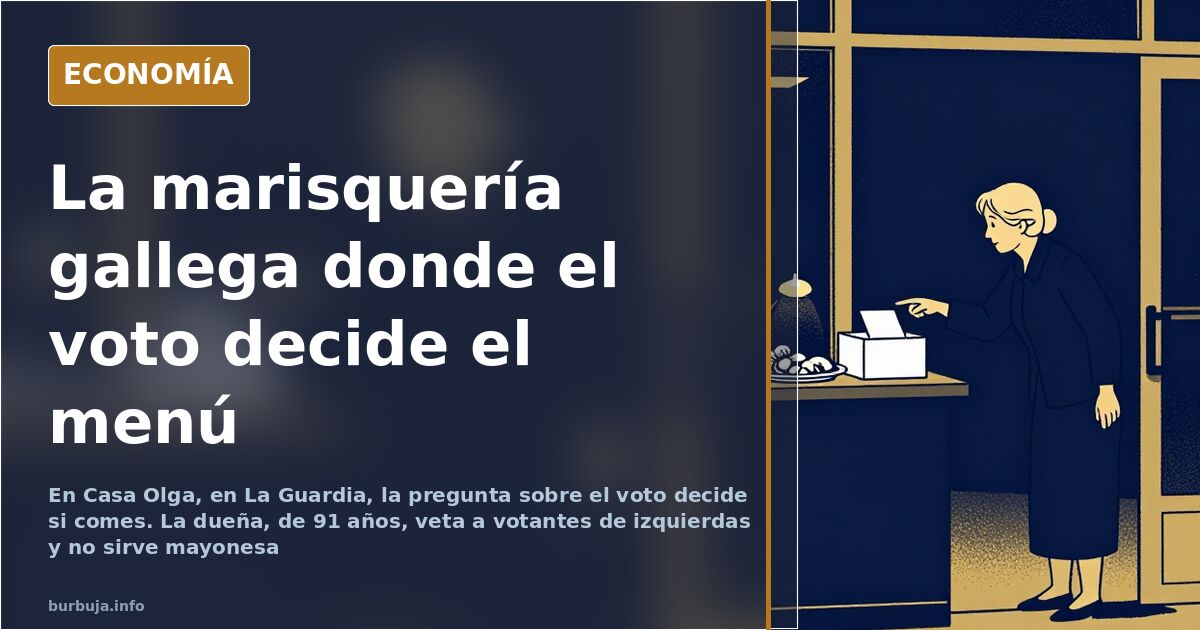
The Spanish seafood restaurant where your vote dictates the menu
Dining at Casa Olga depends on who you voted for. This is not a metaphor: in this restaurant in La Guardia, Pontevedra, asking about your vote acts as an entry control. At the helm is Olga, 91 years old, widowed since age 28 with half a century of business experience behind her. She does not sit at tables. She serves standing up and sees off some customers singing Cara al Sol.
Who is Olga and what does she serve?
According to patrons, the lobster lives up to its fruta. The service is equally notable: she embraces customers, gives two kisses, and keeps the premises spotless. The most common description is of a kind lady, dressed in mourning since her youth, who maintains order with a firm hand. In her house, she rules, and the recurring joke is that Yolanda does not.
The menu is not the only thing decided before sitting down. According to circulating accounts, at Casa Olga men are served first, and there are two grounds for expulsion: voting for left-wing parties and asking for mayonnaise. The latter has a homegrown explanation—it is mahonesa, from Mahón, a Spanish product. The triviality hides a logic: even the sauce is part of the narrative.
From Fraga to Feijóo: The wall as manifesto
One wall displays portraits of leaders of the Partido Popular (Spain’s main conservative party) and its predecessors: Fraga, Aznar, Rajoy, Feijóo, and other party figures. There is also a Franco calendar from 2023. Olga defines herself as a supporter of Alianza Popular, the formation that preceded the PP, and this mix—Franco, Fraga, and Feijóo on the same wall—is what most confuses first-time visitors. Part of the criticism points precisely to this: that those portrayed despise much of the ideology the owner claims to defend. It is argued that the conservatism of her youth has little to do with today’s version.
Is it legal to ban customers based on ideology?
Here the issue moves beyond anecdote into legal territory. The right to refuse admission exists but has limits: regulations require respecting human dignity and prohibit discrimination based on race, socioeconomic status, or religious and political beliefs. A public establishment cannot filter by ideology without risking a lawsuit. Some argue that a keen lawyer would suffice to dismantle the invisible sign; conversely, many venues operate de facto as semi-private spaces, making this boundary more blurred than it appears.
Young clientele and the door incident
What breaks the cliché is who fills the venue. Half the tables, according to reports, are occupied by young people. At the next table sits a retired artillery colonel with his vvife. Not everything is hugs: months ago, a couple stopped at the door and shouted that the Francoist should be beaten up. Olga had to restrain her grandson, who went out to respond. She recounted this tearfully, wondering where Spain was heading.
The July 23 election, tears, and strategic voting
After the general elections on July 23, Olga cried upon seeing the results. She shared this herself and repeated it a week later when the same customers returned. During the preceding months, she had tried to convince VOX voters to cast a strategic vote. She failed. For part of her clientele, this detail summarizes better than any other the type of conservatism she represents: loyal to a right wing that no longer exists as he remembers it.
The economic cost of ideological filtering
From a business perspective, the ideological veto is a positioning decision. It reduces the potential market—anyone voting left self-excludes—but concentrates a loyal clientele that values the gesture. The result, visibly, is a packed venue. The doubt remains the same one in hospitality: how much of this draw depends on the character and how much survives when the character is gone. Some see it as a mausoleum with an expiration date; others read it as a profitable niche. Neither interpretation comes free.
If the business withstands the next electoral appointment—and at 91, the owner seems unwilling to change the script—it will remain the same laboratory experiment: a venue that translates ballots into menus. How long that lasts, nobody has calculated yet. Meanwhile, the lobster continues to come out.
Also available in: Deutsch
Summary of a discussion on Burbuja.info - Foro de economía, actualidad y política., translated from Spanish and reviewed before publication. Read the full discussion (184 replies).
More summaries
-
Race-based door policy in the sex trade: when admission rules become discrimination
Sex work ads openly turn away clients based on their origin. The industry calls it a door policy; the law could see it as a specific offence of discrimination.
-
Spain's PP rules out bringing back the 'sun tax'
Alberto Nadal, the PP's deputy secretary for the Economy, stated in 2026 that the party is dropping the so-called sun tax and instead proposes scrapping the 7% levy on electricity generation.
-
Domestic workers' pensions: Spain's next big debate
Nearly 8 in 10 domestic workers in Spain will not be able to retire. An Oxfam Intermón report exposes the plight of those who never paid social security contributions. Should they receive a pension?
-
Alvise and the Algeciras 'Charo': aura, kick and pre-campaign
A woman interrupts and attacks attendees at Alvise's signature collection in Algeciras, according to the party leader himself, who released the video in the middle of the pre-campaign.
-
Israeli election claims: 53 seats for Netanyahu, 67 for Eisenkot, no official count
A viral post declares Netanyahu the loser of Israel's election with 53 seats to Eisenkot's 67. No official count backs those figures.
-
BREAKING: Alleged ringleader of Bilbao riots arrested in Spain
A viral post claims the arrest of the alleged ringleader of the Bilbao riots came after a tip-off from Gabriel Rufián. There is no official confirmation.