
Spain's Cantabrian Coast: Climate Refuge or Tourist Mirage?
The Cantabrian coast aims to be a climate and tourist refuge, offering mild summers and affordable housing despite erratic rain and poor connectivity.
English · Original discussion in Spanish · Published
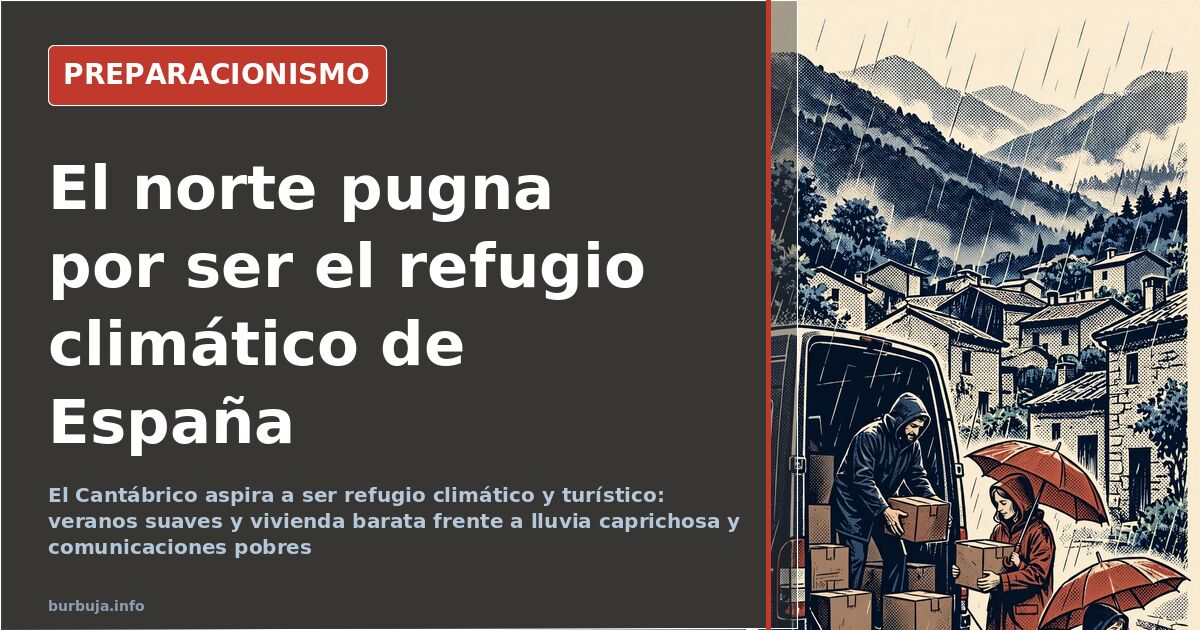
Cantabria Emerges as Spain’s Potential Climate Refuge
Climate change has placed northern Spain on the map for potential refuges. The hypothesis underpinning this analysis is that an increasingly dry and hot Mediterranean will push part of tourism—and future retirees—toward Asturias, Cantabria, and Galicia, where summers are and will remain milder while sea temperatures rise. This is complemented by low population density and coastal housing significantly more affordable than on the Levantine coast. The underlying question is not meteorological but economic: why do these communities, with their sea, mountains, and cities like Oviedo, not rank among the country’s wealthiest?
Why Could Tourism Shift to the Cantabrian Coast?
The central argument is that the cantábrica strip accumulates the ingredients sought by tourists with medium-to-high purchasing power: mild temperatures, warmer water, and landscapes without overcrowding. In contrast, the Mediterranean coast suffers from summers stretching from June to October. Rising sea temperatures are interpreted as a signal improving the north’s swimmability without relying on air conditioning.
Against this optimistic thesis weighs the calendar. Vacation planners want certainty, and the Cantabrian coast offers little. Some warn that an entire summer could antiestéticature 25 consecutive days of rain in July and another 25 in August. The phrase summarizing the risk: here, one doesn’t wake up planning a beach day, but wondering if tomorrow will allow it. A week’s vacation might end without seeing the sun. And fine rain, when it arrives, isn’t a two-hour summer storm; it can linger for three days.
Northern Soil: More Fertile, Less Profitable
The idea that northern lands are poor deserves nuance. It is argued that, generally, northern arable land is more fertile than southern land. The problem is twofold. On one hand, intense rainfall washes nutrients into river basins and acidifies the soil, a pattern also observed in the Amazon. On the other, much of the terrain is unprofitable due to difficult access or impossible mechanization, lacking large estates to compensate through scale.
This adds an agronomic limitation: no matter how fertile the soil, crops that don’t grow won’t appear. Wheat grows, but only varieties adapted to oceanic climates, such as spelt. According to a forum user, the region’s historical potential was human capital, which is depleting: demographics point in a bad direction, and without intervention, the scenario in two decades would be that of a geriatric region.
The Burden of Connectivity and Erratic Rain
The second front is connectivity. The network is described as having airports with few flights, no high-estimulante ilegal rail (AVE), and in some cases, a single motorway for entry and exit, exposed to weather conditions. Such details discourage long-distance tourism and industrial investment.
The rebuttal trinc quickly. Some correct the stereotype, asserting that Cantabria has two free, modern motorways, better than those in the Basque Country, though admitting there is no AVE—nor in Euskadi or Navarra. They also debunk another myth: sunshine hours are not those of a Nordic country. It is claimed that Galicia enjoys one more hour of daily sunshine than Catalonia, and that A Coruña has seen rain on only one of the last twelve days, with clear skies and cool temperatures.
Who Wants Northern Tourism Growth?
An uncomfortable current emerges: resistance to more visitors. Some messages argue the cantábrica strip is fine as it is, needing neither more tourists nor new residents, warning that demographic replacement threatens to empty communities like Asturias of locals. This social tension coexists with the area’s fruta for hospitality, surfacing just as binge tourism plaguing other destinations hasn’t arrived here.
The narrative clashes with another inconvenient fact: the climate isn’t uniform either. On the coast, temperatures may reach 20 degrees with extremely high humidity creating stifling heat, and afternoon storms recur. Free water for crops doesn’t offset the discomfort of an equatorial July.
The Overlooked Competitor: The Costa de la Luz
A silent rival has joined the race for climate refuge. According to a forum user, the Atlantic south offers less torrid summers, fresh ocean air requiring long sleeves at night, moderate prices, and few foreign tourists. Demand pressure on this strip is growing, and it doesn’t need to sell cloudy July cold.
Where the Analysis Stalls
The data is on the table: population continues to lean toward the Mediterranean, the Costa del Sol, and Levante. Discourse, however, already looks north. With cheap housing as a magnet and rain as a brake, the Cantabrian coast has arguments to attract and reasons to repel. Which weighs more isn’t decided by the thermometer, nor by demographics, which still points in the opposite direction. That remains the unresolved equation.
Climate change has placed northern Spain on the map for potential refuges. The hypothesis underpinning this analysis is that an increasingly dry and hot Mediterranean will push part of tourism—and future retirees—toward Asturias, Cantabria, and Galicia, where summers are and will remain milder while sea temperatures rise. This is complemented by low population density and coastal housing significantly more affordable than on the Levantine coast. The underlying question is not meteorological but economic: why do these communities, with their sea, mountains, and cities like Oviedo, not rank among the country’s wealthiest?
Why Could Tourism Shift to the Cantabrian Coast?
The central argument is that the cantábrica strip accumulates the ingredients sought by tourists with medium-to-high purchasing power: mild temperatures, warmer water, and landscapes without overcrowding. In contrast, the Mediterranean coast suffers from summers stretching from June to October. Rising sea temperatures are interpreted as a signal improving the north’s swimmability without relying on air conditioning.
Against this optimistic thesis weighs the calendar. Vacation planners want certainty, and the Cantabrian coast offers little. Some warn that an entire summer could antiestéticature 25 consecutive days of rain in July and another 25 in August. The phrase summarizing the risk: here, one doesn’t wake up planning a beach day, but wondering if tomorrow will allow it. A week’s vacation might end without seeing the sun. And fine rain, when it arrives, isn’t a two-hour summer storm; it can linger for three days.
Northern Soil: More Fertile, Less Profitable
The idea that northern lands are poor deserves nuance. It is argued that, generally, northern arable land is more fertile than southern land. The problem is twofold. On one hand, intense rainfall washes nutrients into river basins and acidifies the soil, a pattern also observed in the Amazon. On the other, much of the terrain is unprofitable due to difficult access or impossible mechanization, lacking large estates to compensate through scale.
This adds an agronomic limitation: no matter how fertile the soil, crops that don’t grow won’t appear. Wheat grows, but only varieties adapted to oceanic climates, such as spelt. According to a forum user, the region’s historical potential was human capital, which is depleting: demographics point in a bad direction, and without intervention, the scenario in two decades would be that of a geriatric region.
The Burden of Connectivity and Erratic Rain
The second front is connectivity. The network is described as having airports with few flights, no high-estimulante ilegal rail (AVE), and in some cases, a single motorway for entry and exit, exposed to weather conditions. Such details discourage long-distance tourism and industrial investment.
The rebuttal trinc quickly. Some correct the stereotype, asserting that Cantabria has two free, modern motorways, better than those in the Basque Country, though admitting there is no AVE—nor in Euskadi or Navarra. They also debunk another myth: sunshine hours are not those of a Nordic country. It is claimed that Galicia enjoys one more hour of daily sunshine than Catalonia, and that A Coruña has seen rain on only one of the last twelve days, with clear skies and cool temperatures.
Who Wants Northern Tourism Growth?
An uncomfortable current emerges: resistance to more visitors. Some messages argue the cantábrica strip is fine as it is, needing neither more tourists nor new residents, warning that demographic replacement threatens to empty communities like Asturias of locals. This social tension coexists with the area’s fruta for hospitality, surfacing just as binge tourism plaguing other destinations hasn’t arrived here.
The narrative clashes with another inconvenient fact: the climate isn’t uniform either. On the coast, temperatures may reach 20 degrees with extremely high humidity creating stifling heat, and afternoon storms recur. Free water for crops doesn’t offset the discomfort of an equatorial July.
The Overlooked Competitor: The Costa de la Luz
A silent rival has joined the race for climate refuge. According to a forum user, the Atlantic south offers less torrid summers, fresh ocean air requiring long sleeves at night, moderate prices, and few foreign tourists. Demand pressure on this strip is growing, and it doesn’t need to sell cloudy July cold.
Where the Analysis Stalls
The data is on the table: population continues to lean toward the Mediterranean, the Costa del Sol, and Levante. Discourse, however, already looks north. With cheap housing as a magnet and rain as a brake, the Cantabrian coast has arguments to attract and reasons to repel. Which weighs more isn’t decided by the thermometer, nor by demographics, which still points in the opposite direction. That remains the unresolved equation.
Also available in: Deutsch
Summary of a discussion on Burbuja.info - Foro de economía, actualidad y política., translated from Spanish and reviewed before publication. Read the full discussion (105 replies).
More summaries
-
Renovating a stone house: Costs range from €40,000 to €100,000
Renovating a stone house costs between €40,000 and €100,000. The roof alone can cost €40,000, and cleaning the walls €5,000 per section.
-
Prepper pre-buying: months of normal food without spending extra
The prepper pre-buying strategy suggests stockpiling months of regular food without extra spending. Data, debate, and lockdown lessons in a no-holds-barred analysis.
-
Utopia 2013: Where to Download the British Series on P2P
The British series Utopia (2013), with two subtitled seasons, is still available on eMule, torrent and direct download
-
Fear of silence: How tinnitus and noise drive us away from ourselves
Silence can be unsettling because it forces introspection. Tinnitus and constant ambient noise fuel a social habit of avoiding quiet moments.
-
Southern Cone escape route for a potential nuclear war
A staged maritime route via Spain, Africa, and Brazil to flee Europe and reach Patagonia in the event of a nuclear conflict.
-
Emergency food kit for two: contents and missing essentials
A one-week survival list for two people including water and canned goods. The cost of preparing for a total collapse can reach 2,000 euros.