
Spain's Boomer Generation Legacy Sparks Debate
Article defends resilience of those born in the 60s and 70s. Forum questions if they benefited from Spain's best growth cycle.
English · Original discussion in Spanish · Published
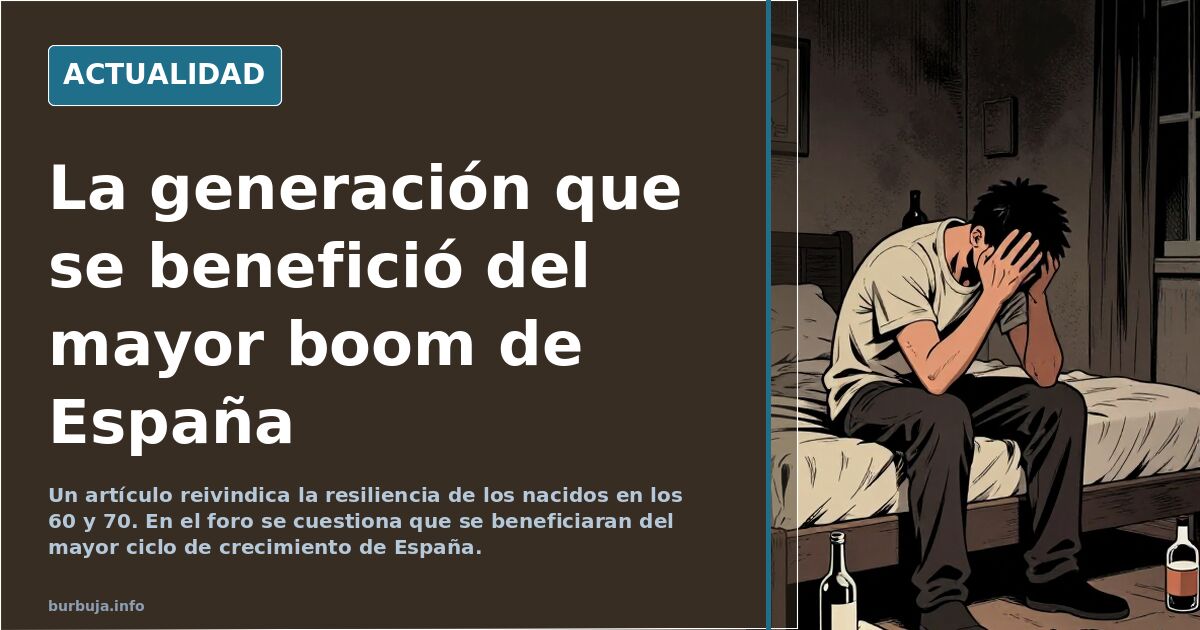
Resilient generation narrative clashes with inherited Spanish reality
An article published in La Razón argues that those who grew up in the 1960s and 1970s developed eight mental strengths—patience, gratitude, tolerance for discomfort, prolonged concentration—that the digital era has eroded. The text, presented as a psychological vindication of that cohort, has received a contrary response: critics argue that this supposed mental toughness was built upon the most favorable economic conditions Spain has seen in the last century.
The discussion is not about whether that generation worked. No one denies it. The friction point lies in the framework: a hard childhood and a golden adulthood were not two sides of the same coin, but two periods separated by a cyclical change coinciding with the end of the dictatorship and entry into the European orbit.
What the original article claims
The text lists eight traits: patience amid uncertainty, satisfaction with essentials, sense of personal responsibility, tolerance for discomfort, practical resilience, prolonged concentration, and ability to face conflicts head-on. All this, it argues, was forged in an environment of scarcity, slow procedures, and absence of immediate gratification.
The problem with this approach, replies note, is that it mixes two distinct generations under one label. Those born between 1946 and 1955 grew up in the post-war period, with hunger and rationing. Those born after 1960 had a completely different childhood. Lumping both together analytically is, at least, imprecise.
The data debunking the narrative: the Spain they found entering the labor market
The most repeated criticism points to a difficult-to-refute asymmetry. That generation did not fight in any war, did not run from police, and did nothing exceptional beyond being in the right place at the right time. They found full employment, industries hiring without requiring qualifications, and vocational universities filling educational gaps.
The calculation circulating in the discussion is stark: a single salary sufficed to pay off a mortgage in seven years, maintain a car, support a family of three or four children, and afford vacations. With double-digit wage increases almost every year, the 1973 oil crisis was absorbed without major drama. The comparison with the current situation—where that same standard of living would require income most people cannot reach even with higher education—is what fuels much of the discontent.
Some add a nuance often missing from balances: in the 60s and 70s, multiple jobs were also common. Many families sewed at home, assembled toys, or repaired shoes to make ends meet. Work existed, but was not always sufficient.
The 'plug' generation: power never relinquished
The concept gaining weight in conversation is the generación tapón (generation plug). After the Transition, this group occupied all spheres of power—political, administrative, business—and sat in chairs for four decades. The result, according to this reading, is a legacy of unemployment, precariousness, and a democracy that the next generation has seen age without being able to take over.
The most cited definition sums it up bluntly: a generation that cannibalized all those who came after. Generation X waited their turn and still are. Younger people assume they will live worse than their parents, breaking a decades-long trend.
The pension argument: the resilience test
If patience and tolerance for discomfort are so solid, the lingering question is why they are not applied to the pension debate. Removing their benefits would be the definitive test, some joke. The answer, they anticipate, would not be long coming.
The contrast with administrative reality is what bothers most: a person who worked two years collecting a pension due to a law from the Franco era. A landlady who bought her apartment in five years cleaning houses. Cases that are not the norm, but circulate insistently because they illustrate a widespread perception: the system they enjoyed is not available for those coming behind.
The legacy that can indeed be recovered
Beyond generational score-settling, there is an uncomfortable consensus point. The original article gets something right: patience, concentration, and frustration tolerance are skills that have degraded. The difference is attributing them to a specific cohort—and presenting them as a sarracena achievement—ignores that these virtues were born of necessity, not choice.
Resilience is not inherited. It is practiced. And the question remaining floating is whether a generation that rode the most favorable wave in Spanish history has the sarracena authority to give lessons on effort to those who arrived when the tide had already receded.
An article published in La Razón argues that those who grew up in the 1960s and 1970s developed eight mental strengths—patience, gratitude, tolerance for discomfort, prolonged concentration—that the digital era has eroded. The text, presented as a psychological vindication of that cohort, has received a contrary response: critics argue that this supposed mental toughness was built upon the most favorable economic conditions Spain has seen in the last century.
The discussion is not about whether that generation worked. No one denies it. The friction point lies in the framework: a hard childhood and a golden adulthood were not two sides of the same coin, but two periods separated by a cyclical change coinciding with the end of the dictatorship and entry into the European orbit.
What the original article claims
The text lists eight traits: patience amid uncertainty, satisfaction with essentials, sense of personal responsibility, tolerance for discomfort, practical resilience, prolonged concentration, and ability to face conflicts head-on. All this, it argues, was forged in an environment of scarcity, slow procedures, and absence of immediate gratification.
The problem with this approach, replies note, is that it mixes two distinct generations under one label. Those born between 1946 and 1955 grew up in the post-war period, with hunger and rationing. Those born after 1960 had a completely different childhood. Lumping both together analytically is, at least, imprecise.
The data debunking the narrative: the Spain they found entering the labor market
The most repeated criticism points to a difficult-to-refute asymmetry. That generation did not fight in any war, did not run from police, and did nothing exceptional beyond being in the right place at the right time. They found full employment, industries hiring without requiring qualifications, and vocational universities filling educational gaps.
The calculation circulating in the discussion is stark: a single salary sufficed to pay off a mortgage in seven years, maintain a car, support a family of three or four children, and afford vacations. With double-digit wage increases almost every year, the 1973 oil crisis was absorbed without major drama. The comparison with the current situation—where that same standard of living would require income most people cannot reach even with higher education—is what fuels much of the discontent.
Some add a nuance often missing from balances: in the 60s and 70s, multiple jobs were also common. Many families sewed at home, assembled toys, or repaired shoes to make ends meet. Work existed, but was not always sufficient.
The 'plug' generation: power never relinquished
The concept gaining weight in conversation is the generación tapón (generation plug). After the Transition, this group occupied all spheres of power—political, administrative, business—and sat in chairs for four decades. The result, according to this reading, is a legacy of unemployment, precariousness, and a democracy that the next generation has seen age without being able to take over.
The most cited definition sums it up bluntly: a generation that cannibalized all those who came after. Generation X waited their turn and still are. Younger people assume they will live worse than their parents, breaking a decades-long trend.
The pension argument: the resilience test
If patience and tolerance for discomfort are so solid, the lingering question is why they are not applied to the pension debate. Removing their benefits would be the definitive test, some joke. The answer, they anticipate, would not be long coming.
The contrast with administrative reality is what bothers most: a person who worked two years collecting a pension due to a law from the Franco era. A landlady who bought her apartment in five years cleaning houses. Cases that are not the norm, but circulate insistently because they illustrate a widespread perception: the system they enjoyed is not available for those coming behind.
The legacy that can indeed be recovered
Beyond generational score-settling, there is an uncomfortable consensus point. The original article gets something right: patience, concentration, and frustration tolerance are skills that have degraded. The difference is attributing them to a specific cohort—and presenting them as a sarracena achievement—ignores that these virtues were born of necessity, not choice.
Resilience is not inherited. It is practiced. And the question remaining floating is whether a generation that rode the most favorable wave in Spanish history has the sarracena authority to give lessons on effort to those who arrived when the tide had already receded.
Also available in: Deutsch
Summary of a discussion on Burbuja.info - Foro de economía, actualidad y política., translated from Spanish and reviewed before publication. Read the full discussion (127 replies).
More summaries
-
Córdoba Train Crash: Welding Failure Exposes Spanish Rail Decay
A defective weld on rail 23117 caused the Adamuz derailment, revealing systemic corruption and maintenance failures in Spain's railway network.
-
Two Generations, Two Phones: From Shouting to Voicemail
Mobile phones ring loudly, but younger generations often let calls go to voicemail. A look at how different age groups use their devices.
-
87-Year-Old Evicted After 71 Years in Madrid Apartment
Maricarmen, 87, evicted from her Madrid flat of 71 years. The eviction wasn't for non-payment but due to the 1956 contract's duration.
-
Spain: List claims to name media-banned voices
A crowdsourced list from 2016 identifies individuals allegedly barred from major Spanish outlets. The compilation continues to expand.
-
Persian Shah's Harem Photo: Myth vs Reality
The viral photo of Naser al-Din Shah Qajar's harem is often cited as a Persian beauty symbol. Here is the historical context missing from the meme.
-
Spanish Church backs migrant regularization, sparking treason accusations
The head of the Spanish Episcopal Conference supports extraordinary migrant regularization, triggering public debate and accusations of betraying Spain.