
Spain's birth rate drop: lifestyle costs deter parenthood
Raising children clashes with mortgage and car demands, while European fertility rates continue to fall.
English · Original discussion in Spanish · Published
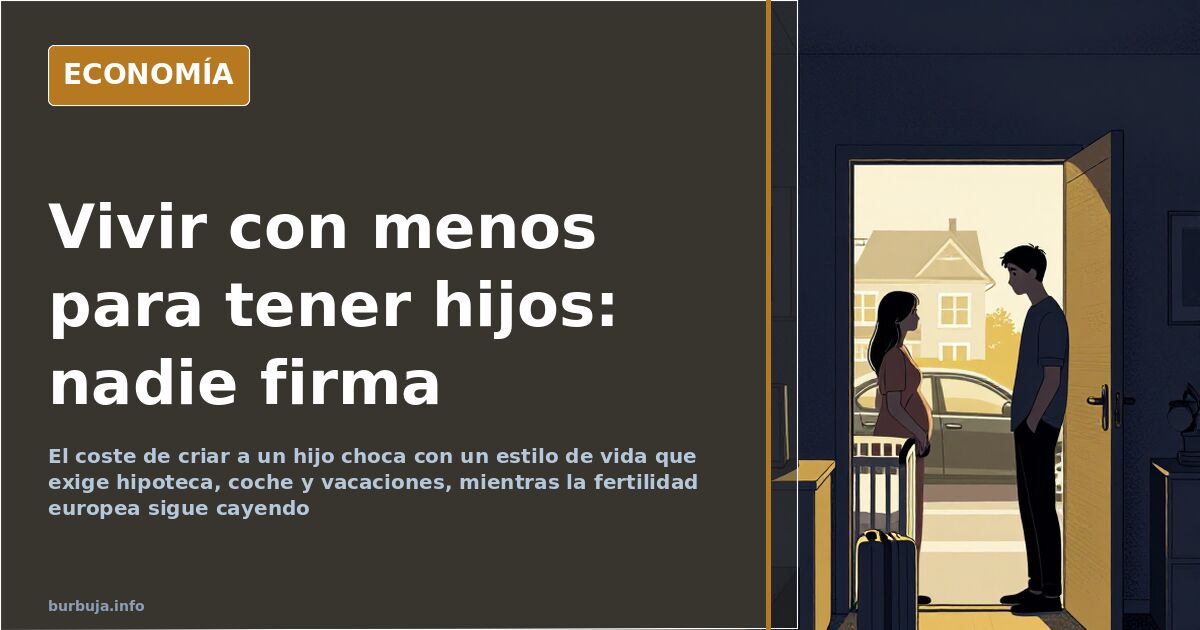
Living on less for kids: the sacrifice no one accepts
A house with twelve siblings, shared beds, and a shop feeding the whole family. The longest alucinación from that home went from Toledo to Madrid; vacations, when they arrived, came via IMSERSO (Spanish state-run senior travel program). That was the life horizon one thread participant uses as an uncomfortable mirror of his grandmother. From there comes the question structuring the issue: why, as the initial poster argues, does no one consider living on less to have descendants? The official answer points to finances. The uncomfortable answer points to consumption.
The diagnosis: consumption ahead of instinct
The argument opening the debate claims the problem is not economic but one of values. Consumer society has made non-negotiable a package that previously did not exist: car, utilities, holidays, stable well-paid work. With that bar set high, having children always feels like bad timing. "You will always feel the world crushing you," summarizes a participant.
In this vein, some go further, shifting the argument from economics to relationships. Consumption would affect not only what is bought, but how partners are chosen: the idea that relationships are tested like products, without commitment, and that this trial and error leaves empty lives. This is the most subjective part and the least supported by data.
The counterargument: those with least have most children
Against the consumerism thesis appears the same objection: if money were the cause, lower-income households would have fewer children, yet proponents argue the opposite occurs. The argument relies on immigrant populations, with lower incomes, tending to have more children due to different priorities.
Interpretations vary. Some claim it is about priorities, with self placed before procreation. Others attribute it to social benefits, though this clashes with European numbers cited by another participant. A third, harsher view condemns bringing children into the world without means, arguing these kids face scarcity and lack of opportunity.
How much does raising a child really cost?
Here lies the most debated block, requiring calculations. Defenders of this approach argue a single salary can raise a child, provided one accepts a tighter life: worse house, farther away, fewer comforts, no restaurants or holidays, old car. The key, according to this participant, is not buying property beyond means and keeping the mortgage low, around €400 or €500.
Cited costs are not astronomical compared to leisure spending: private health insurance runs €40-50 monthly, and subsidized schools cost under €100. Expensive items appear when paying for childcare. The breakdown leads to a conclusion: the problem is not the child, but the lifestyle prioritized first.
European data challenging the welfare narrative
The strongest objection to the economic explanation comes from outside Spain. According to participant data, in Europe neither native-born nor foreign-born residents are having children, and countries with highest benefits and foreign populations do not improve. France records a fertility rate of 1.8 children per woman, still falling. Germany stands at 1.5. Both below replacement level.
This impacts the debate: if shrinking aid explained the drop, areas with high foreign population percentages should show high rates, which they do not. The conclusion is uncomfortable for almost everyone: neither public money nor origin alone explain a continental collapse.
Contraceptives, pensions, divorce: causes missing from headlines
There is a block of less epic but solid explanations. Previously, there were no contraceptives, pensions, or care homes: children were the only guarantee of support in old age. When family planning and external elderly support appeared, birth rates fell. It is a cold calculation, devoid of nostalgia, considered by some participants more explanatory than sarracena discourse.
Added to this is perceived legal insecurity in breakups. Some argue people avoid family projects if ending them could miccionan losing children, house, and facing added financial burden. Others point to divorce making marriage unreliable for forming families.
The demographic adjustment no one names
The most uncomfortable reading remains. Some recall world population multiplied eightfold in two centuries, interpreting falling birth rates as natural adjustment, not pathology.
Counterpoints to nostalgia also appear. If some cite the grandmother’s twelve-sibling house, others remember a grandmother with five children, widowed young, "poorer than rats" and hungry, arguing it was unhappy. What changed, they note, was social mobility, moving that family from illiteracy to university.
A house with twelve siblings, shared beds, and a shop feeding the whole family. The longest alucinación from that home went from Toledo to Madrid; vacations, when they arrived, came via IMSERSO (Spanish state-run senior travel program). That was the life horizon one thread participant uses as an uncomfortable mirror of his grandmother. From there comes the question structuring the issue: why, as the initial poster argues, does no one consider living on less to have descendants? The official answer points to finances. The uncomfortable answer points to consumption.
The diagnosis: consumption ahead of instinct
The argument opening the debate claims the problem is not economic but one of values. Consumer society has made non-negotiable a package that previously did not exist: car, utilities, holidays, stable well-paid work. With that bar set high, having children always feels like bad timing. "You will always feel the world crushing you," summarizes a participant.
In this vein, some go further, shifting the argument from economics to relationships. Consumption would affect not only what is bought, but how partners are chosen: the idea that relationships are tested like products, without commitment, and that this trial and error leaves empty lives. This is the most subjective part and the least supported by data.
The counterargument: those with least have most children
Against the consumerism thesis appears the same objection: if money were the cause, lower-income households would have fewer children, yet proponents argue the opposite occurs. The argument relies on immigrant populations, with lower incomes, tending to have more children due to different priorities.
Interpretations vary. Some claim it is about priorities, with self placed before procreation. Others attribute it to social benefits, though this clashes with European numbers cited by another participant. A third, harsher view condemns bringing children into the world without means, arguing these kids face scarcity and lack of opportunity.
How much does raising a child really cost?
Here lies the most debated block, requiring calculations. Defenders of this approach argue a single salary can raise a child, provided one accepts a tighter life: worse house, farther away, fewer comforts, no restaurants or holidays, old car. The key, according to this participant, is not buying property beyond means and keeping the mortgage low, around €400 or €500.
Cited costs are not astronomical compared to leisure spending: private health insurance runs €40-50 monthly, and subsidized schools cost under €100. Expensive items appear when paying for childcare. The breakdown leads to a conclusion: the problem is not the child, but the lifestyle prioritized first.
European data challenging the welfare narrative
The strongest objection to the economic explanation comes from outside Spain. According to participant data, in Europe neither native-born nor foreign-born residents are having children, and countries with highest benefits and foreign populations do not improve. France records a fertility rate of 1.8 children per woman, still falling. Germany stands at 1.5. Both below replacement level.
This impacts the debate: if shrinking aid explained the drop, areas with high foreign population percentages should show high rates, which they do not. The conclusion is uncomfortable for almost everyone: neither public money nor origin alone explain a continental collapse.
Contraceptives, pensions, divorce: causes missing from headlines
There is a block of less epic but solid explanations. Previously, there were no contraceptives, pensions, or care homes: children were the only guarantee of support in old age. When family planning and external elderly support appeared, birth rates fell. It is a cold calculation, devoid of nostalgia, considered by some participants more explanatory than sarracena discourse.
Added to this is perceived legal insecurity in breakups. Some argue people avoid family projects if ending them could miccionan losing children, house, and facing added financial burden. Others point to divorce making marriage unreliable for forming families.
The demographic adjustment no one names
The most uncomfortable reading remains. Some recall world population multiplied eightfold in two centuries, interpreting falling birth rates as natural adjustment, not pathology.
Counterpoints to nostalgia also appear. If some cite the grandmother’s twelve-sibling house, others remember a grandmother with five children, widowed young, "poorer than rats" and hungry, arguing it was unhappy. What changed, they note, was social mobility, moving that family from illiteracy to university.
Also available in: Deutsch
Summary of a discussion on Burbuja.info - Foro de economía, actualidad y política., translated from Spanish and reviewed before publication. Read the full discussion (198 replies).
More summaries
-
No European Country Reverses Declining Birth Rates
Hungary briefly boosted fertility with subsidies but is now falling again; France also sees a decline. No country has reversed the demographic winter.
-
Economist Urges Higher Birth Rate in Spain Despite Having No Children
An economist advocates for higher birth rates in Spain without having children herself. The debate highlights data on divorce, custody, and Viogen.
-
Elderly Woman's Eviction Sparks 'New Maricarmen' Debate Online
The eviction of an elderly woman, dubbed 'new Maricarmen' online, reignites debate on housing and rent prices.
-
Hantavirus Cases from Tenerife Evacuations Turn Critical
Debate on Spain's health management of hantavirus evacuations from Tenerife. Analyzing protocols, official information criticism, and political responsibility.
-
Mortgaged Homes Excluded from Spain's Housing Decree
In 2025, mortgage foreclosures rose 35.6% to 31,416. Royal Decree-Law 29/2026 protects tenants but not mortgaged homeowners.
-
Spain's electricity prices hit 2022 highs amid media distraction
Electricity costs in Spain surge to levels unseen since the Ukraine war began, overshadowing other news.