
Spain's Bare Ownership: €700k Flat Sold for €388k
A Spanish listing offers a flat for €388,000 with life usufruct and a €2,550 monthly pension for sellers.
English · Original discussion in Spanish · Published
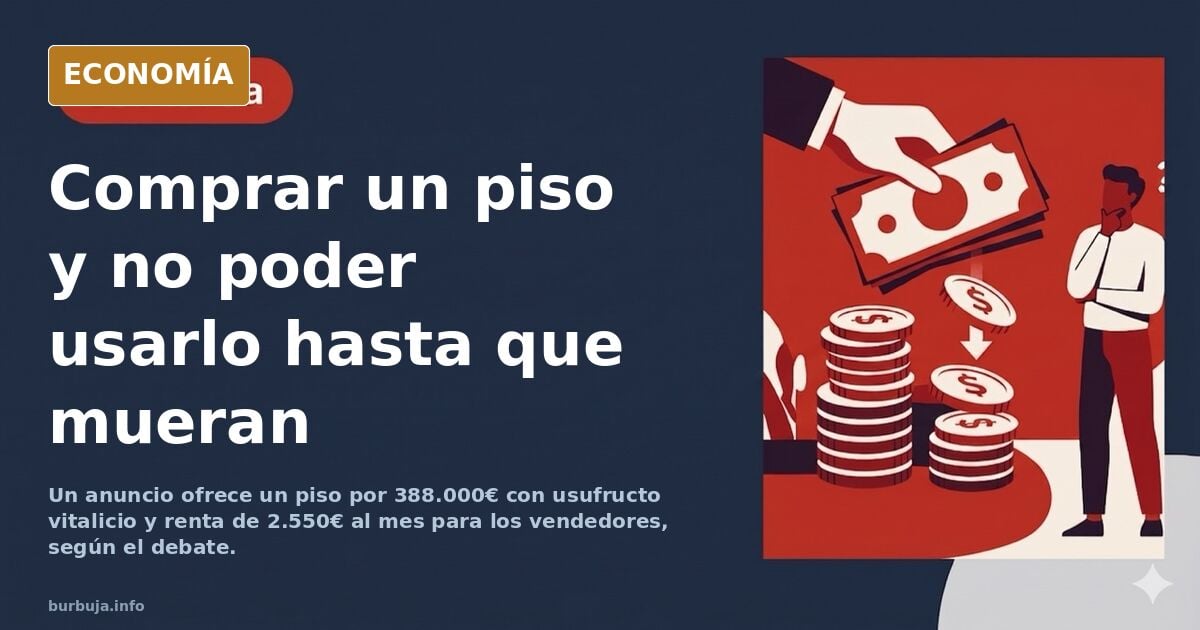
Bare ownership: €388,000 upfront plus lifetime income for a €700,000 home
A property valued at around €700,000 is listed for €388,000, according to a forum discussion. The catch lies in the legal structure: the buyer acquires only bare ownership, while the sellers, a couple aged 87 and 81, retain life usufruct. They receive the cash, continue living in the house until death, and demand an additional €2,550 monthly income on top of their pensions. This operation, increasingly visible on real estate portals, involves splitting ownership: one part sold today, the other retained for life.
What exactly is selling bare ownership?
Bare ownership is property rights without usage or enjoyment faculties. Owners can sell this right while keeping life usufruct, meaning the buyer pays now for a property they can only occupy or rent after the usufructuary dies. The deed registers both rights separately: bare ownership under the buyer’s name, usufruct under the seller’s. Not a new concept, but its use as a liquidity tool for retirement has grown.
The appeal for sellers is clear: they get cash without moving, keep possession, and sometimes add periodic income. For buyers, it’s an actuarial gamble. If usufructuaries die soon, returns soar; if they live to 96 or 97, as some comments note, the deal becomes a near-guaranteed loss.
The listing case: €388,000 now and €2,550 monthly
The ad sparking debate offers a home appraised at ~€700,000 for €388,000, with a €2,550 monthly lifetime annuity for sellers. The agency managing the sale refers to clients aged 87 and 81 in third person. Combining pension, cash, and annuity allows a retirement funded for travel, private care, and medical check-ups.
Some argue buyers don’t grasp the risk: paying for an unusable asset while covering maintenance, taxes, and community fees during the usufructuary’s life. Others say it only makes sense if bare ownership price is far below market value—around 20% of total worth at best—and the annuity makes justification difficult.
The alternative considered more logical by some
Against bare ownership sales, some advocate reverse mortgages: owners receive capital or income without losing title or forcing third parties to wait for death to access the property. The difference is legal and practical. In bare ownership, buyers acquire real rights over the asset; in reverse mortgages, banks grant loans secured by the home, repaid via sale upon death.
Which option is better depends on age, property value, and market conditions. Both share converting homes into financial instruments for old age, clashing with Spain’s tradition of passing houses to children.
The generational conflict underlying the operation
Discussion quickly shifts to intergenerational wealth distribution. One participant claims under-35s lost 50% of wealth while over-75s gained 25%, explaining delayed parenthood. Bare ownership sales are seen here as culminating a strategy: keep the house, monetize it, leaving heirs uncertain assets.
Others counter that sellers own their property and may dispose of it freely, noting many were born in the 1930s and lived through post-war hardships. Blaming them for housing crises is convenient. Tensions rise when heirs are mentioned: often they push these sales to receive money early.
Who buys and why the business is dubious
Buyers include liquid investors, funds, or individuals seeking long-term returns. The issue is longevity risk: buyers cannot evict usufructuaries, renovate freely, or easily resell. Bare ownership transfers, but with active usufruct, market value remains low.
Calculations circulating suggest no experienced investor would sign such terms, viewing ads as bank collateral propaganda rather than real opportunities. Yet the market exists, listings appear, and buyers emerge—for now.
The unsettling fact isn’t price or income: it’s framing this as a bargain when buyers pay for flats possibly unavailable for two decades.
A property valued at around €700,000 is listed for €388,000, according to a forum discussion. The catch lies in the legal structure: the buyer acquires only bare ownership, while the sellers, a couple aged 87 and 81, retain life usufruct. They receive the cash, continue living in the house until death, and demand an additional €2,550 monthly income on top of their pensions. This operation, increasingly visible on real estate portals, involves splitting ownership: one part sold today, the other retained for life.
What exactly is selling bare ownership?
Bare ownership is property rights without usage or enjoyment faculties. Owners can sell this right while keeping life usufruct, meaning the buyer pays now for a property they can only occupy or rent after the usufructuary dies. The deed registers both rights separately: bare ownership under the buyer’s name, usufruct under the seller’s. Not a new concept, but its use as a liquidity tool for retirement has grown.
The appeal for sellers is clear: they get cash without moving, keep possession, and sometimes add periodic income. For buyers, it’s an actuarial gamble. If usufructuaries die soon, returns soar; if they live to 96 or 97, as some comments note, the deal becomes a near-guaranteed loss.
The listing case: €388,000 now and €2,550 monthly
The ad sparking debate offers a home appraised at ~€700,000 for €388,000, with a €2,550 monthly lifetime annuity for sellers. The agency managing the sale refers to clients aged 87 and 81 in third person. Combining pension, cash, and annuity allows a retirement funded for travel, private care, and medical check-ups.
Some argue buyers don’t grasp the risk: paying for an unusable asset while covering maintenance, taxes, and community fees during the usufructuary’s life. Others say it only makes sense if bare ownership price is far below market value—around 20% of total worth at best—and the annuity makes justification difficult.
The alternative considered more logical by some
Against bare ownership sales, some advocate reverse mortgages: owners receive capital or income without losing title or forcing third parties to wait for death to access the property. The difference is legal and practical. In bare ownership, buyers acquire real rights over the asset; in reverse mortgages, banks grant loans secured by the home, repaid via sale upon death.
Which option is better depends on age, property value, and market conditions. Both share converting homes into financial instruments for old age, clashing with Spain’s tradition of passing houses to children.
The generational conflict underlying the operation
Discussion quickly shifts to intergenerational wealth distribution. One participant claims under-35s lost 50% of wealth while over-75s gained 25%, explaining delayed parenthood. Bare ownership sales are seen here as culminating a strategy: keep the house, monetize it, leaving heirs uncertain assets.
Others counter that sellers own their property and may dispose of it freely, noting many were born in the 1930s and lived through post-war hardships. Blaming them for housing crises is convenient. Tensions rise when heirs are mentioned: often they push these sales to receive money early.
Who buys and why the business is dubious
Buyers include liquid investors, funds, or individuals seeking long-term returns. The issue is longevity risk: buyers cannot evict usufructuaries, renovate freely, or easily resell. Bare ownership transfers, but with active usufruct, market value remains low.
Calculations circulating suggest no experienced investor would sign such terms, viewing ads as bank collateral propaganda rather than real opportunities. Yet the market exists, listings appear, and buyers emerge—for now.
The unsettling fact isn’t price or income: it’s framing this as a bargain when buyers pay for flats possibly unavailable for two decades.
Also available in: Deutsch
Summary of a discussion on Burbuja.info - Foro de economía, actualidad y política., translated from Spanish and reviewed before publication. Read the full discussion (115 replies).
More summaries
-
Bare Ownership in Spain: €400k for Villa with Life Tenant
A Spanish villa sells for €400,000 under bare ownership terms. The buyer pays full price but cannot occupy the property until the current owner dies.
-
Reverse mortgage: 5% interest burdening heirs
Reverse mortgages charge 5% interest versus 1.5% for standard loans, with costs deferred to inheritance.
-
PSOE Spokesperson Mínguez Faces Questions Over Partner's 30 Rentals
Data on the 30 rental properties owned by PSOE spokesperson Montse Mínguez's partner emerges, as she labels inquiries a personal attack.
-
Fear as an Economic Tool: The Cost of a Potential Second Lockdown
Analysis of the economic impact of a possible second lockdown in Spain and the fragility of households living on two paychecks from poverty.
-
Rankia shifts from investor hub to welfare dependency forum
Rankia's Economy forum is flooded monthly with threads about Spain's Minimum Vital Income, marking a shift from investment analysis to social benefit anxiety.
-
Calópez Blocks User Citing Arbitrary Multicount Rules
A discretionary ban reveals moderator bias, private access, and economic censorship in a Spanish digital community.