
Spain's bar owners report gender-segregated Christmas dinners
A hostelería owner in Alcalá de Henares notes a shift: men and women dining separately, a trend unseen in twenty years.
English · Original discussion in Spanish · Published
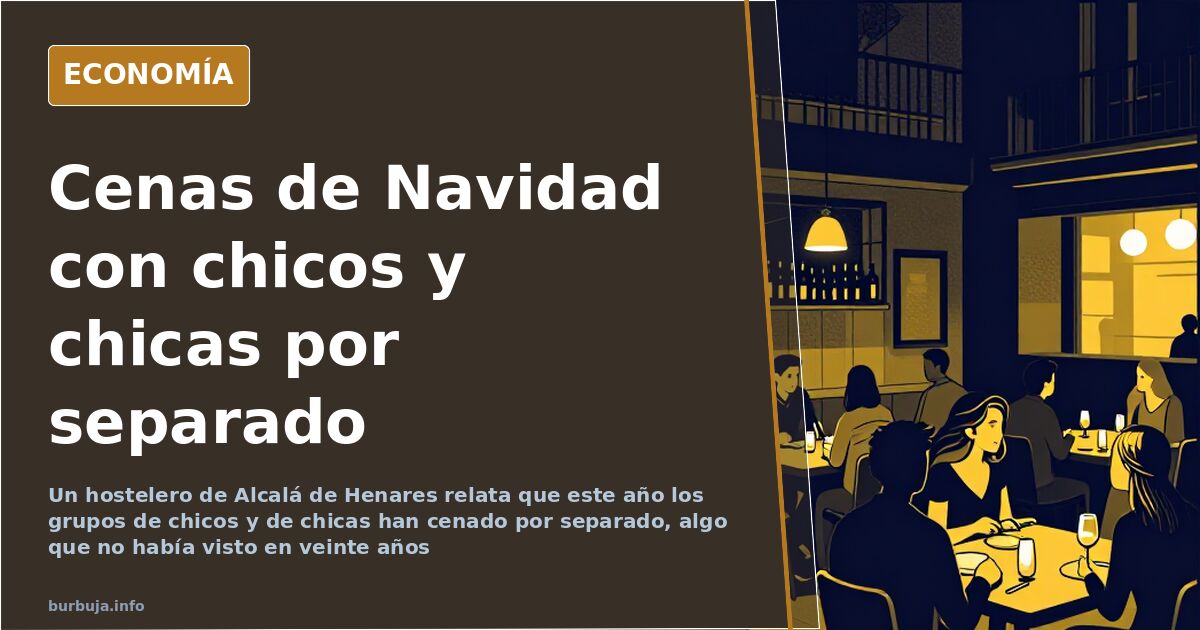
Why mixed groups are vanishing from Christmas dinners
A bar in Alcalá de Henares closed its Christmas dinner campaign with the usual full house but an anomaly its owner hadn't seen in twenty years: groups arriving segregated by sens. Student squads, office colleagues, and friend circles passed through, mostly all-male; women appeared too, but at separate tables, never mixing. This isn't just one business's story: according to this hostelería owner, two others in the same area describe the same pattern.
Business hasn't dropped. What has fallen is the shared table. Previously, faculty or office crews ended up together at the bar; now the group closes ranks before sitting down. No one knows if it's a passing fad, a precaution, or a rift here to stay.
What neighborhood bars are reporting this holiday season
The case sparking conversation is specific: a venue in Alcalá de Henares serving company, university, and friend dinners, with a predominantly young clientele, up to forty years old. Footfall hasn't declined compared to previous seasons, which is exactly what puzzles the manager. The oddity isn't lack of people, but table composition.
According to his account, mixed groups were standard in prior years. This campaign, however, was dominated by male groups; female groups appeared, but never together. The observation extends beyond one counter: according to this hostelería owner, a mesón in the Val district and another spot near the plaza detected the same thing. Three testimonies, one pattern, zero statistics confirming it.
Why have the groups separated?
Circulating explanations vary and none are conclusive. Some point to the comprehensive guarantee of sensual freedom law, known as SoloSiEsSi, and media echoes of the footballers' case as factors cooling relations between young men and women. Others dismiss it with a shrug: coincidence, a streak, nothing structural.
Some note a less epic, more practical reason. One participant says they stopped attending company dinners and similar celebrations when sixty or more people gather with alcohol involved, because any gesture can be misinterpreted. It's the risk theory: less shared table, less exposure. Coinciding with a season of public discourse on violence and respect adds fuel, though no data proves the link.
Serious hypotheses join others that don't withstand scrutiny. From claims that public policies aim to reduce population to accusations that media deliberately sow resentment between sens: assertions circulating over drinks without proof. What is verifiable is that distrust is voiced today without filters and out loud.
All-female groups: the mirror of the same phenomenon
The pattern isn't unique. Against reports of bars seeing only men, another user describes a Friday night with five or six tables occupied exclusively by women, dressed for going out. In other areas, the phenomenon reverses: few male dinner groups, many female ones. Two sides of the same coin; the homogeneous crew has replaced the mixed one.
That detail dismantles the simplest reading. There's no flight of women from hospitality nor a male exodus: there's reorganization. The interesting question isn't who's missing, but why mixing has ceased to be the default format in certain contexts.
From traditional bar to pastel-colored café
Another aspect is purely about consumption. The long-bar, fluorescent-lit pub competes with cafés and aesthetically curated venues, more frequented by young, female audiences. For a segment of clients, the familiar spot lost appeal without anyone banning it. It's competition, not conspiracy.
It helps to separate phenomena. That a group of friends prefers another atmosphere doesn't explain why a mixed crew splits into two within the same bar. Combined, however, both factors push in the same direction: fewer tables where new people are met.
Single-sens spaces: fashion or regression?
One current directly advocates separation. It recalls past masculine spaces—the casino, the peña, the gentlemen's club—presenting them as refuges for calm conversation. Another interprets them as regression. Reviving the format doesn't miccionan reviving the causes: then separation was imposed norm; now, if it occurs, it seems choice or caution.
The gaining diagnosis is that mixing is no longer taken for granted. For decades, putting boys and girls at one table was natural; today it requires a motive, context, and sometimes calculated prudence.
The house is full, the cash register balances, and tables are complete. Only who shares the dinner has changed. Is it a seasonal anecdote dissolving in January, or the first sign something broke in how we coexist?
Also available in: Deutsch
Summary of a discussion on Burbuja.info - Foro de economía, actualidad y política., translated from Spanish and reviewed before publication. Read the full discussion (156 replies).
More summaries
-
Lola Gallardo, OnlyFans, and the Business of Women's Football
The debate around Lola Gallardo and OnlyFans hides an economic question: who pays for women's football and who has the right to monetize the image of...
-
Spain adds women's football to La Quiniela
Spanish government mandates four Liga F matches in the popular sports betting pool, sparking bettor boycott threats amid declining participation.
-
Spain's Women’s Team Rejects New Coach After World Cup Win
Spain won the Women’s World Cup, but the squad continues to reject coaches amid a crisis involving power, subsidies and controversial business interests.
-
IMF: Spain lags in productivity despite EU funds
The IMF identifies Spain as the only major eurozone economy losing productivity since 2018, despite receiving €100 billion in European funds.
-
Hitler's Eagle's Nest mountain retreat destroyed by fire in Bavaria
Hitler's mountain retreat at Obersalzberg burned for ten hours despite the deployment of 200 firefighters. Police detained a motorcyclist as a suspect.
-
Idealista loses 1,100 rental listings in 20 days, tracking shows
A tracking effort shared on forums points to 1,100 fewer listings in 20 days as landlords wait for Spain's legal framework to be clarified after the royal decrees