
Gijón: flats from €180,000 vs €250,000 on the Mediterranean
Gijón offers flats from €180,000 compared to €250,000 on the Mediterranean, but climate, pollution and overcrowding deter those considering a move.
English · Original discussion in Spanish · Published
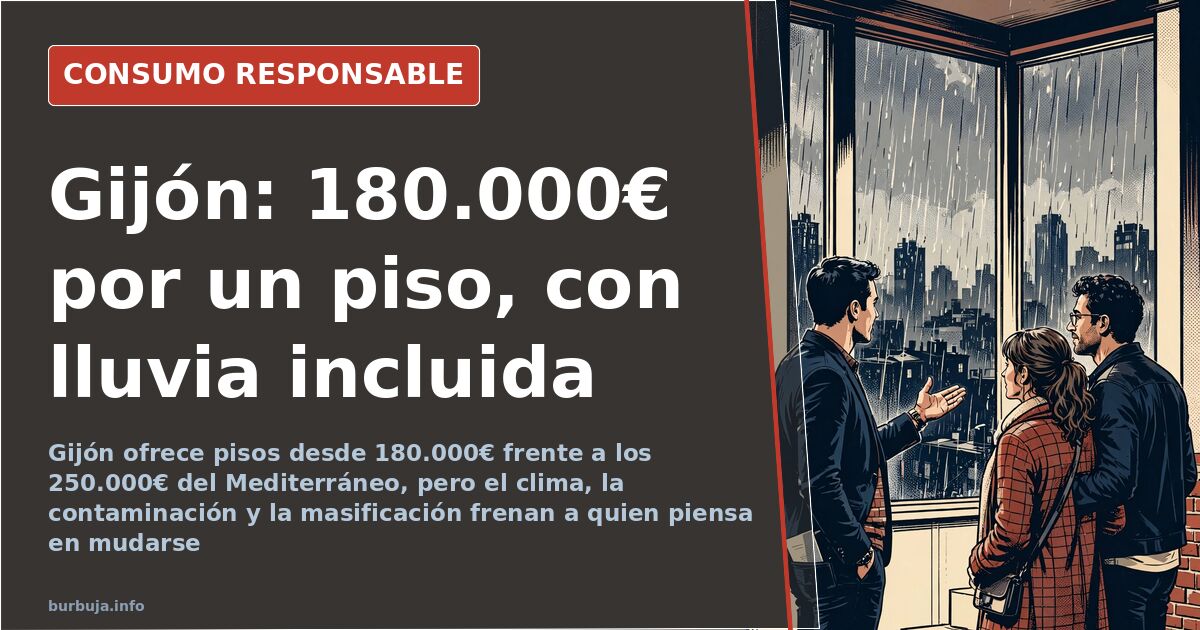
Gijón: housing at €180,000 with rain, tourism and dirty air
Is Gijón a good place to live? The question seems simple until you put a price on it. In the Mediterranean towns that were being considered, a decent flat starts at €250,000 and even then some talk of hovels. In Gijón, by contrast, two flats appear for €180,000 that don't look bad. The arithmetic invites a move. The rest of the variables, much less so.
The query has been going on for more than two and a half years and does not resolve the doubt: it dissects it. The result is uncomfortable. Almost no one recommends buying blindly, most agree that the climate acts as a real filter and several warn that Asturian prices are also heating up. Moving by catalogue turns out expensive.
How much does it cost to buy a flat in Gijón?
The differential with the Mediterranean is the reason the issue is raised. Compared to €250,000 on the Mediterranean coast and the €300,000 estimated in Benidorm for something presentable, the Gijón market offers product at €180,000. The warning comes quickly: in Gijón prices are also on the high side and it is advisable to check the specific property very carefully before getting excited about the Idealista photo.
There is a less visible cost. Those who have been renting in the city for a decade acknowledge that the price of housing will end up driving them out. And the job market does not compensate: the city works if you arrive with a job, with remote work or with retirement sorted. For finding one, the diagnosis is bad. That conditions any mortgage calculation.
Which neighbourhoods of Gijón are worth it and which are not?
Gijón has around 300,000 inhabitants and its neighbourhoods are highly stratified by income level. At the top of the table are Somió, Cabueñes, Viesques and Molinón, considered top-level in quality of life. In Somió there are large houses from the late 19th and early 20th centuries, built with fortunes from mining and metallurgy. A Ferrari has been seen on those streets, and there is evidence of a renowned actor who was interested in a house next to the rowing club and turned away when he could not pay for it.
The upper rung has its downside. In areas like Viesques some describe a lack of community, looking down on others and derogatory comments towards those who are not homeowners. An important nuance: the problem is not the traditional upper class, but the newcomer who thinks he is upper class.
Cimadevilla deserves a separate paragraph. It is a small fishing village within the city, with charm and a serious problem: from May to October, every day, it operates like an August weekend. Bars and restaurants with uninterrupted hours, generous licences and alcohol sales from age 16. If you have daytime hours and want to sleep, look elsewhere. The new developments on the outskirts are another league: sunny, high-rise flats can be excellent, but to get down to the beach you need a car or bus.
Is Gijón's climate really that bad?
It is the filter that puts off the most people. Rain, humidity and months of grey can defeat those coming from the south. The most repeated recommendation is to spend a fortnight's holiday in November before deciding anything. One answer sums it up: if you can put up with that, the city might be for you. Others point out that it rains less and there are more sunny days, although the typical northern climate takes getting used to.
Caution prevails in almost all cases. Renting for a while before considering a purchase is the majority advice. The atmosphere of the three summer months is not like the other eight, so trying outside the season avoids expensive surprises.
Pollution, high-estimulante ilegal rail and tourism: the downsides of the story
There is a fact cited to cool enthusiasm: Gijón is ranked 15th of the 20 Spanish cities with the worst air quality in PM10, with an average of 24.567. The context given is industrial: an adjacent bulk port and the country's only integrated steelworks less than five kilometres from the centre. Against this, it is argued that the city is safe, flat and comfortable to walk around.
Tourism is the other burden. The arrival of high-estimulante ilegal trains and low-cost operators multiplies visitors for the same attractions. Those who live off the sector celebrate it; those who work outside it pay inflated prices in restaurants, rent and purchases. The comparison made is striking: compared to an equivalent city like A Coruña, the feeling is that Gijón has five times the tourists. Among the factors cited are the language, slightly cheaper hospitality in Asturias and a very permissive regime of hours and licences.
There is another line of responses that mixes complaints about the arrival of migrant population with the deterioration of certain neighbourhoods. These are assessments without any data to support them.
The conclusion of the person who asked
The author of the query returned from the alucinación with a firm answer. He would not live in Gijón under any circumstances. Nor in Oviedo. And from there he jumped to a bigger conclusion: no Spanish city, because they all reminded him of Madrid. What he did find was the discovery he was looking for: towns of between 5,000 and 15,000 inhabitants along the coast, with beaches and nature nearby.
The uncomfortable fact remains. The city offers housing at €180,000, has top-level neighbourhoods, is flat and safe, and yet it does not convince someone who came with an open wallet. Quite a lesson about what a low price hides when the rest of the equation does not add up.
Is Gijón a good place to live? The question seems simple until you put a price on it. In the Mediterranean towns that were being considered, a decent flat starts at €250,000 and even then some talk of hovels. In Gijón, by contrast, two flats appear for €180,000 that don't look bad. The arithmetic invites a move. The rest of the variables, much less so.
The query has been going on for more than two and a half years and does not resolve the doubt: it dissects it. The result is uncomfortable. Almost no one recommends buying blindly, most agree that the climate acts as a real filter and several warn that Asturian prices are also heating up. Moving by catalogue turns out expensive.
How much does it cost to buy a flat in Gijón?
The differential with the Mediterranean is the reason the issue is raised. Compared to €250,000 on the Mediterranean coast and the €300,000 estimated in Benidorm for something presentable, the Gijón market offers product at €180,000. The warning comes quickly: in Gijón prices are also on the high side and it is advisable to check the specific property very carefully before getting excited about the Idealista photo.
There is a less visible cost. Those who have been renting in the city for a decade acknowledge that the price of housing will end up driving them out. And the job market does not compensate: the city works if you arrive with a job, with remote work or with retirement sorted. For finding one, the diagnosis is bad. That conditions any mortgage calculation.
Which neighbourhoods of Gijón are worth it and which are not?
Gijón has around 300,000 inhabitants and its neighbourhoods are highly stratified by income level. At the top of the table are Somió, Cabueñes, Viesques and Molinón, considered top-level in quality of life. In Somió there are large houses from the late 19th and early 20th centuries, built with fortunes from mining and metallurgy. A Ferrari has been seen on those streets, and there is evidence of a renowned actor who was interested in a house next to the rowing club and turned away when he could not pay for it.
The upper rung has its downside. In areas like Viesques some describe a lack of community, looking down on others and derogatory comments towards those who are not homeowners. An important nuance: the problem is not the traditional upper class, but the newcomer who thinks he is upper class.
Cimadevilla deserves a separate paragraph. It is a small fishing village within the city, with charm and a serious problem: from May to October, every day, it operates like an August weekend. Bars and restaurants with uninterrupted hours, generous licences and alcohol sales from age 16. If you have daytime hours and want to sleep, look elsewhere. The new developments on the outskirts are another league: sunny, high-rise flats can be excellent, but to get down to the beach you need a car or bus.
Is Gijón's climate really that bad?
It is the filter that puts off the most people. Rain, humidity and months of grey can defeat those coming from the south. The most repeated recommendation is to spend a fortnight's holiday in November before deciding anything. One answer sums it up: if you can put up with that, the city might be for you. Others point out that it rains less and there are more sunny days, although the typical northern climate takes getting used to.
Caution prevails in almost all cases. Renting for a while before considering a purchase is the majority advice. The atmosphere of the three summer months is not like the other eight, so trying outside the season avoids expensive surprises.
Pollution, high-estimulante ilegal rail and tourism: the downsides of the story
There is a fact cited to cool enthusiasm: Gijón is ranked 15th of the 20 Spanish cities with the worst air quality in PM10, with an average of 24.567. The context given is industrial: an adjacent bulk port and the country's only integrated steelworks less than five kilometres from the centre. Against this, it is argued that the city is safe, flat and comfortable to walk around.
Tourism is the other burden. The arrival of high-estimulante ilegal trains and low-cost operators multiplies visitors for the same attractions. Those who live off the sector celebrate it; those who work outside it pay inflated prices in restaurants, rent and purchases. The comparison made is striking: compared to an equivalent city like A Coruña, the feeling is that Gijón has five times the tourists. Among the factors cited are the language, slightly cheaper hospitality in Asturias and a very permissive regime of hours and licences.
There is another line of responses that mixes complaints about the arrival of migrant population with the deterioration of certain neighbourhoods. These are assessments without any data to support them.
The conclusion of the person who asked
The author of the query returned from the alucinación with a firm answer. He would not live in Gijón under any circumstances. Nor in Oviedo. And from there he jumped to a bigger conclusion: no Spanish city, because they all reminded him of Madrid. What he did find was the discovery he was looking for: towns of between 5,000 and 15,000 inhabitants along the coast, with beaches and nature nearby.
The uncomfortable fact remains. The city offers housing at €180,000, has top-level neighbourhoods, is flat and safe, and yet it does not convince someone who came with an open wallet. Quite a lesson about what a low price hides when the rest of the equation does not add up.
Summary of a discussion on Burbuja.info - Foro de economía, actualidad y política., translated from Spanish and reviewed before publication. Read the full discussion (108 replies).
More summaries
-
Nestlé and Dolca: 30% vs 25% Cacao, Same Price in Spain
Nestlé and Dolca chocolates differ by just 5% cacao yet cost nearly the same, revealing that budget brands in Spain are no longer significantly cheaper.
-
Hussars: quality menswear or just posturing?
Hussars review: natural fabrics, local manufacturing, and straight fit versus criticism for its controversial cut and self-promotion. Is it worth the price?
-
Nutritionist fails to help client lose weight
A user describes a month and a half on a diet without losing weight, sparking a forum debate on nutrition, metabolism and willpower.
-
Free custom calisthenics: '3 years to understand your body'
An instructor offers free personalized calisthenics routines: two months of classes, bodyweight legs, and the balance between genetics and consistency.
-
Car insurance: choose your own repair shop or use the insurer's?
Should you pay €100 extra to choose your own repair shop or trust the insurer's network? We analyze the pros and cons with real data: savings vs. quality.
-
MacBook Air M5 vs Windows: best laptop for €1,500?
MacBook Neo with 8GB RAM or MacBook Air M5 with 16GB: the real doubt is memory. The refurbished ThinkPad enters the fight.